Wooden Birds Over Ancient China
Some of the first kites may have been made of wood. In China, the invention is credited to the 5th-century BC thinkers Mozi and Lu Ban, who flew wooden kites called muyuan. When paper was invented during the Han dynasty, paper kites became popular.
China had perfect materials close at hand: silk for the sail, strong silk thread for the line and springy bamboo for a light, sturdy frame. Kites soon had serious jobs. Old Chinese texts describe them measuring distances, testing the wind and sending signals. By 549 AD, a kite carried a message for a rescue mission.
Later, during the Tang dynasty, people tied bamboo flutes, whistles and ribbons to kites so they would make sound. That led to the modern Chinese word fengzheng, named after the noise kites made in the wind. Kites went on to spread to India and across Polynesia, but arrived late in Europe.
How the Wind Holds a Kite Up
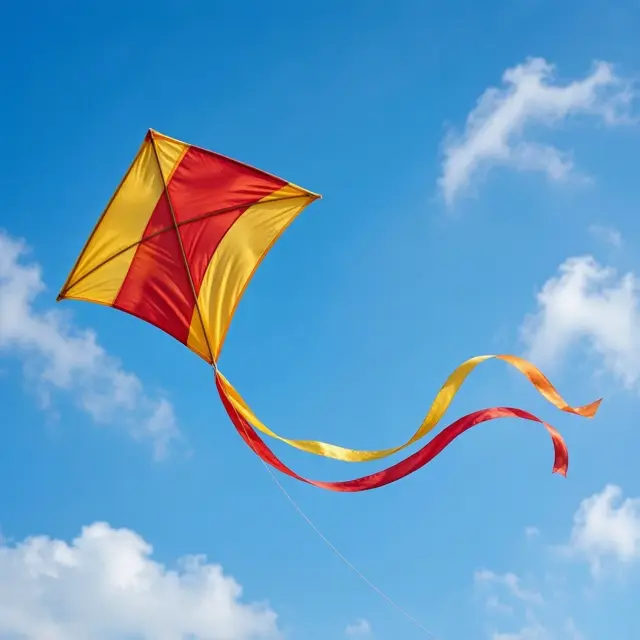
A kite is a flying craft that is heavier than air and stays tied down. It flies because air moving around it creates lift, with low pressure above the wing and high pressure below. The wind also pushes it backward, a force called drag. The pull of the line holds these forces in balance.
Many kites use a bridle, a set of strings that sets the angle of the kite's face to the wind. A tail helps keep the nose pointing into the wind. Box kites, though, can manage with a single attachment point.
The name comes from the kite, a bird of prey known for hovering in the air. And the same physics works in water, since liquids flow by the same rules. Underwater kites are now being developed to harvest renewable power from moving water, turning underwater currents into a new kind of wind.
Kites That Did Serious Science
By the 18th and 19th centuries, kites had grown from curiosities into tools for research. In 1752, Benjamin Franklin published an account of a kite experiment showing that lightning is caused by electricity. In 1847, at Kew Observatory, Francis Ronalds and William Radcliffe Birt described a very stable kite tested for carrying weather instruments high up.
Kites also helped invent the airplane. The Wright brothers used them in their research, and Alexander Graham Bell experimented with very large kites that could lift a person. The years from 1860 to about 1910 became Europe's 'golden age of kiting'.
Radio owes kites a favor too. Kite-lifted antennas were used at the receiving station for Marconi's first transatlantic transmission. Kites even worked as signal boards. In Korea, Admiral Yi of the Joseon dynasty commanded his navy using kites with specific markings, each telling his fleet to carry out a different order.
Riding the Wind for Sport and Power
Today kites are mostly flown for fun, and some of that fun is mighty. A power kite has several lines for steering and can pull with serious force. It drives sports such as kite surfing, kite buggying, kite landboarding and snow kiting.
Like a sailboat, an efficient kite can even travel upwind, as long as wheels, boards or blades grip the ground or water. Kites also have perks that sails lack. Winds are stronger higher up, and a kite swooping through the air can greatly boost its pull.
Some kite designs launched whole new sports. The Rogallo wing was adapted for hang gliding, and the parafoil for parachuting and paragliding. Kites may even help keep the lights on. Computer-controlled kites can make electricity where windmills are impractical. Some companies pack self-launching kites and batteries into shipping containers for remote places, and long lines let some designs reach high winds that are always present.
Giant Kites, Singing Kites and a Record Climb
Japan's Yōkaichi Giant Kite Festival began in 1841. Its largest kite ever was 19 metres wide, 20 metres high and weighed 1,500 kilograms. At the Hamamatsu Kite Festival, parents with a new baby make a bamboo and paper kite with the baby's name on it and fly it.
Some kites sing. In Vietnam, kites fly without tails but carry small flutes, so the wind hums a tune. In Bali, large bows on the front make a deep throbbing vibration, and in Malaysia, a row of gourds with slots whistles as the kite flies.
Then there is height. On 23 September 2014, a team led by Robert Moore flew a delta kite to 16,009 feet (4,880 metres) above the ground in western New South Wales, Australia. It took ten years of attempts and 12,400 metres of ultra-strong line. The whole flight, up and back down, lasted about eight hours.