A Puzzle Outside the Cafeteria
One of the most famous unsolved codes in the world stands outside a cafeteria. Kryptos is a sculpture by American artist Jim Sanborn, dedicated on 3 November 1990 in a courtyard at CIA headquarters in Langley, Virginia. Its name comes from the Ancient Greek word for hidden.
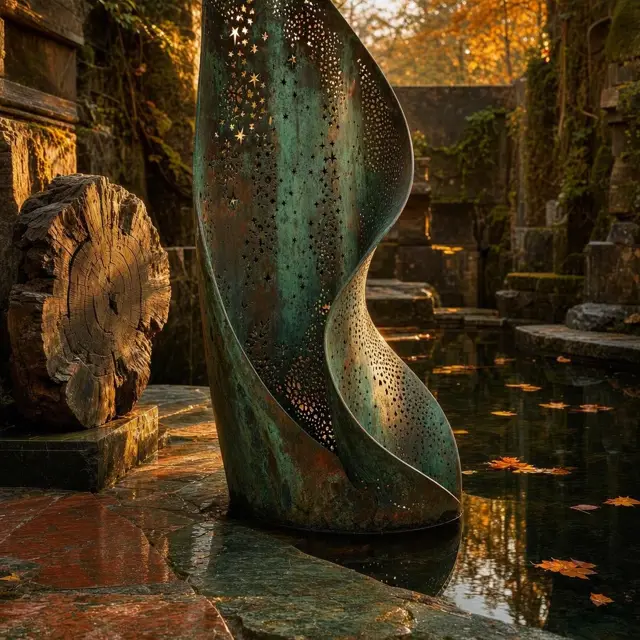
The main piece is a tall S-shaped copper screen that looks like a sheet of paper curling out of a printer. Letters are cut right through the metal. The left side holds the coded text: 869 characters, including 4 question marks. The right side holds a Vigenère tableau, a grid of shifted alphabets with 867 letters.
Sanborn scattered more clues around the grounds. Granite slabs hold copper sheets with Morse code messages, and one stone carries a compass rose pointing to a lodestone. There is also a fish pond, a reflecting pool and petrified wood. Building it cost US$250,000 in 1988.
Meant to Take Five to Ten Years
Sanborn designed the codes with Edward Scheidt, a retiring CIA employee. Scheidt rated the difficulty at around nine out of ten and expected it to be solved in five to ten years. He also said the method changes on purpose partway through. Most of the text uses a Vigenère cipher, with the word Kryptos as a key.
The puzzle is full of odd details. Three words in the solved parts are misspelled, which Sanborn says was deliberate. One line of the tableau has an extra L, and with it the letters HILL line up down the right edge, which some researchers read as a hint towards the Hill cipher.
Two of the secret keywords are PALIMPSEST and ABSCISSA. Rearranged as an anagram, they spell "P.S. It's as simple as ABC." Sanborn once said most of his work is "rife with mistakes on purpose", so nobody is fully sure which slips are clues.
Three Teams, One Answer
In 1999, computer scientist Jim Gillogly from southern California announced that he had cracked the first three messages using a computer. Then the CIA revealed that one of its analysts, David Stein, had solved the same three in 1998 with pencil and paper, working in his own time.
The NSA said it had got there too, and later records showed a small NSA team had solved the first three passages by June 1993, after a challenge from a CIA deputy director.
There was one more twist. Everyone agreed the second message ended with "WESTIDBYROWS". In 2005, Nicole Friedrich, a logician from Vancouver, suggested a different reading. In April 2006, Sanborn told an online Kryptos group that he had left out a letter S when making the sculpture. The real ending was "WESTXLAYERTWO", or "layer two". Even the artist's small errors changed the answer.
What the Solved Messages Say
The first message reads like a poem: "Between subtle shading and the absence of light lies the nuance of iqlusion." Yes, iqlusion, with a Q. Sanborn says the misspelling was on purpose.
The second is a spy story. It says something was "totally invisible", that information was gathered using the Earth's magnetic field and sent underground to an unknown place. It asks, "Who knows the exact location? Only WW." Then it gives map coordinates that point to a spot about 174 feet (53 metres) southeast of the sculpture itself.
The third message is a reworded passage from Howard Carter's account of opening the tomb of Tutankhamun in 1922. It describes widening a small hole, pushing a candle through and peering in. It ends with the question "Can you see anything?" The Morse code on the slabs adds its own teasing words, including "virtually invisible", "shadow forces" and "T is your position".
The Fourth Message and a Big Twist
The fourth passage, known as K4, is the one that got away. Sanborn has dropped four clues. In 2010 he revealed that part of the ciphertext becomes BERLIN in the plaintext. In 2014 he added CLOCK, and in 2020 he gave NORTHEAST and EAST. He also hinted there are several really interesting clocks in Berlin, and in 2025 he confirmed the clue meant the World Clock.
In 2025, Sanborn decided to auction the K4 solution, with a prototype and his coding tables. The archive sold for $962,500. Then came a surprise. Two journalists, Jarett Kobek and Richard Byrne, found scraps of paper among Sanborn's papers at the Smithsonian's Archives of American Art that, pieced together, seemed to give the full K4 answer. Sanborn confirmed it and said the scraps had been included by mistake.
The Smithsonian sealed those files until 2075. And the game is not over. Sanborn has confirmed a fifth message, K5, which will only reveal itself after K4 is solved.