A Fifth of the World's Fresh Water in One Place
By surface area, Lake Baikal is merely impressive: 31,722 km², slightly larger than Belgium, making it the world's seventh-largest lake and the second-largest in Eurasia after the Caspian Sea.
Depth is where it stops being ordinary. Baikal reaches 1,642 metres — the deepest lake on Earth. That depth turns a moderate footprint into an absurd volume: 23,615 km³ of water, or 22–23% of all fresh surface water on the planet, more than all the North American Great Lakes combined. It holds an estimated 19% of the world's unfrozen fresh water.
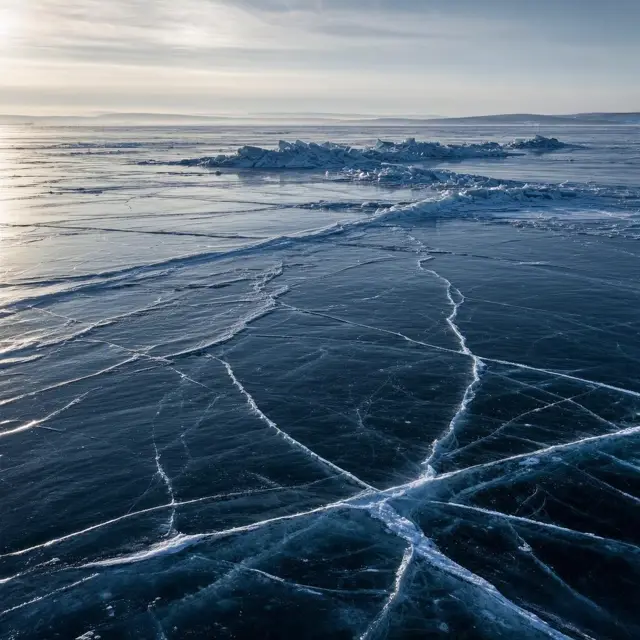
It is also astonishingly clear. In winter, transparency in open sections reaches 30–40 metres; in summer it typically drops to 5–8 metres. Standing on winter ice, you can look down through the length of a ten-storey building and still see.
A Crack in a Continent
Baikal is a rift lake, and that single word explains almost everything strange about it. It does not sit in a valley carved by ice or water. It sits in a gash where the Earth's crust is pulling apart.
That makes it the world's oldest lake at 25–30 million years. Ordinary lakes are geologically temporary — they silt up and vanish within tens of thousands of years. A rift keeps deepening as fast as sediment fills it, so Baikal has simply kept going while entire species evolved, flourished and died around it.
The process has not stopped. The Baikal Rift Zone is still active, and the basin widens by about 4 mm every year. It is, very slowly, becoming something larger than a lake. Baikal sits in southern Siberia between Irkutsk Oblast to the northwest and the Republic of Buryatia to the southeast, and the region east of it is known as Transbaikalia.
The Seal That Should Not Be There
Baikal's most famous resident raises an obvious question. The Baikal seal, or nerpa (*Pusa sibirica*), is endemic to the lake — a true seal living permanently in fresh water, thousands of kilometres from any ocean.
It is not alone in being unique here. The lake hosts thousands of plant and animal species, a great many found nowhere else. Amphipods alone number more than 350 species and subspecies, all endemic. The golomyanka, a translucent oily fish, are the deepest-living freshwater fish in the world.
This concentration of endemism is the direct product of that geological age. Give an isolated body of water 25 million uninterrupted years and evolution will fill it with things that exist in exactly one place on Earth. Baikal is less a lake with unusual animals in it than a separate small world that happens to be surrounded by Siberia.
Three Hundred Rivers In, One Out
The lake's plumbing is lopsided in a way that sounds made up. As many as 330 inflowing rivers feed Baikal. Exactly one drains it: the Angara.
Within the lake sits Olkhon, 72 km long and the third-largest lake-bound island in the world — an island large enough to have its own landscapes, in a lake, in Siberia.
Winter transforms the whole system. Ice reaches an average thickness of 0.5 to 1.4 metres, and in places where hummocks form — ridges of ice shoved upward by pressure — it can exceed 2 metres. The surrounding region supports Buryat communities who raise goats, camels, cattle, sheep and horses on the eastern shore, where the mean temperature swings from a winter low of −19 °C to a summer high of just 14 °C.
Protecting Something Irreplaceable
UNESCO declared Baikal a World Heritage Site in 1996, and the reasoning barely needs stating: there is no substitute for a fifth of the planet's unfrozen fresh water, and no way to rebuild 25 million years of isolated evolution.
The threats have been very concrete. The Baykalsk Pulp and Paper Mill was built in 1966 directly on the shoreline — an industrial plant discharging into the clearest large body of fresh water on Earth. It operated for over four decades before closing in November 2008.
That timeline is the uncomfortable part. The mill was not a historical accident from an unenlightened age; it ran well into the era when Baikal's global significance was fully understood and formally recognised by UNESCO. Protection on paper and protection in practice took twelve more years to converge.