Ships That Arrived in Pieces
Lake Titicaca sits 3,812 metres (12,507 ft) above sea level, high in the Andes. It is often called the highest navigable lake in the world, a claim usually taken to mean commercial boats. So how do you get a big steamship up there? You build it in Britain, take it apart, and haul the pieces up the mountains.
That is exactly what happened. Each of the lake's steamships was built in the United Kingdom in "knock down" form with nuts and bolts, split into many hundreds of pieces, moved to the lake, then riveted back together and launched. The sister ships Yavari and Yapura were built on the River Thames in 1862. After years of delay getting them from the Pacific coast to the lake, Yavari was launched in 1870 and Yapura in 1873.
Later ships came by rail. In 1930, the parts of SS Ollanta landed at the Pacific port of Mollendo and went up by train to Puno. At 79 metres long, she was so big that a new slipway had to be built first. Yavari is still around today, moored at Puno Bay and serving as a place for tourists to stay while her restoration goes on.
South America's Biggest Lake
Titicaca sits right on the border of Peru and Bolivia. Its western part lies in Peru's Puno Region, and its eastern side is in Bolivia's La Paz Department. It is the largest lake in South America by both water volume and surface area, and the 18th largest lake in the world. Its surface covers 8,372 square kilometres (3,232 sq mi).
The lake is really two nearly separate basins joined by the Strait of Tiquina, just 800 metres across at its narrowest. The big basin, Lago Grande, reaches 284 metres (932 ft) deep. The small one, Wiñaymarka, averages only 9 metres. Five major rivers and more than 20 smaller streams feed the lake, and it holds 41 islands.
Here is the odd part: very little water leaves by river. The single outlet, the Río Desaguadero, carries away only about 10% of the water the lake loses. The other 90% goes into the air through evapotranspiration, driven by strong winds and intense sunlight at high altitude. That is one reason the water is slightly brackish, even though the lake is often listed as freshwater.
Islands Made of Reeds
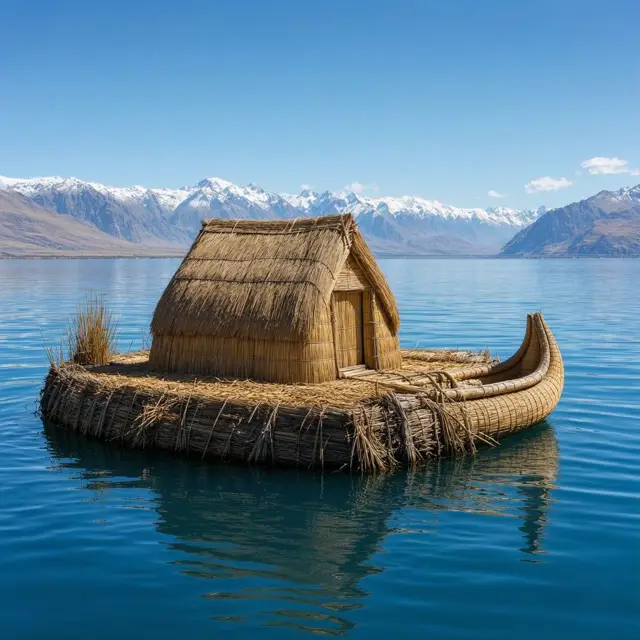
Some of the lake's most famous islands are not natural at all. The Uros (or Uru) people build "floating islands" from layers of cut totora, a thick sedge that floats well and grows plentifully in the shallows. They keep the islands going by adding fresh reeds to the surface, over and over again.
Many of these golden islands measure about 15 by 15 metres, and the largest are roughly half the size of a football field. Each one holds several thatched houses, usually for members of one extended family. Some even have watchtowers and other buildings made from the same reeds. The islands can also be moved into deep water or to other parts of the lake when needed.
Most Uros islands once sat near the middle of the lake, about 14 km from shore. After a major storm wrecked them in 1986, many Uros rebuilt closer to land. As of 2011, about 1,200 Uros lived on 60 artificial islands near Puno, Peru's main port on the lake. Today they add to their hunting and fishing by taking visitors out by motorboat and selling handicrafts.
Where Men Knit and Cars Are Missing
On Taquile island, on the Peruvian side, knitting is done only by men, starting at age eight. The women make the yarn and weave. Their work is so fine that UNESCO named "Taquile and Its Textile Art" one of the "Masterpieces of the Oral and Intangible Heritage of Humanity". The island was used as a prison in colonial times and into the 20th century, then became the property of the Taquile people in 1970.
Taquile's roughly 2,200 residents follow an old Inca code: do not steal, do not lie, do not be lazy. About 40,000 tourists visit each year, and the islanders have set up their own home stays and a local travel agency to win back control of tourism.
Nearby Amantani has about 4,000 people and no cars or hotels. Machines are not allowed, so all farming is done by hand on terraced hillsides of wheat, potatoes and vegetables. Guests who stay overnight usually bring gifts like rice or cooking oil, but never sugary treats, because the island has no dental care.
A Giant Frog and a Shrinking Lake
The lake is home to more than 530 aquatic species. Among the rarest are the huge Titicaca water frog and the Titicaca grebe, a water bird that cannot fly. Both are threatened and live largely or entirely at this one lake. About 90% of the fish species in the basin are endemic, including 23 species of Orestias fish found only in the lake.
In 1998, Titicaca was named a Ramsar Site for its large populations of water birds, which include Chilean flamingos, Andean gulls and Puna ibises. But life here is under pressure. One native fish, the Titicaca orestias, was last seen in 1938 and has likely died out after introduced rainbow trout and another foreign fish moved in.
Water levels have been falling since 2000. Between April and November 2009 alone, the lake dropped 81 centimetres, reaching its lowest level since 1949. Shorter rainy seasons and melting glaciers are to blame. Growing cities also add pollution, and a 2011 United Nations report found worrying levels of cadmium, arsenic and lead in parts of the lake. In 2012, the Global Nature Fund named it "Threatened Lake of the Year".