Power Measured in Razor Blades
When Theodore Maiman built the first working laser, he needed a way to describe how strong it was. He picked a very odd unit: the Gillette. His laser could burn through one Gillette razor blade, so he said it had the power of one Gillette.
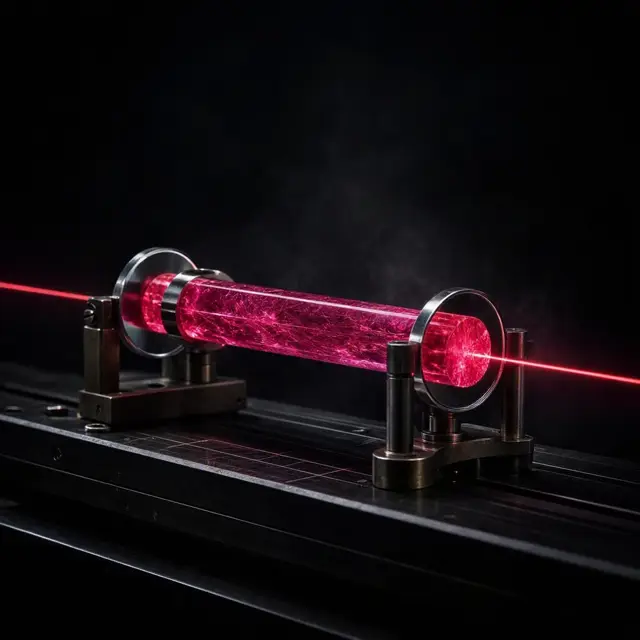
That first laser ran on 16 May 1960 at Hughes Research Laboratories in Malibu, California, ahead of several rival teams. Maiman used a flash lamp to power a synthetic ruby crystal, which gave off red light at 694 nanometers. It could only work in short pulses, not as a steady beam.
Early on, people called the laser "a solution looking for a problem." That joke did not age well. Today lasers show up in barcode scanners, printers, fiber-optic links, chip factories, eye surgery and light shows. The laser is now seen as one of the greatest inventions of the 20th century.
A Name That Could Have Been LOSER
Laser started life as an acronym: light amplification by stimulated emission of radiation. Before it came the maser, which did the same trick with microwaves. When optical versions appeared, they were first called optical masers, until "light" replaced "microwave" in the name.
Gordon Gould first published the acronym LASER in 1959. He hoped other parts of the spectrum would get their own names, like XASER for x-rays, UVASER for ultraviolet and RASER for radio waves. That never caught on. Instead, every such device working above microwave frequencies is now simply called a laser.
There is a funny catch. A laser that makes its own light is really an oscillator, not an amplifier. So people have joked that the more accurate acronym would be LOSER, for light oscillation by stimulated emission of radiation. The field even made a verb out of the word. To "lase" means to give off coherent light, so a working laser is said to be "lasing."
One Photon Copies Another
Ordinary light, like that from a light bulb or a star, comes out messy. Atoms release it at many different energies, at random. A laser works differently. In stimulated emission, a passing photon nudges an excited atom into releasing a second photon that is an exact copy of the first.
Both photons can then trigger more copies, which sets off a chain reaction. To make this work, you need a gain medium, a material whose atoms stay excited for a relatively long time. An energy source keeps feeding it in a process called pumping, usually with an electric current, a flash lamp or even another laser.
Most lasers put a mirror at each end of the gain medium, forming an optical cavity. Light bounces back and forth and grows stronger on each pass. One mirror lets a little light leak out, and that is the beam. It works a bit like the screech you hear when a microphone gets too close to a speaker. The result has high coherence, so it can be focused to a tiny spot or stay narrow over great distances.
Famous Scientists Said It Would Never Work
The idea goes back to Albert Einstein, who laid down the theory in 1917. In 1953, Charles H. Townes and his graduate students built the first maser. Townes later said several famous physicists, including Niels Bohr and John von Neumann, argued that it broke the uncertainty principle and could never work. It did work, and Townes shared the 1964 Nobel Prize in Physics for this field.
Then came a long fight over credit. In November 1957, graduate student Gordon Gould wrote down his ideas for a laser in a notebook, including the first recorded use of the word. He filed a patent application in 1959, but the US patent office turned him down and gave a patent to Bell Labs in 1960.
That started a legal fight that lasted twenty-eight years. Gould won his first patent only in 1977, and his first major patent case only in 1987. Even today, historians have not settled who really invented the laser, because so many different people patented different parts of it.
From Supermarkets to Record-Breaking Flashes
The first use most people noticed was the supermarket barcode scanner, introduced in 1974. The laserdisc player followed in 1978, and the compact disc player became the first common laser device in 1982. In 2004 alone, about 733 million diode lasers were sold.
Doctors use lasers for eye surgery, skin treatments and breaking up kidney stones. Factories use them to cut, weld and even 3D print metal. Some lasers are extreme. The National Ignition Facility uses 192 beams at once, and a laser in Romania was the most powerful in the world as of 2019, at 10 petawatts.
The strangest lasers are almost hard to believe. Scientists have made laser light from living cells that were engineered to glow green. There are bubble lasers that use a tiny bubble in place of the usual mirror setup. Even Mars and Venus give off natural laser light when their gases are hit by radiation.