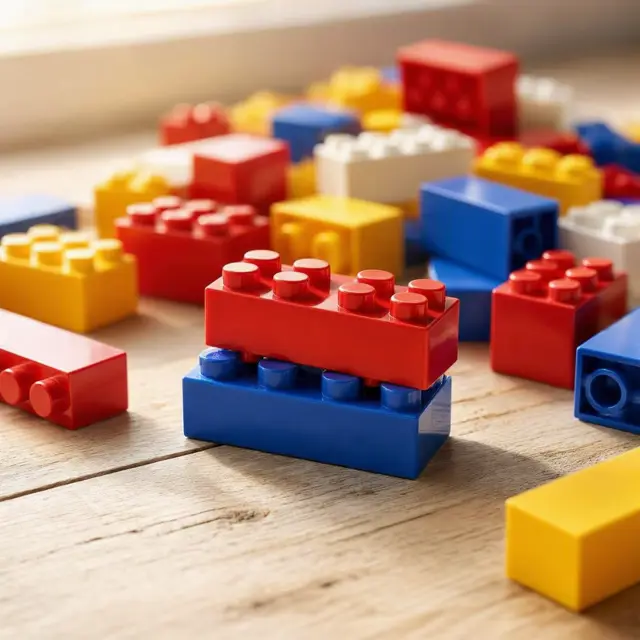
A Carpenter, a Danish Pun, and Someone Else's Idea
Lego began in 1932, when Ole Kirk Christiansen, a carpenter from Billund, Denmark, started making wooden toys. The name is a compression of the Danish phrase "leg godt" — play well.
The famous plastic bricks came later, and they were not an original invention. The Lego Group began manufacturing interlocking bricks in 1949, calling them Automatic Binding Bricks, directly inspired by the self-locking bricks the English toymaker Hilary Page invented in 1939 and patented in the UK in 1940 through his company Kiddicraft.
What Lego added was the part that mattered. On 28 January 1958 a patent application was filed in Denmark for the modern design — the stud-and-tube coupling that grips firmly but still pulls apart. That single mechanical decision is why the system works at all, and why it survived long enough to become the largest toy company in the world by sales.
Ten Micrometres of Stubbornness
Here is the quietly extraordinary fact about Lego: a brick made in 1958 still fits a brick made today.
Sustaining that for nearly seventy years requires manufacturing precision that has nothing to do with toys and everything to do with engineering. Moulding tolerances are held to as little as 10 micrometres — one hundredth of a millimetre. Every brick must be almost identical to every other brick ever made, because a fractionally loose or tight stud breaks the promise the whole system rests on.
The material matters too. Lego switched to ABS — acrylonitrile butadiene styrene — in 1963, a rigid plastic that holds a sharp edge and resists wear. Moulding now happens in Denmark, Hungary, Mexico, China, Vietnam and the United States, with decoration and packaging handled in the first three of those plus the Czech Republic.
Nine Hundred Million Ways to Stack Six Bricks
The combinatorics are where Lego stops being a toy and becomes a mathematical curiosity. Six standard 2×4 stud bricks can be combined in 915,103,765 different ways.
Six bricks. Nine hundred and fifteen million outcomes. That number is the entire pitch of the product: assembled models can be taken apart and their pieces reused to build something else entirely, so a finite box of parts never really runs out of possibilities.
The system extends well beyond plain bricks. It includes gears, figurines called minifigures — introduced in 1978 — and an enormous range of specialised parts, enough to build vehicles, buildings and working robots. And one consequence of all those small rubber wheels is properly absurd: a 2006 BusinessWeek claim reported Lego producing about 306 million small rubber tyres a year, making it by unit count the world's number-one tyre manufacturer.
Eleven Hundred Bricks Every Second
Production runs at a rate that is difficult to picture. Annual output averages roughly 36 billion bricks — about 1,140 elements every second. As of July 2015, 600 billion Lego parts had been produced in total.
The company remains privately held, based in Billund where it started, and is one of Europe's biggest companies as well as the largest toy manufacturer in the world by sales.
The brand long ago outgrew the box. There is a large fan community built around building competitions and custom creations, alongside films, video games, and ten Legoland amusement parks. The through-line from 1949 is unusually clean for a company this size: the product is still small plastic bricks that clip together, and the thing that made them worth buying — that any two of them, from any decade, will fit — has never been allowed to change.