Before Towers, There Were Hilltop Fires
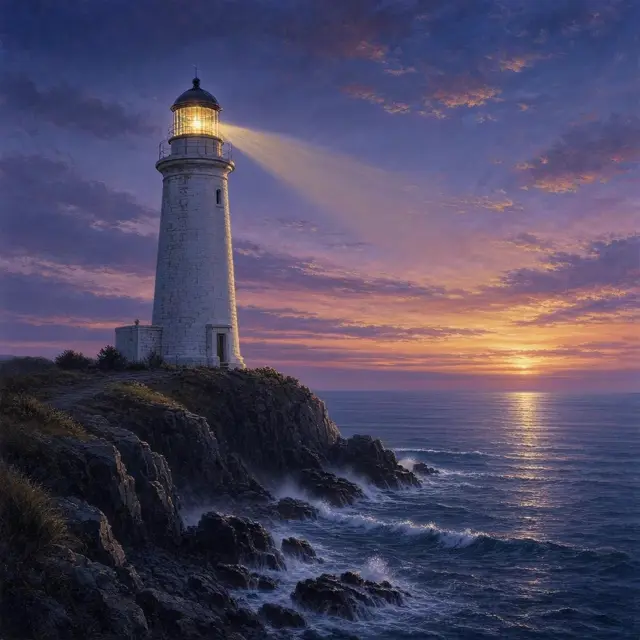
Long before ports had clear markings, sailors were guided home by fires built on hilltops. People noticed that a higher fire could be seen from farther away, so they began placing fires on raised platforms. That simple idea grew into the lighthouse.
Ancient lighthouses had a different job from most modern ones. They worked mainly as entrance markers for ports, not as warnings about reefs and rocks. The most famous was the Pharos of Alexandria in Egypt. It finally collapsed after a series of earthquakes between 956 and 1323.
Much of what we know about ancient lighthouses comes from art and money. Coins and mosaics show them, and many of these images represent the lighthouse at Ostia. Coins from Alexandria, Ostia and Laodicea in Syria have survived too. An intact ancient tower at A Coruña in Spain also gives a rare look at how these early lights were built.
A Lighthouse Shaped Like an Oak Tree
The Eddystone Rocks in the English Channel were a major hazard for ships. Henry Winstanley built the first lighthouse there between 1696 and 1698. It was an eight-sided wooden tower held down by 12 iron posts fixed into the rock. It was the first tower in the world fully exposed to the open sea.
Engineer John Smeaton rebuilt it between 1756 and 1759, and his design changed everything. He shaped the tower like an oak tree and built it from granite blocks. He rediscovered hydraulic lime, and he locked the blocks together with dovetail joints and marble pins. The tower curved gently inward toward the top, which also let waves lose some of their energy as they hit the walls.
Smeaton's tower stayed in use until 1877 and became the model for modern lighthouses. Robert Stevenson built on it with Bell Rock Lighthouse in 1810, which added rotating lights that switched between red and white.
The Lens That Changed Everything
Until 1782, lighthouses usually burned wood or coal. Then the Argand lamp arrived with a steady, smokeless flame. It ran on whale oil, olive oil or other vegetable oils, and it stayed the standard for lighthouses for over a century.
The real leap came from optics. French physicist Augustin-Jean Fresnel designed a lens made of many parts. His lens could be much thinner and lighter than a normal lens of the same size. It focused 85% of a lamp's light, compared with 20% for the parabolic reflector of the time. The first one was used in 1823 at the Cordouan lighthouse in France, and its light could be seen more than 20 miles (32 km) away.
Turning these heavy lenses took real effort. A weight-driven clockwork spun them, and keepers sometimes had to wind it as often as every two hours. To cut friction, some lens assemblies floated in liquid mercury.
Every Light Has a Signature
How do sailors tell one lighthouse from another at night? Each one has its own light characteristic, a pattern of bright flashes. The Scheveningen Lighthouse, for example, flashes at intervals of 2.5 and 7.5 seconds. Some lights also use colored sectors to separate safe water from dangerous shoals.
By day, lighthouses near each other are painted differently so they are easy to recognize. This marking is called a daymark. Cape Hatteras Lighthouse wears a black and white spiral like a barber pole.
Height matters, but more is not always better. The reach of a light grows with the square root of its height. Yet on the west coast of the United States, low clouds can hide a light that sits too high. The Old Point Loma lighthouse in San Diego was so often lost in fog that it was replaced in 1891 by a lower one. Paired range lights also guide ships: when the front and rear lights line up vertically, the ship is on course.
From Keepers to LEDs
Electric lights and automatic lamp changers slowly made lighthouse keepers unnecessary, and GPS pushed things further. Still, Canada keeps 51 lighthouses with staff, split roughly evenly between its east and west coasts.
Today many lighthouses run on a single flashing light powered by solar-charged batteries. LED lights were in wide use by 2020. An LED light lasts 50,000 to 100,000 hours, compared with about 1,000 hours for an old filament bulb. Not every experiment worked. The first practical laser lighthouse, set up in 1971 at Point Danger in Queensland, was replaced after four years because its beam was too narrow to see easily.
In the Soviet era, remote lighthouses in northern Russia ran on radioisotope thermoelectric generators, which needed no refuelling or maintenance. After the Soviet collapse, many records were lost, and some of these lighthouses cannot be found at all. Today fans work to save old lighthouses, including an amateur radio society that publicizes remote ones.