A Nobel Prize You Are Holding
In 2019 the Nobel Prize in Chemistry went to three people for something almost everyone already owned. M. Stanley Whittingham conceived intercalation electrodes in the 1970s and built the first rechargeable lithium-ion battery, though it had safety problems and was never sold. John Goodenough improved it in 1980 by using lithium cobalt oxide as the positive electrode. Akira Yoshino built the first prototype of the modern version in 1985, using a carbon anode instead of lithium metal, and a Sony and Asahi Kasei team led by Yoshio Nishi commercialised it in 1991.
The scale of what followed is easy to miss. In the three decades since they first went on sale, their volumetric energy density tripled while their cost dropped tenfold. In late 2024, global demand passed one terawatt-hour per year, with production capacity more than twice that. Portable electronics, laptops, phones, electric cars and grid-scale energy storage all sit downstream of that one invention.
Ions in a Rocking Chair
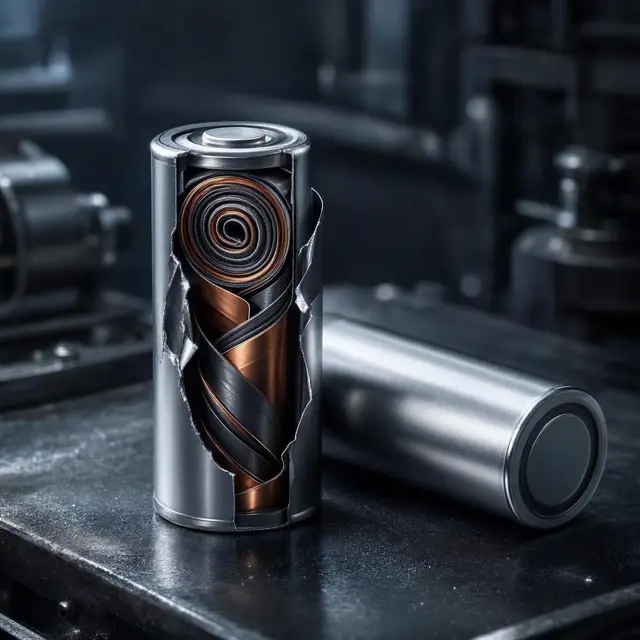
The clever part of a lithium-ion cell is that nothing is destroyed. Both electrodes are built from intercalation compounds, materials that let lithium ions slide in and out of their internal structure without the structure collapsing.
During discharge, an oxidation reaction at the negative electrode, usually graphite, releases lithium ions and electrons. The electrons take the long way round through your device, doing the useful work, while the ions travel through the electrolyte to the positive electrode and recombine there. Charging simply runs the whole thing backwards, with the external supply pushing electrons the other way.
Because the lithium ions just rock back and forth between the two electrodes rather than being consumed, these are sometimes called "rocking-chair batteries" or "swing batteries". The electrolyte, usually lithium hexafluorophosphate dissolved in organic carbonates, is only a conductive medium and takes no part in the reaction itself.
What Actually Kills a Battery
Cycle life is not the whole story, and this is where the familiar advice comes from. Manufacturers typically define it as the number of charge and discharge cycles until capacity falls to 80% of the rated value, but a battery also ages while doing nothing at all.
Simply storing a lithium-ion battery in a fully charged state reduces its capacity and raises its internal resistance. They also self-discharge whether connected or not, at a rate manufacturers typically state as 1.5 to 2% per month, and that rate climbs with both temperature and state of charge. Older measurements showed the effect of heat starkly: in 1999, monthly self-discharge was measured at 8% at 21 °C, 15% at 40 °C and 31% at 60 °C.
Heat is the recurring villain. Charging limits are stricter than operating limits, with fast charging generally suitable between 5 and 45 °C. Charging above 45 °C degrades performance, while below 0 °C the internal resistance rises and charging simply takes longer.
The Bill for the Boom
Lithium-ion cells can be a fire or explosion hazard, because they contain flammable electrolytes. Overcharging beyond design voltage can lead to an explosion, which is why cells ship with temperature sensors, voltage regulators and charge-state monitors built around them. Solid-state lithium designs are being developed specifically to remove the flammable liquid.
The raw materials carry their own problems. Lithium extraction is water intensive, often in already arid regions, and some chemistries rely on minerals such as cobalt that can be conflict minerals.
That pressure is reshaping what goes into the cells. Handheld electronics still favour lithium cobalt oxide with a graphite anode for maximum energy density, but lithium iron phosphate offers longer life and a higher discharge rate at lower environmental cost, and nickel manganese cobalt chemistries dominate electric vehicles. Researchers are also pursuing non-lithium alternatives entirely, including sodium-ion and iron-air batteries.