The island that drifted off on its own
Some ecologists call Madagascar the "eighth continent." That sounds like a big claim for an island. But about 90 percent of all the plant and animal species found there live nowhere else on Earth.
The reason goes back a very long way. Madagascar was once part of Gondwana, a giant supercontinent that slowly broke apart. Madagascar split from Africa around 180 million years ago. Then, about 84 to 92 million years ago, it split from the land that became India. Since then it has floated alone off the southeastern coast of Africa.
All that time apart let its plants and animals change in their own way, with no outside neighbors moving in. Today Madagascar is the fourth-largest island in the world, with an area of 592,800 square kilometres. Its nearest mainland neighbor is Mozambique, to the west.
Lemurs, chameleons and a giant lost bird
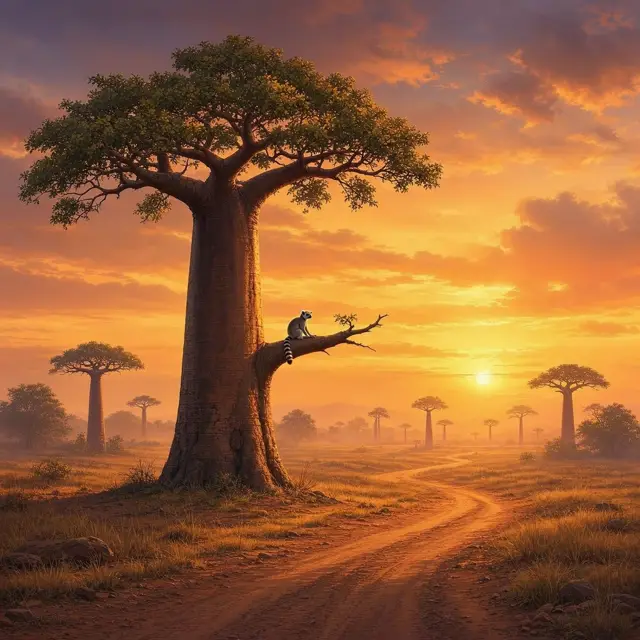
Lemurs are the island's star animals. With no monkeys around to compete with them, these primates spread into all kinds of habitats and split into many species. As of 2012 there were 103 official species and subspecies, and 39 of them were only described by scientists between 2000 and 2008.
Madagascar is also home to two-thirds of the world's chameleon species, including the smallest one known. There is also the catlike fossa, found only here. All 651 species of land snail on the island are found nowhere else. Over 300 bird species have been recorded, and more than 60 percent of them are endemic.
The first settlers met even stranger creatures. There were 17 species of giant lemur and huge flightless elephant birds, possibly including the largest bird that ever lived. Hunting and habitat loss wiped them out. Many lemurs today are rare or endangered.
Baobabs, palms and a flower that fights cancer
The plant life is just as unusual. More than 80 percent of Madagascar's 14,883 plant species grow nowhere else. Six of the world's nine baobab species are found there. The island has around 170 palm species, three times as many as all of mainland Africa, and 165 of them are endemic.
One small plant changed medicine. The Madagascar periwinkle gave doctors two drugs, vinblastine and vincristine, used to treat leukemia, Hodgkin lymphoma and other cancers. The traveler's palm is so loved that it appears on the national emblem.
The land itself has big contrasts. A steep escarpment runs down the east coast and holds much of the remaining rainforest. In the middle sits a high plateau with terraced rice valleys. The west and south are dry, with spiny forests and desert scrub. The highest peak, Maromokotro, reaches 2,876 metres.
Settled by sailors from across an ocean
You might expect Madagascar's first people to come from nearby Africa. They did not. The first lasting settlers were Austronesian people who most likely arrived in outrigger canoes from what is now Indonesia, around 500 to 700 CE. That makes Madagascar one of the last big landmasses on Earth to be settled, earlier than Iceland and New Zealand.
Bantu groups from East Africa joined them around the ninth century. DNA research shows the average Malagasy person is a roughly equal blend of Southeast Asian and East African roots. The Malagasy language reflects this. Its closest relative is Ma'anyan, a language from southern Borneo.
The island's name has a puzzling past too. A map by Muhammad al-Idrisi from 1154 called it "Malay island" in Arabic. Another idea is that Marco Polo mixed it up with Mogadishu. Today Malagasy and French are the official languages.
Vanilla, sapphires and a plate of rice
That vanilla in your ice cream may well come from Madagascar. The island supplies 80 percent of the world's natural vanilla. It is also the world's main supplier of cloves and ylang-ylang. In 2017, vanilla was its top export, worth 894 million US dollars.
The ground holds treasure too. Sapphires were found near Ilakaka in the late 1990s, and by 2001 Madagascar provided half of the world's supply. The island also has one of the largest reserves of titanium ore.
At mealtime, almost the whole country eats the same base: rice, called vary, served with a side dish called laoka. The sauces often use ginger, garlic, tomato, coconut milk and even vanilla. For fun, people play fanorona, a popular board game, and rugby union is the national sport. In some regions, people even wrestle zebu cattle in a sport called savika.