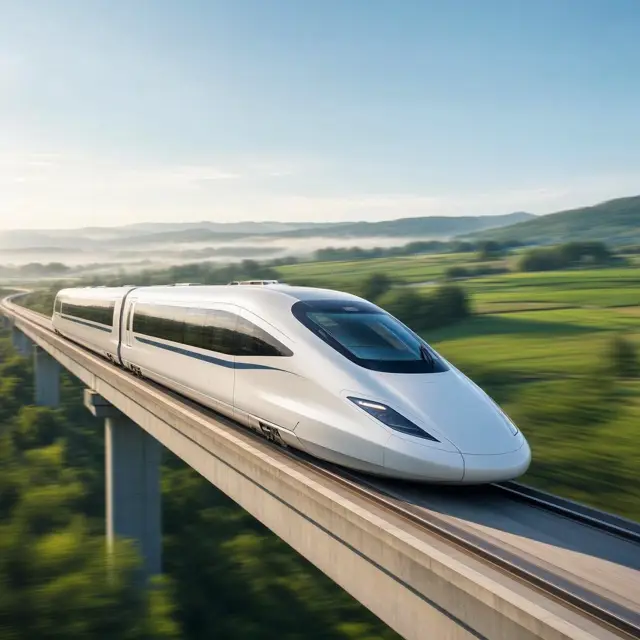
The Floating Train That Set the Record
In April 2015 a Japanese test train reached 603 km/h. No train carrying a crew has ever gone faster. The trick sounds simple but is hard to pull off: the train did not roll on wheels at all. It floated.
This is maglev, short for magnetic levitation. Magnets lift the train above its track, so nothing grinds or rubs at speed. Compared with normal trains, maglevs can reach higher top speeds, speed up and slow down faster, climb steeper slopes and make less noise. They also cost less to maintain.
There is a catch. Maglevs are more expensive to build, cannot use existing railway tracks, and use more energy at very high speeds. Despite more than a century of research, only six maglev lines run today: four in China, one in Japan and one in South Korea.
A Mayor's Basement and Other Early Dreams
The idea is older than most people think. The first relevant patent came in 1902, when Albert C. Albertson used magnets to take some of the weight off a train's wheels. In 1908 the mayor of Cleveland, Tom L. Johnson, filed a patent for a wheel-less "high-speed railway." He tested a car on a 90-foot track in his own basement. People jokingly called it "Greased Lightning," and it was said to run without noise or the least vibration.
In 1912 the French-American inventor Émile Bachelet showed a model train in Mount Vernon, New York, that both floated and moved using electromagnets. He took it to London in 1914.
The first commercial maglev opened in 1984 near Birmingham, England. It shuttled along 600 meters between the airport and a railway station, floating just 15 millimeters up at speeds of up to 42 km/h. It closed in 1995 after its aging electronics became unreliable. One of its cars is now on display in a museum in Peterborough.
Two Ways to Make a Train Fly
Maglevs lift off in two main ways. In electromagnetic suspension, magnets on the train reach under a steel rail and pull up toward it. That pull changes sharply with tiny changes in distance, so feedback systems constantly adjust the magnets to hold a gap of about 15 millimeters. The upside is that it works at all speeds.
In electrodynamic suspension, magnets on the moving train create currents in the track, and the track pushes back. This setup steadies itself, with no active control needed. But it only lifts the train above about 30 km/h. Until then, the train rides on wheels or landing gear, waiting to reach take-off speed.
Why all this fuss? A physics rule known as Earnshaw's theorem shows that fixed magnets alone can never hold something in a stable balance. And because maglevs essentially fly, they must be kept from pitching, rolling and swaying, just like an aircraft.
From the Airport in Seven Minutes
The Shanghai maglev links Pudong International Airport with the edge of central Pudong, 30.5 km away. It uses German Transrapid technology. Until May 2021 it ran at up to 431 km/h and made the trip in about 7 minutes. Today it tops out at 300 km/h, takes 8 minutes and makes 115 trips a day. In a 2003 test run it hit 501 km/h, and its on-time reliability, down to the second, is above 99.97%.
Japan's Linimo line is the gentle cousin. It opened in 2005 for the Expo in Aichi, runs at up to 100 km/h, and carried more than 10 million passengers in its first three months.
Most maglevs are pushed along by a linear motor. At high speed, the biggest energy cost is not floating but pushing through air. Power needs rise with the cube of speed, so going 400 km/h takes 2.37 times the power needed for 300 km/h.
Tokyo to Nagoya in 40 Minutes
The next big leap is Japan's Chūō Shinkansen, which began construction in 2014. It uses the same superconducting maglev technology that set the 603 km/h record on the Yamanashi test track. In a 2014 test there, 100 passengers rode at speeds of up to 500 km/h. The line's trains are planned to run at up to 505 km/h, making the trip from Tokyo to Nagoya in 40 minutes and from Tokyo to Osaka in 1 hour 7 minutes.
It will take patience. The Tokyo to Nagoya section was meant to open in 2027, but construction delays have pushed it into the mid-2030s.
Some ideas go even further. Proposals such as Swissmetro and the Hyperloop would use a vactrain, a maglev running through a tube with little or no air inside. The RAND Corporation described a vacuum-tube train that could, in theory, cross the Atlantic in about 21 minutes. And NASA has announced a project called FLOAT to build a maglev train on the Moon.