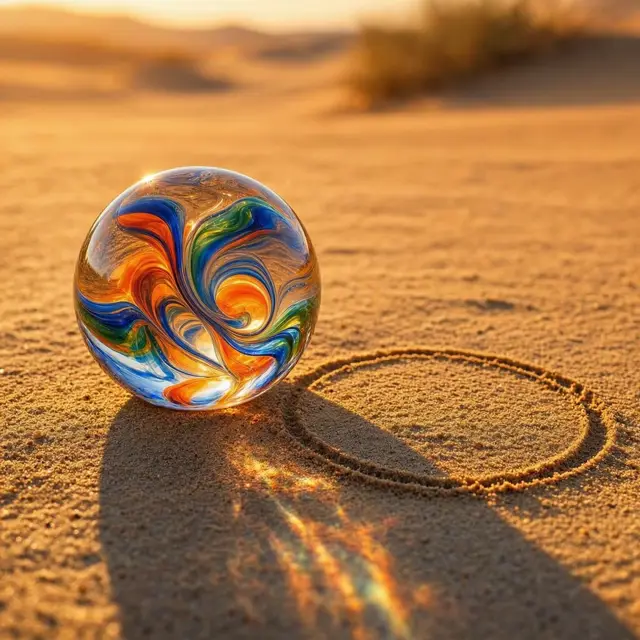
Playthings From 2500 BCE
Marbles are one of the oldest toys around. In the early 20th century, archaeologists digging near Mohenjo-daro, a site of the Indus Valley Civilization, found small stone balls from about 2500 BCE that they identified as marbles. Marbles also turn up in digs from ancient Egypt and Mesopotamia, and Roman writers mention them often. Back then they were made of clay, stone or glass.
Marbles reached Britain from the Low Countries in medieval times. In 1503, the town council of Nuremberg, Germany, went as far as limiting marble games to a meadow outside the town.
The name "marble" comes from that region and era. Many of the little balls were made in mills and quarries by polishing small chips of real stone, such as marble, agate, alabaster and limestone. Some were even made of brass.
From Glass Rods to Giant Screws
Nobody knows where marbles were first manufactured. But in 1846, a German glassblower invented marble scissors, a tool for making marbles. Makers stacked glass rods into a pattern, cut the rod into marble-sized pieces, and rounded them while the glass was still soft. Cheap ceramic marbles entered mass production in the 1870s.
Machines took over next. One method drops blobs of molten glass into a groove between two interlocking screws. As the screws turn, the glass rolls along and slowly becomes a sphere as it cools. For a cat's-eye marble, colored glass veins are injected into a clear stream of glass.
In 1903, Martin Frederick Christensen of Akron, Ohio, made the first machine-made glass marbles on his patented machine. Today the biggest maker is Vacor de Mexico, founded in 1934. It makes 90% of the world's marbles, more than 12 million a day.
Knuckle Down, No Quitsies
Every playground seems to have its own rules and slang. In ring taw, or "ringer", players draw a ring on the ground, fill it with small marbles, and flick a bigger taw to knock them out. In kanche, from South Asia, players keep every marble they knock out of a circle, and whoever ends with the most wins.
The lingo is half the fun. "Knuckle down" means starting with your knuckle against the ground. "Keepsies" means you keep the marbles you win. "Quitsies" lets anyone stop the game with no penalty. "Elephant stompies" lets a player stomp their marble level with the ground, making it very hard to hit.
Big marbles have a long list of nicknames, including bonker, plumper, thumper, tonk, jumbo and toebreaker. A "grandfather" is the largest, as big as a tennis ball. In northern England, larger marbles are called "bottle washers", after the marble used in Codd-neck bottles.
Copper Sparkles and Tiny Statues
Marbles come in dozens of named types. An aggie is made of agate or glass that looks like it. A steely was traditionally a flat piece of steel folded into a ball, leaving an X-shaped mark where the corners meet.
Some antique handmade German marbles are especially prized. A Lutz holds bands of fine copper flakes that glitter like gold. People wrongly believed it was invented by the glassmaker Nicholas Lutz. A sulphide is a large clear glass ball with a small white clay figure inside, usually a dog, cat or cow. The clay looks silvery because of the way light bends through the glass. Figures of trains or pocket watches are very rare and fetch high prices.
For collectors, "condition is king". A single chip or pit usually cuts a marble's value by half or more. Modern art marbles, often about 50 millimetres wide, can sell for thousands of dollars.
A World Championship Since 1932
Marbles even has a world title. The British and World Marbles Championship has been held at Tinsley Green, in West Sussex, England, every year since 1932. People there have played marbles for centuries, and TIME magazine traced the local game back to 1588.
More than 20 teams from around the world take part. German teams have won several times since 2000, but local teams from nearby Sussex and Surrey villages still join in. The very first champion, in 1932, was Ellen Geary, a young girl from London.
Marbles rolled into video games too. In Marble Madness, an Atari game from 1984, players race each other to the finish line. Marbles on Stream, from 2018, is a marble racing game made to be streamed live on Twitch. Even Chinese checkers, played with marbles as pieces, is often called "marble checkers".