A Note That Waited 131 Years
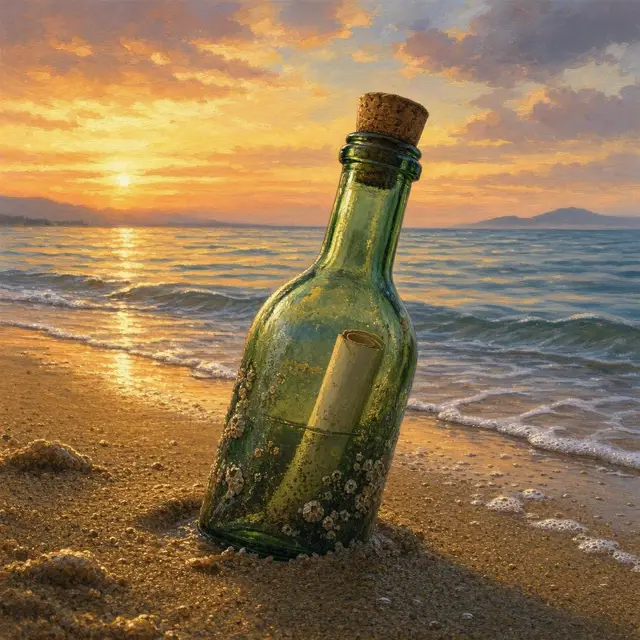
In January 2018, a couple walking on a beach in Western Australia found a bottle with a message inside. It had been thrown into the sea on June 12, 1886, from the German ship Paula, which was running drift bottle experiments for the German Naval Observatory. The message was checked against the captain's original Meteorological Journal and confirmed as real.
At 131 years, it beat the previous confirmed record of 108 years. That earlier bottle was found in 2015 on the German island of Amrum. It was one of 1,020 bottles released into the North Sea between 1904 and 1906 by British marine biologist George Parker Bidder III. The 1886 bottle's thick glass and narrow opening are thought to have kept the paper safe.
One fishing boat seems to have a lucky streak. In 2006, a Shetland fisherman pulled up a bottle that had spent over 92 years at sea. In 2012, the same vessel, the Copious, recovered another bottle released 98 years earlier to test currents around Scotland. The finder of a 98-year-old message even compared his find to winning the lottery.
Bottles That Mapped the Oceans
Bottled messages may go back to about 310 BC, when Greek philosopher Theophrastus is said to have used them to study water currents. In the mid-1700s, experiments by Benjamin Franklin and others pointed to the Gulf Stream. In the late 1800s, Albert I, Prince of Monaco, found that the Gulf Stream splits into the North Atlantic Drift and the Azores Current. Floating test objects like these are called drifters.
Bidder had a clever trick. He weighted bottles with a long copper wire, so they sank until the wire trailed on the seabed and the bottle hovered a few inches above it. This let him prove that deep currents in the North Sea flow from east to west. He also showed that bottom feeders prefer to move against the current. The US Coast and Geodetic Survey used drift bottles from 1846 to 1966.
Bottle studies help track where fish eggs drift, how oil spills might spread and how garbage patches form. Today, thousands of modern drifters send their position and temperature to satellites. Still, the old way stayed popular: an estimated six million bottled messages were released from the mid-1900s to 2009, including 500,000 from oceanographers. There is even a story that Queen Elizabeth I created an official job called "Uncorker of Ocean Bottles," though it may be a misconception.
Why Most Bottles Are Never Found
Only a small share of bottles are ever found, perhaps less than 3%, so scientists release them by the thousands. A Woods Hole study of 156,276 bottles in the Atlantic got 11% back. A Scripps study of 148,384 bottles in the Pacific got only 3.4%. Location matters a lot: drift cards came back at a rate of 50% in busy areas like the North Sea, but just 1% near Antarctica.
Oceanographer Curtis Ebbesmeyer came up with a rule of thumb. Bottles released more than 160 kilometres from shore come back less than 10% of the time, and only a few percent return from more than 1,600 kilometres out. Beaches are not equal either. About 90% of marine debris washes up on less than 10% of the world's coastlines.
Time works against the bottle, too. A Scripps scientist said sea creatures grow on bottles and make them sink within eight to ten months unless they wash ashore first. Design helps: some bottles carry dry sand as ballast, so they float upright and the wind pushes them less. Surprisingly tough survivors have included a baby food bottle, a ginger beer bottle and a 7-Up bottle.
Journeys of Thousands of Kilometres
Bottles can ride a gyre, and they can even pass from one ocean's gyre to another's. Trips of 6,500 to 9,700 kilometres are not uncommon, sometimes at 160 kilometres a day. Bottles have drifted from Antarctica to Tasmania, from Mexico to the Philippines, and from New Zealand to Spain, which is almost the exact opposite side of the planet.
In 1929, a German marine science expedition released a bottle with a note asking finders to report it and then put it back in the sea. People did, again and again. It travelled 25,750 kilometres, from the southern Indian Ocean to Cape Horn and back through the Indian Ocean, until its last reported find in 1935 on the west coast of Australia. In 1969, a Canadian expedition dropped a bottle through a hole in the ice near the North Pole. It turned up in northeast Iceland in 1972.
Other bottles barely moved at all. A message launched by two girls in 1915 was found in 2012 near Harsens Island, Michigan, close to where it started. And in 1959, Guinness released 150,000 bottles into the Atlantic Ocean and the Caribbean Sea as a promotion. Hunters on Coats Island, in Canada's Hudson Bay, found 80 of them.
Pen Pals, Weddings and a Very Late Postcard
In 1955, Swedish sailor Åke Viking sent a bottled message addressed "To Someone Beautiful and Far Away." It reached Paolina Puzzo in Sicily. The two began writing to each other and married in 1958. The story drew so much attention that 4,000 people celebrated their wedding, and they stayed married for 43 years.
In 1945, medical corpsman Frank Hayostek threw an aspirin bottle with a message from his ship as it neared New York. Eight months later, Irish milkmaid Breda O'Sullivan found it near Dingle. Her reply started a stream of letters, and he saved up to visit her in 1952. The media, including Time magazine, went wild for the "impossibly romantic story."
In 2014, a fisherman near Kiel in the Baltic Sea found a Danish postcard dated May 17, 1913, from a 20-year-old baker's son named Richard Platz. Researchers tracked down his granddaughter and delivered the 101-year-old message to her. On one remote Scottish island, notes were sent in 1876 in cocoa tins tied to a sheep's bladder to keep them afloat. Visitors to the island still send messages this way for fun.