A Perfect Cone You Can See From Tokyo
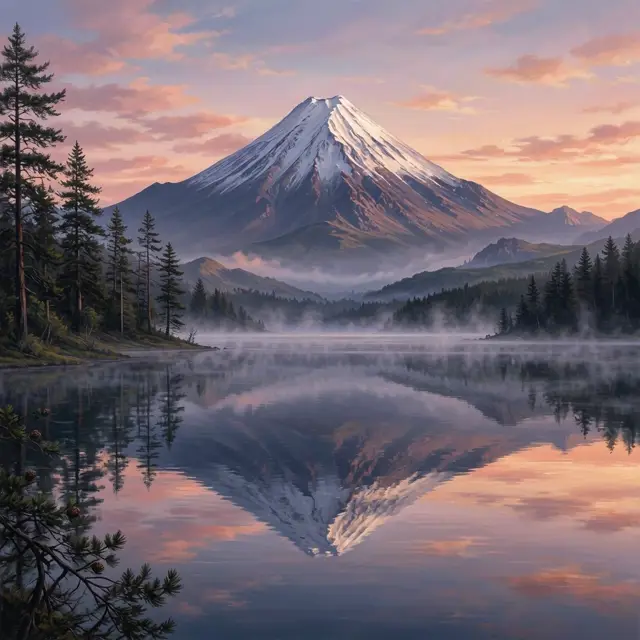
Stand in Tokyo on a clear day and look southwest. About 100 km away, a snowy cone rises over the land. That is Mount Fuji, and its shape is famous for being almost perfectly even on every side. Snow covers the cone for about five months of the year.
At 3,776.24 m, Fuji is the highest mountain in Japan. It is also the seventh-highest peak on any island on Earth. It sits on the island of Honshu, on the border between Shizuoka and Yamanashi prefectures, and five lakes wrap around its base.
Don't let the calm look fool you. Fuji is an active stratovolcano. It last erupted from 1707 to 1708, and it has even been photographed from space during a space shuttle mission.
Three Old Volcanoes Hiding Inside
Fuji sits on a rare spot in the Earth's crust. Three plates meet there: the Eurasian, North American and Philippine Sea plates. This meeting point is called a triple junction. The Pacific Plate also slides beneath these plates, a process called subduction, and that feeds the volcano.
The mountain you see is really several volcanoes stacked on top of each other. Deep inside is an old core called Sen-komitake, found only in 2004. Over it lies Komitake Fuji, formed several hundred thousand years ago. Then came Old Fuji, about 100,000 years ago, and finally New Fuji, which formed on top around 10,000 years ago.
The main crater is 780 m wide and 240 m deep. The slopes also hold more than 100 cones and more than 70 lava tunnels.
The Eruption of 1707 and Today's Worries
The last recorded eruption began on December 16, 1707, and ended around January 1, 1708. It is called the Hoei eruption. It blasted open a new crater and even created a second peak, Mount Hoei, halfway down the southeastern side. Cinders and ash fell like rain on nearby provinces.
Since then, Fuji has been quiet. As of December 2002, experts classed it as active but with a low risk of eruption. After the 2011 Tohoku earthquake, media began to wonder if Fuji might wake up.
In 2012, mathematical models suggested the pressure in its magma chamber could be higher than before the 1707 eruption. But nobody can measure that pressure directly, so the results stayed unproven. A new hazard map came out in 2021, and a new evacuation plan followed in 2023.
Climbing Through the Night for Sunrise
About 300,000 people climbed Mount Fuji in 2009. Most go in July and August, when the huts are open and the weather is warmest. Climbing from October to May is discouraged because of the cold.
There are four main routes: Yoshida, Subashiri, Gotemba and Fujinomiya. Each has numbered stations, and most climbers start at the fifth station, which buses and cars can reach. The summit is the tenth station. Going up takes five to seven hours. Many Japanese climbers hike through the night so they reach the top as the sun rises. That morning light even has a name, goraiko, meaning "arrival of light".
Crowds became a real problem. In 2024, Yamanashi began charging a 2,000 yen fee on the Yoshida trail and set a daily limit of 4,000 hikers. A Japanese saying warns that a wise person climbs Fuji once, but only a fool climbs it twice.
An Icon for Artists and Travelers
For centuries, the summit was closed to women. Tatsu Takayama became the first woman on record to reach the top, in the fall of 1832. In 1872, a government order ended such bans on women. The first foreigner to climb it was Sir Rutherford Alcock in 1860. He went up in 8 hours and came down in 3.
Fuji has been painted, printed and photographed endlessly. Hokusai made his famous woodblock print series, Thirty-six Views of Mount Fuji, in the 1830s. The mountain also inspired the Infiniti car logo. Mount St. Helens in the US was once called "The Fuji of America" because it looked so similar.
UNESCO added Mount Fuji to the World Heritage List on June 22, 2013. It noted that the mountain has inspired artists and poets for centuries.