Alone on the Plains
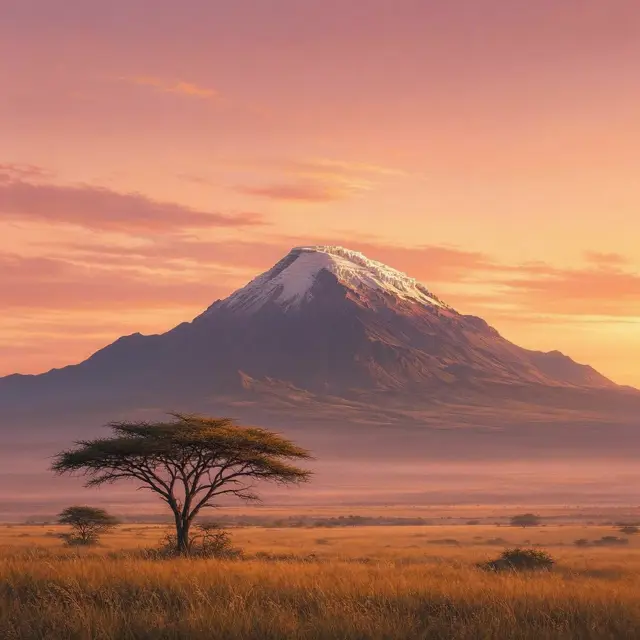
Most of the world's tallest peaks hide inside crowded mountain ranges. Mount Kilimanjaro does not. It rises on its own in Tanzania, which makes it the highest free-standing mountain above sea level in the world. Its top sits 5,895 m above the sea and a full 4,900 m above its own plateau base.
The mountain collects titles. It is the highest peak in Africa and the highest volcano in the Eastern Hemisphere. It is also the fourth most prominent peak on Earth, ranked by a measure called topographic prominence. As one of the Seven Summits, it draws hikers and climbers from everywhere.
Even its exact height keeps shifting. The official figure comes from a British survey in 1952. Later surveys measured 5,892 m in 1999, 5,902 m in 2008 and 5,899 m in 2014.
Three Volcanoes in One Mountain
Kilimanjaro is a large stratovolcano built from three separate cones. Shira is the lowest at 4,005 m. Mawenzi reaches 5,149 m and has a jagged top. Kibo is the tallest, and its crater rim holds Uhuru Peak, the highest point. Shira and Mawenzi are extinct, but Kibo is only dormant and could erupt again.
The mountain grew out of the East African Rift over two million years ago. Shira began erupting about 2.4 million years ago. Mawenzi and Kibo both started about 1 million years ago. Kibo's last activity, between 150,000 and 200,000 years ago, shaped the crater at its summit.
Kibo is not completely asleep. Gas still escapes from fumaroles in its crater. Its sides carry more than 250 small side cones, and deep inside the crater lies the Ash Pit, a hole 350 m deep.
An Ice Cap Running Out of Time
In the late 1880s, an ice cap of about 20 square km covered the whole summit of Kibo, with glaciers spilling down its western and southern slopes. That picture has changed fast. Over 80 percent of the ice cap was lost in the 20th century. Between October 1912 and June 2011, ice cover shrank from 11.40 square km to less than 1.
The cause at the top is not simple. Air at that height always stays below freezing, and scientists found no clear warming trend there between 1948 and 2005. Drier air seems to have shrunk the slope glaciers. On the summit, sunlight eats away at the steep ice walls. The ice both melts and turns straight into vapor, a process called sublimation.
In 2013, researchers estimated that most of the ice will be gone by 2040. They called it highly unlikely that any ice would remain after 2060. Surprisingly, losing it would barely touch the local water supply. The forests far below are the real water reservoirs for the people around the mountain.
Snow Near the Equator and the First Climbers
German missionary Johannes Rebmann is credited as the first European to report the mountain, in 1848. In his diary on 11 May 1848, he described a summit covered by what looked like a beautiful white cloud. When he asked about it, his guide simply called it cold. Rebmann knew at once it was snow.
Reaching the top took decades. Several European teams turned back because of bad weather or missing gear. In 1889, German geology professor Hans Meyer returned with Austrian climber Ludwig Purtscheller. They set up camps stocked with food, so they could try again without going far down. They reached the highest summit and were the first to confirm that Kibo has a crater.
Meyer named the peak after Kaiser Wilhelm. After Tanzania formed in 1964, it was renamed Uhuru Peak, meaning Freedom Peak in Swahili. The first woman to reach the summit was Sheila MacDonald, on 30 September 1927.
Climbing the Roof of Africa Today
The mountain became part of Kilimanjaro National Park in 1973. Today roughly 50,000 trekkers a year try for the summit, and about 70 to 80 percent make it. The climb is not technically hard, but the height alone is a real danger.
Even fit hikers can get altitude sickness. In one study of climbers in July and August 2005, 77 percent suffered from it. Routes that climb high and then sleep lower can delay it, but they cannot prevent it.
The records are wild. Anne Lorimor reached the top at 89 years and 37 days old in 2019. Keats Boyd summited at age 7 in 2008, even though the permit age limit is 10. Runner Karl Egloff went from Umbwe Gate to the summit in 4 hours and 56 minutes. And writer Douglas Adams once climbed it in a rubber rhinoceros suit to raise money for rhino conservation.