The Ice Cream That Froze Too Fast
In 1963, a student named Erasto Mpemba was in a cookery class at Magamba Secondary School in Tanganyika. He was freezing a hot ice cream mixture. To his surprise, it froze before a cold mixture did.
That is not what you would expect. Surely the colder one has less cooling to do? Yet Mpemba had spotted something real. Today the idea that very hot liquids can sometimes freeze more quickly than colder ones, in similar amounts and conditions, carries his name: the Mpemba effect.
Ice cream is a colloid, a mix of tiny bits spread through a liquid. The effect was first seen only in ice cream and water. Later it turned up in other colloids too. Researchers have since studied it in magnetic metals, tiny machines and even quantum systems. Not bad for a school cooking lesson.
The Question That Stumped a Physicist
Mpemba later moved to Mkwawa Secondary School in Iringa. One day the headmaster invited Dr. Denis Osborne from the University College in Dar es Salaam to give a physics lecture. Afterward, Mpemba asked him a puzzling question.
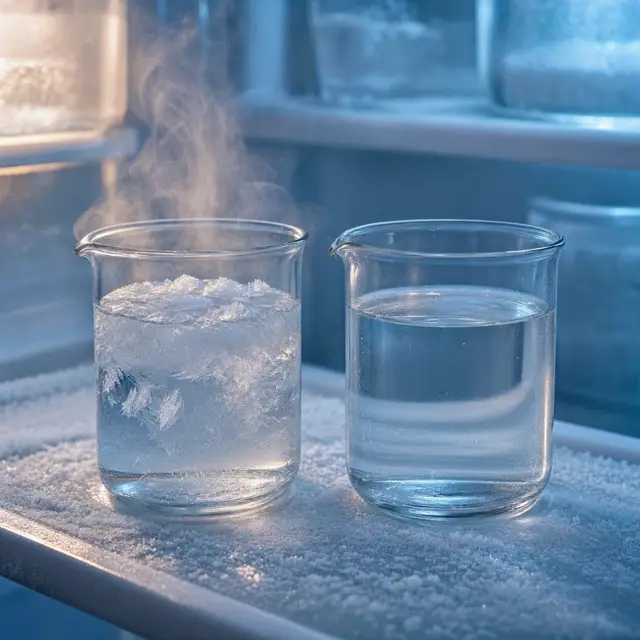
If you put two similar containers of water in a freezer, one at 35 °C and one at 100 °C, why does the 100 °C one freeze first? Osborne thought the student was mistaken. But he was curious enough to test it back at his workplace. He was amused to find that Mpemba was right.
The two published their results together in 1969, while Mpemba was studying at the College of African Wildlife Management. They had put 70 ml of water into 100 ml beakers in the icebox of a home fridge, on a sheet of foam. Water starting at 25 °C took the longest to begin freezing. Water at around 90 °C took much less time. They also ruled out evaporation and dissolved air as big factors.
Aristotle Got There First
Mpemba was not the first to notice. Long before him, the ancient scientist Aristotle wrote that water which has been warmed first freezes quickly. He said many people who wanted to cool water fast would start by putting it in the sun. His explanation used an idea called antiperistasis.
Centuries later, Francis Bacon noted that slightly lukewarm water freezes more easily than water that is completely cold. René Descartes wrote that water kept on a fire for a long time freezes faster than other water.
In 1775, Scottish scientist Joseph Black tested a special case. He compared water that had been boiled with water that had not. The boiled water froze more quickly, even when he controlled for evaporation. He also found that stirring mattered. When he stirred the unboiled water, it froze at the same time as the boiled water. Stirring very cold unboiled water made it freeze instantly.
Why Scientists Still Argue About It
Here is the twist. Scientists still cannot fully agree on whether the effect is real in water, or even how to define it. Does "frozen" mean a thin layer of ice on top, or a completely solid block? Studies pick different answers, which makes them hard to compare.
Much depends on supercooling, when water drops below its freezing point without turning to ice. In 1995, David Auerbach saw water supercool to between minus 6 and minus 18 °C before freezing, and sometimes the hotter water began freezing first. Others found the container itself made a difference. A reviewer for Physics World listed a long list of things to control, from dissolved gas to container shape to fridge temperature.
In 2016, two researchers concluded there was no evidence for meaningful observations of the effect. Yet in 2021, a way to reliably reproduce it was described. And in 2024, a team watching small drops with a heat camera found hot drops froze faster every time. The moment ice starts forming, called recalescence, is one thing they tracked.
From Frosty Freezers to Quantum Particles
So why might hot water win? There are plenty of ideas. Boiling can push out minerals, which changes the freezing point. Cold water can hold more dissolved gas. A hot container may melt through a layer of frost, which otherwise acts like a blanket around a cooler container. Changes in convection, the flow that carries heat through a liquid, may also matter. One team suggested that warm water has more strong hydrogen bonds, which help ice crystals get started when it is chilled fast.
The idea has also grown far beyond water. A "strong" version, with super fast cooling at certain starting temperatures, was predicted in 2019 and shown in a lab in 2020. In 2022, researchers even showed the reverse: a cold system heating up faster than a warmer one.
Want to try it? New Scientist writer Mick O'Hare suggested starting with containers at 35 °C and 5 °C to give the effect its best chance.