Drawings Only the Sky Can Read
The Nazca lines are a group of geoglyphs cut into the floor of the Nazca Desert in southern Peru, created between 500 BC and 500 AD across two major phases.
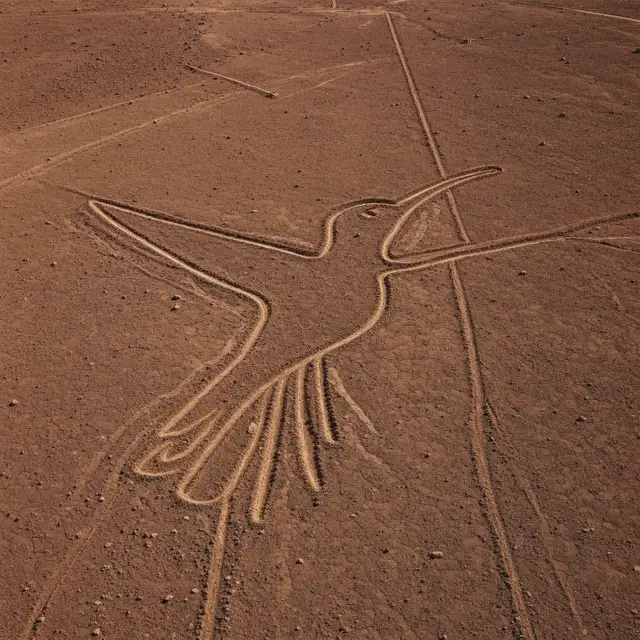
The scale is the first shock. The combined length of all the lines exceeds 1,300 km, covering an area of about 50 square kilometres. Most run straight across the landscape, but more than 70 are figurative designs of animals: a hummingbird, a spider, a fish, a condor, a heron, a monkey, a lizard, a dog, a cat and a human, plus trees and flowers. The largest figures are about 370 m long, and each shape is usually drawn as a single continuous line.
Some of them are best seen from the air, at around 500 m up, though they are also visible from the surrounding foothills and other high places. They have survived largely because of where they are: the plateau's isolation and its dry, windless, stable climate have preserved them naturally for two millennia.
How You Draw Something You Cannot Stand Back From
The technique is startlingly simple. The desert floor is covered in reddish-brown pebbles coated in iron oxide. Scrape that top layer away and you expose a yellow-grey subsoil underneath, which contrasts sharply with everything around it.
That is the entire method. The trenches are only 10 to 15 cm deep, and more than half the lines are a little over 33 cm wide, ranging from about 30 cm to 1.8 m. The exposed sub-layer contains high amounts of lime, which hardens in the morning mist to form a protective crust that shields the lines from wind erosion. The desert has effectively been sealing them in as it goes.
Working out how they were made has always been easier than working out why. Archaeologists have found wooden stakes driven into the ground at the ends of some lines, supporting the theory that simple surveying tools were used, and one of those stakes was carbon-dated to establish the age of the complex.
Debunked by Someone With a Stick and Some Rope
In 1969 Erich von Däniken proposed that "ancient astronauts" had constructed the works, a claim that spread far more widely than any archaeological paper.
It was answered practically rather than academically. In the early 21st century Joe Nickell, an American investigator of paranormal claims and folk mysteries, simply reproduced the figures using only the tools and technology that would have been available to the Nazca people. With careful planning and simple technology, he showed a small team could recreate even the largest figures within days, with no aerial assistance of any kind.
*Scientific American* described his work as "remarkable in its exactness" compared with the existing lines. The point was not that the Nazca definitely used Nickell's exact method, but that the supposed impossibility at the heart of the mystery does not exist. Building them needs planning and patience, not a view from above.
The Question Nobody Has Answered
How they were made is settled enough. Why remains genuinely open, and this is the real mystery.
The most durable proposal came from Paul Kosok, the first scholar to study them in depth, who flew over the lines in 1940 to 1941 while researching ancient irrigation and realised one was shaped like a bird. He noticed lines converging on the horizon at the winter solstice, and together with archaeologist Richard Schaedel and the German mathematician Maria Reiche he proposed the figures were astronomical markers indicating where the sun and other celestial bodies rose on significant dates. Archaeologists, historians and mathematicians have all tried since. Scholars differ, but generally ascribe religious significance to the designs.
A 2019 study added an odd wrinkle. Birds are the animals most frequently depicted, and a Japanese team found that some birds previously assumed to be local species more closely resemble exotic birds from non-desert habitats, which they suspect is closely related to the purpose of the etching itself. The site was designated a UNESCO World Heritage Site in 1994.
The Machines Are Still Finding More
Far from being a closed book, the Nazca desert is currently yielding new figures faster than at any point in its recorded history.
A Yamagata University team has conducted fieldwork since 2006 and had found roughly 100 new geoglyphs by 2012. In 2019 the university and IBM Japan announced 143 more, one of which was located using machine learning. A cat was discovered on a steep, erosion-prone hillside in 2020, which is why nobody had spotted it before. By 2022 the count of known geoglyphs stood at 358.
Then the numbers jumped. In 2024, archaeologists from Yamagata University's Nazca Institute working with IBM Research used artificial intelligence to identify 303 previously unknown geoglyphs, depicting parrots, cats, monkeys and killer whales. The AI did the searching, but people did the confirming: the field survey ran on foot from September 2022 to February 2023 and took 1,440 hours of labour, with a further 1,200 hours spent screening candidate photographs. Archaeologists believe there are still more to be found.