Carved by the End of an Ice Age
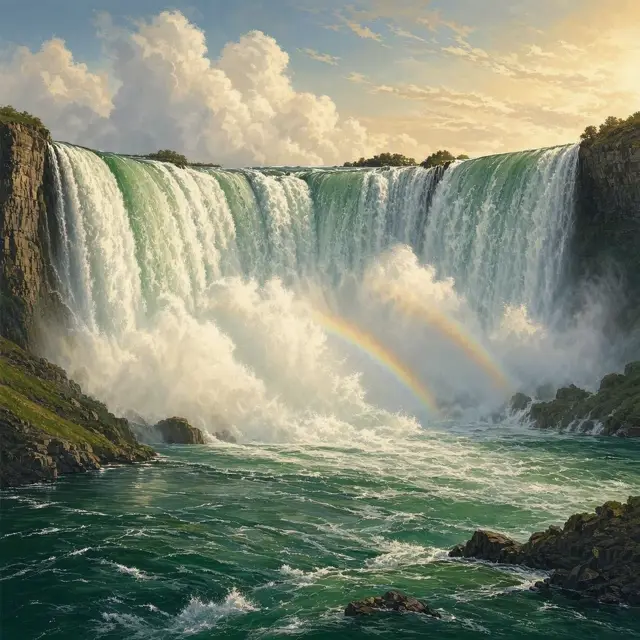
Niagara Falls is really three waterfalls on the border between Canada and the United States. The biggest, Horseshoe Falls, stands about 57 metres high and 790 metres wide, and is mostly on the Canadian side. The smaller American Falls and Bridal Veil Falls are in New York.
At peak tourist hours, more than 168,000 cubic metres of water pours over the edge every minute, giving the falls the highest flow rate of any waterfall in North America. The water has a bright green colour because it carries an estimated 60 tonnes of dissolved salts and rock flour every minute.
The falls were born when the last ice age ended. As the ice melted, the Great Lakes formed and drained through the Niagara River. Over time, the river cut a deep gorge. It wore away a soft layer of shale sitting beneath a hard cap of rock, and with nothing left to hold it up, the hard top broke off in great chunks, again and again.
A Waterfall That Walks Backward
The falls are not staying put. About 10,900 years ago, they sat near what is now Queenston, Ontario. Since then, erosion has pushed them back about 10.9 kilometres upriver.
For at least the last 560 years, they moved back by 1 to 1.5 metres a year. Engineering has slowed that to about 30 centimetres a year. Even at that pace, in about 50,000 years the falls will wear through the remaining 32 kilometres to Lake Erie and cease to exist.
People have stepped in to slow things down. In June 1969, workers built a temporary dam of rock and earth that completely stopped the river flowing over American Falls for several months. With the rock face dry, the U.S. Army Corps of Engineers studied it and bolted weak spots into place. In November 1969, they blew up the dam and the water returned.
The falls have also stopped on their own. On 29 March 1848, an ice jam cut the flow for as long as 40 hours. Waterwheels stopped turning, and mills and factories shut down.
The Barrel Riders
The first stunt at the falls did not even involve a real person. In 1827, local hotel owners sent an old ship called the Michigan over the edge, loaded with animals and fake human figures, and charged fifty cents to watch.
Then came the daredevils. On 24 October 1901, Annie Edson Taylor, a 63-year-old schoolteacher from Michigan, became the first person to go over the falls in a barrel. She came out bleeding but otherwise unhurt, and soon after climbing out, she warned that no one ought ever do that again. Days before, her cat had been sent over in the same barrel to test it. The cat survived and later posed with her in photographs.
Many people ignored her advice. Some survived, while others were badly hurt or died. Today, trying to go over the falls is illegal on both sides of the border.
Tightrope walkers chose the gorge instead. In 1859, Jean François Gravelet, known as Blondin, became the first to cross it, and once even carried his manager across on his back.
Power, Honeymoons and a Curtain of Water
Niagara is not just a view. It is a giant power source. In 1895, a large-scale alternating current power system switched on at the falls, and by 1896 electricity was being sent all the way to Buffalo, 32 kilometres away.
Today, between 50 and 75 percent of the river's water is sent through four huge tunnels to power stations before it ever reaches the falls. Niagara is still the biggest producer of electricity in New York state.
So what stops the falls from running dry? A 1950 treaty between the United States and Canada, designed to protect an unbroken curtain of water. During daylight in the tourist season, at least 2,800 cubic metres per second must flow over the falls. At night and in winter, when fewer people are watching, that can drop to 1,400, and the rest goes to making power.
The falls have been a honeymoon favourite for a long time. The first recorded couple to honeymoon there visited in 1801.