Ninety-Seven Percent of the Water
The ocean is the body of salt water covering approximately 70.8% of Earth. It is conventionally divided into named oceans — in descending order by area, the Pacific, Atlantic, Indian, Antarctic/Southern and Arctic — themselves divided into seas and gulfs.
It contains 97% of Earth's water and is the primary component of the planet's hydrosphere. All the rivers, lakes, ice caps, groundwater and clouds combined make up the remaining three percent.
Its role is not passive storage. The ocean acts as a huge reservoir of heat for Earth's energy budget, and for its carbon cycle and water cycle, forming the basis of climate and weather patterns worldwide. It also originated photosynthesis, and therefore Earth's atmospheric oxygen — and still supplies half of it today.
The Thin Layer Where Life Happens
Scientists divide the ocean vertically into zones defined by light, and the divisions are stark.
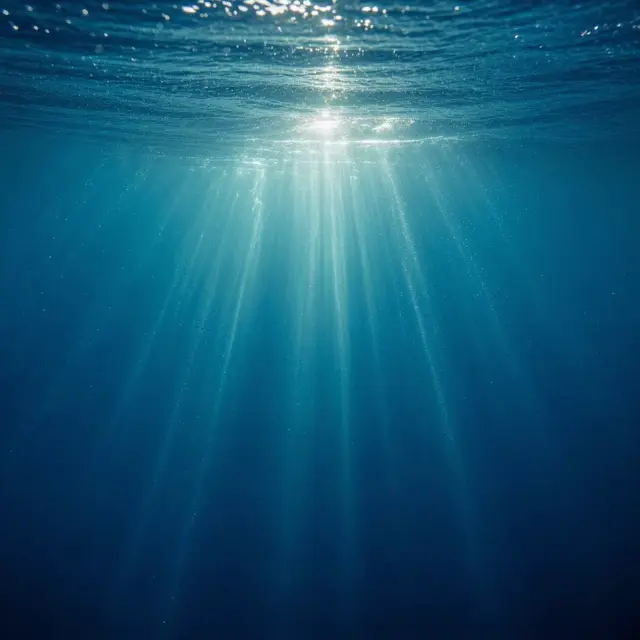
The photic zone starts at the surface and is defined as the depth at which light intensity is only 1% of the surface value — approximately 200 m in the open ocean. This is the only zone where photosynthesis can occur, where plants and phytoplankton use light, water, carbon dioxide and nutrients to produce organic matter.
That makes the photic zone the most biodiverse part of the ocean and the source of the food supply sustaining most of the ocean ecosystem. Light penetrates only a few hundred metres further; everything below is cold and dark, in the mesopelagic and aphotic zones. The pelagic zone — the open ocean's whole water column from surface to floor — is therefore mostly darkness with a thin lit skin on top.
Rivers Inside the Sea
Ocean temperature depends on how much solar radiation reaches the surface. In the tropics, surface temperatures can exceed 30 °C. Near the poles, where sea ice forms, equilibrium temperature is about −2 °C. But at depth, everywhere on Earth, the range narrows to between −2 °C and 5 °C.
Constant circulation creates ocean currents, driven by temperature and salinity differences, atmospheric circulation, and the Coriolis effect. Tides create tidal currents; wind and waves create surface currents.
The major currents — the Gulf Stream, Kuroshio Current, Agulhas Current and Antarctic Circumpolar Current — transport massive quantities of water, gases, pollutants and heat between parts of the world and from the surface into the deep. This is why the ocean is a climate system rather than a body of water: it moves heat around the planet on a scale nothing else matches.
Absorbing Our Carbon, at a Cost
Ocean water contains dissolved gases including oxygen, carbon dioxide and nitrogen, exchanged at the surface, with solubility depending on temperature and salinity.
That exchange has become a problem. Atmospheric carbon dioxide is rising due to emissions, mainly from fossil fuel combustion — and as the oceans absorb that CO₂, the higher concentration leads to ocean acidification, a drop in pH. The ocean is buffering the atmosphere by changing its own chemistry.
It gives humans a great deal: ecosystem services, seafood and marine resources, and transport. It is known to host over 230,000 species, and may hold considerably more — perhaps over two million. Against that, the threats stack up: marine pollution, overfishing, and the effects of climate change including ocean warming, acidification and sea level rise. Human activity is mostly coastal, and the continental shelf and coastal waters are the most affected.