A Japanese Word for a Universal Habit
Origami (折り紙) is the art and technique of folding paper, and also the two- and three-dimensional forms produced by it.
Here is the detail that surprises people. Although the word origami has Japanese roots, the practice itself is universal and its origin remains unknown. Paper folding is not a thing Japan gave the world so much as a thing many places arrived at, which Japan named and refined.
In modern use the term has stretched well beyond paper, covering other materials such as metal and textiles, and it is even used in the biological sciences to describe folded structures like DNA. When a biologist says a molecule is "origami", they are borrowing a Japanese word for an activity of uncertain origin to describe the shape of the code inside your cells.
One Square, No Cheating
The goal is to transform a flat square sheet of paper into a finished sculpture through folding and sculpting alone.
Modern practitioners generally discourage the use of cuts, glue or markings. Designs that do use cuts get their own name — folders call them kirigami — which keeps the distinction clean rather than treating cutting as a failure.
Those constraints are what make the craft interesting rather than merely fiddly. A small number of basic folds can be combined in enough ways to produce genuinely intricate designs, and every one of them has to be reachable from an uncut square. Designs typically begin with a square whose two sides may differ in colour, print or pattern — a choice that becomes part of the finished object, since folding decides which face ends up showing.
Ceremony Versus Play
Japanese classification splits the practice in a way English does not.
On one side sits stylised ceremonial origami — *girei origami* — the formal folding used to wrap and present things properly. On the other sits recreational origami, *yūgi origami*, folding for its own sake.
Only recreational folding is generally recognised as origami. In Japan the ceremonial kind is usually called origata instead, to keep the two apart — and "origata" is itself one of the old terms for origami. Traditional Japanese origami, practised since the Edo period (1603–1868), has often been less strict than modern purism, sometimes cutting the paper or starting from non-square shapes. The rules everyone now treats as ancient are, in part, a modern tightening.
From Paper Cranes to Heart Stents
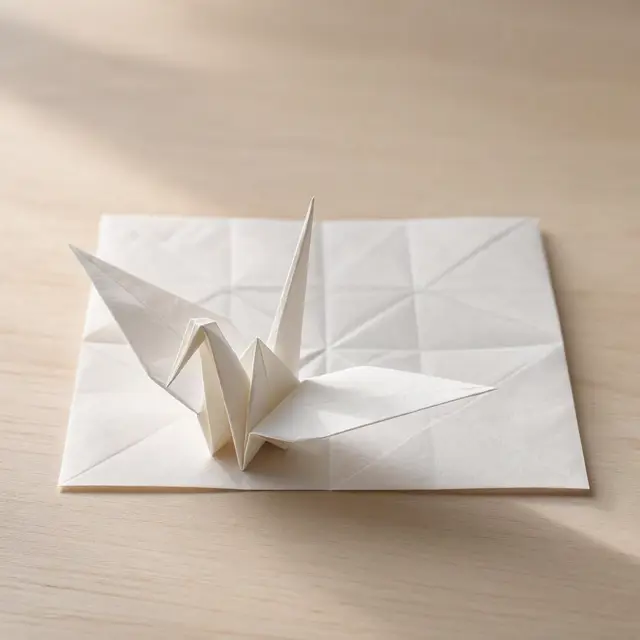
The best-known origami model is the Japanese paper crane — the single design that represents the entire craft in most people's minds.
But the reach of the underlying mathematics is far wider, because folding solves a specific engineering problem: how to make something large become compact, and then reliably unfold again.
That is why the principles of origami are now used in stents — tubes folded small enough to be threaded through a blood vessel before expanding inside an artery — as well as in packaging and other engineering applications. An art form defined by refusing to cut or glue turned out to be a design language for anything that has to arrive folded and deploy on demand.