The Dinner Menu That Took Flight
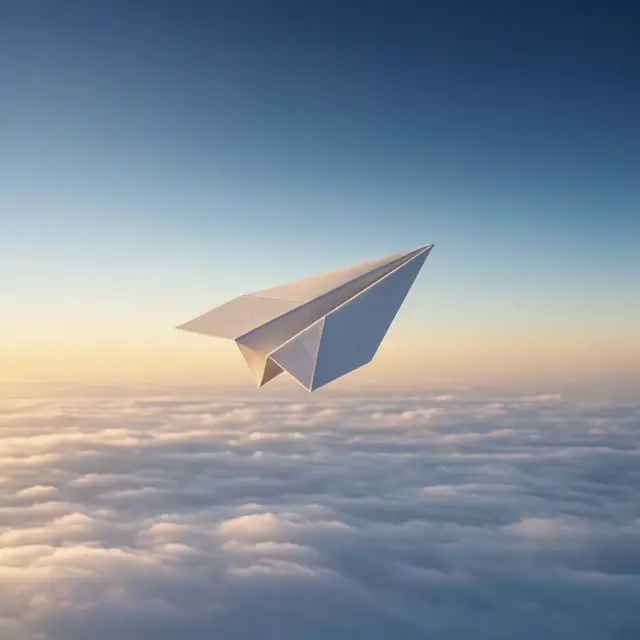
One of the best paper plane stories happened at a formal dinner after a 1924 conference in Delft, the Netherlands. The scientist Ludwig Prandtl was asked a question about the mechanics of flight by the woman sitting next to him. While explaining, he picked up a paper menu, folded it into a small plane and launched it without thinking where he was.
It landed on the shirtfront of the French Minister of Education. The woman was the sister of fellow scientist Theodore von Kármán, who later recalled how embarrassed everyone at the table was. He also dismissed the paper plane as an artless exercise.
Paper planes were around long before that. An American children's book from 1864 already described how to build them. The classic version is a glider made from one folded sheet, a simple nose-heavy triangle thrown like a dart. Over time, designs have improved in speed, lift, launching and style.
Paper Is Tougher Than It Looks
Paper sounds flimsy, but at the size of a model plane it is surprisingly strong. A sheet of ordinary 80 g/m2 office printer paper has roughly the in-scale strength of aircraft-grade aluminium sheet. Card stock behaves more like steel at that size. The catch is that paper is denser than balsa wood, so simple folded planes suffer from more drag.
A plain folded plane is not a great flyer. Its glide ratio is often no better than 7.5 to 1. Over the years, designers added more folds, extra weight and even kirigami, cutting the paper as part of the design.
Two professors made the biggest leap. Yasuaki Ninomiya in Japan worked on it in the late 1960s, and E.H. Mathews in South Africa did so in the 1980s. Using real aerodynamic design, they pushed typical flights of 10-plus meters to 85-plus meters. Their work is still the last research on improving how far paper gliders fly.
Paper Kits with Spinning Propellers
Ninomiya's designs appeared in two books in 1966 and 1967, and later became the White Wings glider packs, sold from the 1970s to today. They are not folded at all. Instead, paper parts are cut out and glued together. Some of his models had working propellers spun by the passing air, a first for any paper model. Others were designed so carefully they could fly without ballast, such as paperclips.
Mathews published his first book, Paper Pilot, in 1984 while lecturing at the University of the Witwatersrand. He tuned his gliders in a small wind tunnel and drew their parts with CAD software. Later books added a bungee hook launch, a small version of how real sailplanes are launched. One scale model glider flew more than 120 meters that way.
He also created the Papercopter, a paper helicopter with a ring-shaped wing. Its longest flight time is 27.9 seconds.
The Race for Seconds and Meters
Paper plane records are serious business. Under Guinness rules, you must use A4 paper of at most 100 g/m2, plus one piece of tape no bigger than 25 by 30 mm.
For time in the air, Ken Blackburn held the record for 13 years, from 1983 to 1996, then won it back in 1998 with 27.6 seconds indoors. Takuo Toda of Japan beat that in 2010 with 29.2 seconds. Blackburn disagreed with the common view that light planes go farther. For the best height, he said, you must throw within 10 degrees of straight up, and that takes a throw of at least 60 miles per hour (97 km/h).
Distance records keep falling. Stephen Kreiger threw 63.20 meters in 2003. Joe Ayoob reached 69.14 meters in 2012, and Kim Kyu Tae hit 76.99 meters in 2022. Then on 28 December 2025, Liu Liwen threw a paper plane 98.43 meters indoors in Shanghai, using a plane refined over more than six months of testing.
Paper Planes Near the Edge of Space
Some fans aim much higher. In March 2008, a paper plane prototype passed a durability test in a wind tunnel, and Japan's space agency JAXA considered launching it from the International Space Station. The plan was put on hold because it would be almost impossible to track the planes during their week-long trip down to Earth.
In February 2011, 200 paper planes were released from a net under a weather balloon 37 km (23 miles) above Germany. They carried memory chips, and some were reported found elsewhere in Europe and as far away as Canada, India, South Africa and Australia. A project spokesman admitted he was a bit suspicious of the southern reports. Still, he noted that a well-built paper plane travels 12 feet across the ground for every foot it drops.
On 24 June 2015, a club from Kesgrave High School in Suffolk, UK, set the record for the highest paper plane launch: 35,043 meters (114,970 ft).