The Land of Giants That Never Were
In 1520, Ferdinand Magellan's expedition reached the bottom of South America and met the local people. The crew's chronicler, Antonio Pigafetta, wrote that they measured some 9 to 12 feet tall. He said the sailors "reached only to his waist". Magellan named the people Patagons, and the region became Patagonia.
The story of giants spread fast. Early maps of the New World sometimes marked the area as "regio gigantum", the region of the giants. In 1767, an account of Commodore John Byron's voyage seemed to prove they were real. It became an overnight bestseller.
The truth arrived in 1773. Official logs showed the people Byron met were no taller than about 6 feet 6 inches. That is very tall, but not giant. They were probably the Tehuelche, who tended to be taller than Europeans of the time. The name itself may come from Patagón, a wild creature in a Spanish adventure novel from 1512 that was a favourite of Magellan's.
Rainforest on One Side, Desert on the Other
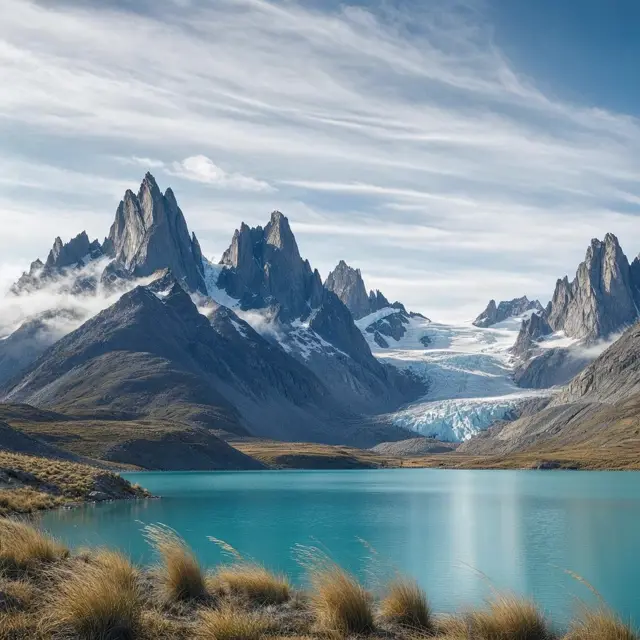
Patagonia sits at the southern end of South America, and Argentina and Chile share it. The Andes run down the middle and split it in two very different worlds. The west has lakes, fjords, temperate rainforests and glaciers. The east has deserts, tablelands and dry steppe.
The reason is the wind. The prevailing winds blow from the west and drop their rain on the western slopes. This creates a rain shadow to the east. Islands near Torres del Paine get 4,000 to 7,000 mm of rain a year. Some eastern plains get as little as 200 mm.
The change can be shocking over short distances. Laguna Frías in Argentina gets about 4,400 mm a year. The city of Bariloche, about 40 km east, gets about 1,000 mm. Its airport, another 15 km on, gets less than 600 mm. The wet west feeds the largest ice field areas in the Southern Hemisphere outside Antarctica, and ice carved out huge lakes such as Lake Argentino.
Wind, Snow and Summer Surprises
Patagonia's winds are famous. The city of Rio Gallegos is among the windiest places on Earth, with winds that sometimes reach 100 km per hour. All that air has a use. The winds have made Patagonia Argentina's main source of wind power, and plans exist for much more.
The cold can be fierce too. On a plateau at Maquinchao, the record low is minus 35 °C. Some nights there are 10 degrees colder than in Bariloche, at the same altitude. Across the border, the town of Balmaceda is known as the coldest place in Chile.
In Tierra del Fuego, at the very tip, summers are cool, cloudy and very windy. Snow can fall even in summer in most areas. Ushuaia hovers around 0 °C for several months each winter. Yet the east coast is warmer than the west, because a branch of the southern equatorial current reaches its shores, while the west coast is washed by a cold current.
Hummingbirds in the Snow
Patagonia's wildlife fits its tough setting. The plains are home to guanacos, cougars, Patagonian foxes and skunks. The steppe is one of the last strongholds of the guanaco and Darwin's rhea. Above them, the Andean condor, one of the largest birds in the world, rides the wind.
Some sights seem impossible. Green-backed firecrowns, a kind of hummingbird, may be seen flying through falling snow. The coast hosts Magellanic penguins, elephant seals, killer whales and southern right whales. The Valdés Peninsula is a UNESCO World Heritage Site for its marine mammals.
The past was even wilder. Around 12,000 to 10,000 years ago, most of the region's megafauna died out. Gone were a cow-sized ground sloth and a sabertooth cat. Fossils of Argentinosaurus, which may be the largest dinosaur of all, have been found here too. Charles Darwin explored the region in the 1830s, riding long distances with gauchos.
Welsh Tea Rooms and Fondue at the End of the World
Patagonia's people are a surprising mix. In the 19th century, settlers arrived from Europe, including the Welsh, who settled the Chubut Valley. Their mark is still there. The Chubut River's name grew from a local word, "chupat", meaning transparency, through Welsh pronunciation. In Patagonian Welsh the river is called "Camwy". Tea rooms are a feature of the Welsh towns of Gaiman and Trevelin.
Food tells more stories. Lamb is the traditional Patagonian meat, grilled for several hours over an open fire. Around Bariloche, an Alpine tradition lives on, with chocolate bars and even fondue restaurants. Sheep matter here too. About half of Argentina's 15 million sheep live in Patagonia.
Today tourism is a big business. Visitors come for the Perito Moreno glacier, the Valdés Peninsula and Ushuaia, a jumping-off point for trips to Antarctica. On the Chilean side, Punta Arenas, founded in the 1840s, is the oldest permanent settlement in Southern Patagonia.