Birds That Fly Underwater
Penguins are birds that cannot fly. Their wings became flippers long ago, useless in the air but superb in the water. When a penguin swims, it looks very much like a bird flying. They spend about half their lives on land and the other half at sea.
Almost all penguins live in the Southern Hemisphere, but not only in icy places. Only a few species live as far south as Antarctica. One, the Galapagos penguin, lives at and slightly north of the equator. It can survive there thanks to cold, rich waters of the Humboldt Current flowing around the islands.
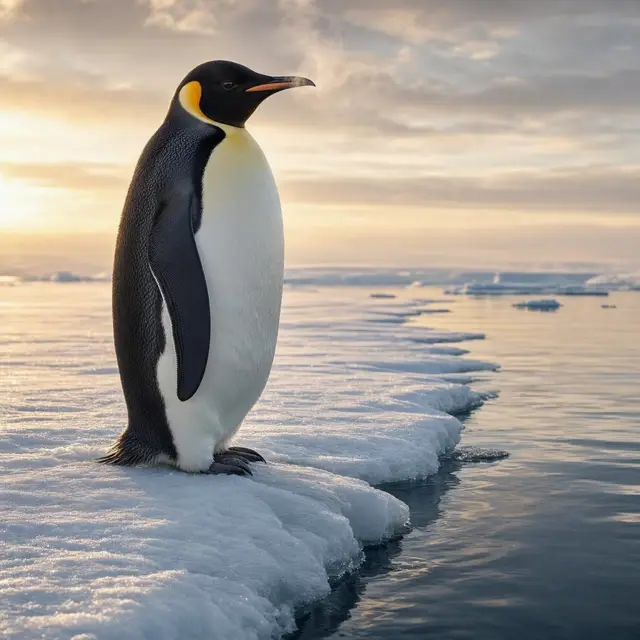
And despite what cartoons show, there are no wild penguins in the Arctic. Today's largest species is the emperor penguin, at about 1.1 m tall and 35 kg. The smallest, the little blue penguin, stands only 30 to 33 cm.
Giants of the Ancient Seas
Some prehistoric penguins were enormous, as tall or as heavy as an adult human. Between about 40 and 30 million years ago, several lines of giant penguins lived in the southern oceans. Nordenskjoeld's giant penguin was the tallest, reaching nearly 1.80 meters. The New Zealand giant penguin was probably the heaviest, at 80 kilograms or more.
The oldest known penguin fossils come from New Zealand and date back roughly 62 to 58 million years. Even these early penguins were already flightless, with short wings suited to deep diving.
Giant penguins even lived far from the cold. One, Icadyptes salasi, stood about 1.5 m tall in northern Peru around 36 million years ago. The giants were gone by about 25 million years ago. Their decline matched the spread of early fish-eating toothed whales, which competed with them for food.
A Name Borrowed from Another Bird
The word "penguin" was not first used for penguins at all. At the end of the 16th century, it was another name for the great auk, a bird of the Northern Hemisphere. When European explorers met the southern birds, they saw the likeness and reused the name, even though the two are not closely related.
Where the word itself comes from is still debated. Some dictionaries link it to the Welsh pen, "head," and gwyn, "white." Another idea ties it to the Latin pinguis, meaning "fat."
The great auk, the original "penguin," went extinct in the mid-19th century. Puffins, its relatives, show a case of convergent evolution: they share the black back and white chest of penguins, but they can still fly. A group of penguins in the water, by the way, is sometimes called a raft.
Built for Cold, Deep Water
All penguins wear countershading: black backs and white fronts. A predator looking up from below struggles to tell a white belly from the bright water surface, while the dark back hides them from above.
Gentoo penguins are the fastest underwater birds in the world, reaching up to 36 km per hour. Emperor penguins are the deepest-diving birds, going down about 550 meters. On snow, penguins often slide on their bellies, a move called "tobogganing" that saves energy.
Staying warm takes clever plumbing. Every living penguin has a humeral plexus in its flippers, which uses already warm blood to heat cold blood and limits heat loss. A supraorbital gland filters extra salt from the blood, so penguins can drink seawater. About one in 50,000 penguins is born with brown rather than black feathers.
Eggs, Huddles, and Chick Nurseries
Most penguins breed in large colonies, some with several hundred thousand pairs. Pairs usually stay together for a breeding season. Most species lay two eggs, but the two biggest, the emperor and king penguins, lay just one. In most species both parents take turns keeping the eggs warm, but in emperor penguins the male does it all.
Penguin eggs are small for the size of the parents. The emperor's 450 g egg is only 2.3% of its mother's weight. Leftover yolk may help feed a newly hatched chick if the parents are late with food.
In the Antarctic winter, male emperors huddle together and rotate so each one gets a turn in the warm center. Chicks of some species gather in large groups called crèches. Penguins also show little fear of humans, likely because they have no land predators in Antarctica.