To Smoke Through
The word comes from the Latin perfumare, meaning to smoke through, which tells you where scent began: burning aromatic material. Perfumery as a craft started in Mesopotamia, Egypt and the Indus Valley, and possibly ancient China.
The first chemist whose name we know may have been a perfume maker. A cuneiform tablet from the second millennium BC in Mesopotamia mentions a woman named Tapputi, who distilled flowers, oil and calamus with other aromatics, filtered the result, and ran it through the still again and again.
The oldest surviving perfumes were found in 2003 at Pyrgos in Cyprus and are over 4,000 years old. They turned up in what was plainly a factory: a building of some 300 square metres holding at least 60 stills, along with mixing bowls, funnels and bottles.
The ancients used almond, coriander, myrtle, conifer resin and bergamot alongside flowers. A temple in Elis was said to have saffron blended into its wall plaster, leaving the interior fragrant for 500 years.
The Rose and the Alembic
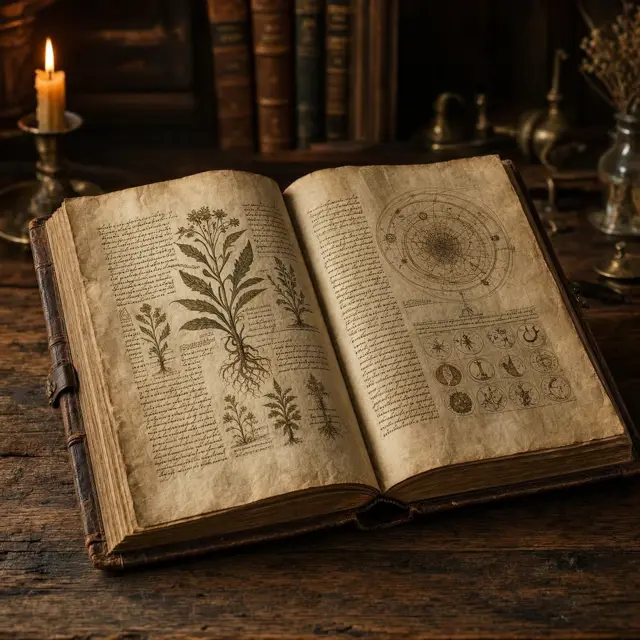
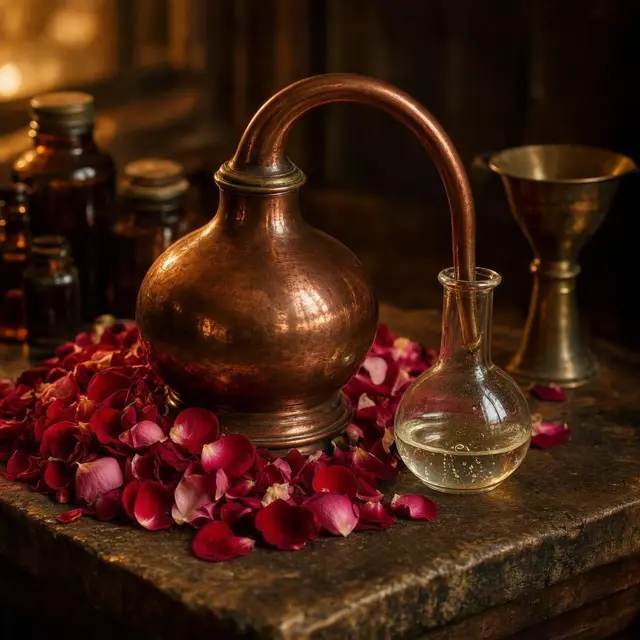
Two figures shaped how perfume is actually made. In the 9th century the Arab chemist Al-Kindi wrote the Book of the Chemistry of Perfume and Distillations, which held more than a hundred recipes for fragrant oils, salves and aromatic waters, along with 107 methods and descriptions of the equipment. That equipment included the alembic, the still whose name is still Arabic today.
The Persian scholar Ibn Sina, known in Europe as Avicenna, introduced the technique of extracting oils from flowers by distillation, which remains the method most used now. He experimented first with the rose.
The difference was immediate. Before this, liquid perfumes were mixtures of oil and crushed herbs or petals, which produced a heavy blend. Rose water was far more delicate and became popular at once.
The cities of Al-Andalus in Spain became major perfume producers, trading across the Old World, and both the raw materials and the distilling technology fed into European perfumery and into chemistry itself.
How France Took the Trade
Monks in Florence were recording perfume recipes by 1221. Around 1370 the Hungarians produced scented oils blended into alcohol, known as Hungary Water, for their queen.
The decisive move was a transfer of talent. Catherine de' Medici's personal perfumer, known as Rene the Florentine, brought Italian methods to France in the 16th century. His laboratory was connected to her apartments by a secret passage, so that no formula could be stolen on the way. France became a European centre of perfume and cosmetics manufacture soon after.
Growing flowers specifically for their essence had begun in the 14th century and turned into a major industry in the south of France. By the 18th century the Grasse region, along with Sicily and Calabria, was supplying the raw material.
In 1693 an Italian barber created a scented water called Aqua Admirabilis, better known now as eau de cologne. Modern perfumery arrived in the late 19th century, when chemists synthesised aroma compounds such as vanillin and coumarin.
Top, Heart and Base
A perfume is described with a musical metaphor, as three sets of notes that appear in sequence as it dries.
The top note is what you smell immediately. These are small light molecules that evaporate quickly, which is why they matter so much in selling a bottle, and they include mint, lavender and citrus. The heart notes emerge as the top fades and form the main body, with things like sandalwood and jasmine. The base note usually is not noticeable until about half an hour in, bringing depth with materials such as tobacco, amber and musk.
The layers interfere with each other, so the base changes how the top smells and the middle alters the base.
Plants supply most of the material, usually as essential oil, and flowers most of that. Fresh fruit rarely gives the smell you expect when extracted, so fruity notes in a bottle are usually synthetic. Animal sources were once central: ambergris comes from the sperm whale, and musk originally came from a deer, though synthetic musks have largely replaced it.