A Message Nobody Can Read
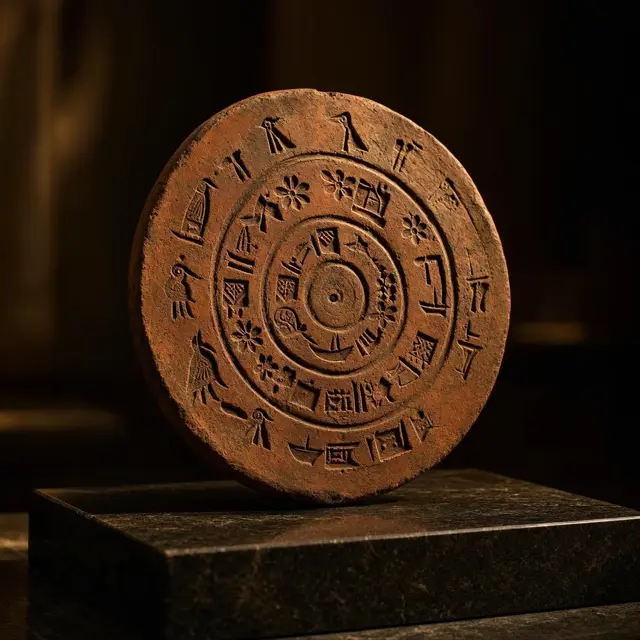
In 1908, archaeologists digging in the Minoan palace of Phaistos on Crete found a clay disc about 16 cm wide. Both faces were covered with a spiral of tiny pictures: 242 signs in all, drawn from just 45 different symbols. To this day, nobody has managed to read them.
The signs were not scratched or painted. Each was pressed into the soft clay with its own stamp, and then the disc was fired. The text is in an unknown script and an unknown language. Even its purpose, and the place where it was made, are still disputed.
It is not even certain that the signs are writing at all. Most would-be codebreakers assume they are. At first, the disc looked so unusual that some scholars suspected a forgery or a hoax. Today, archaeologists generally accept it as authentic. It is on display at the archaeological museum of Heraklion.
Found in a Sealed Basement
The Italian archaeologist Luigi Pernier recovered the disc intact on 3 July 1908. It lay in the basement of a building northeast of the main palace, near the south coast of Crete. The exact spot was the main cell of an underground "temple depository."
These basement cells could only be reached from above, and they were neatly covered with a layer of fine plaster. They held few precious objects. Instead, they were full of black earth and ashes, mixed with burnt cattle bones. In the same black layer, just a few centimetres from the disc, lay a clay tablet written in Linear A, a script used across the Aegean.
Dating the disc has proved hard. One scholar, Yves Duhoux, placed it between 1850 BC and 1600 BC, based on Pernier's report. Another put it after 1400 BC. Louis Godart, doubting the original report, concluded that it could date from almost anywhere in the second millennium BC.
Printed Long Before Gutenberg
The disc's most remarkable feature is how it was made. Every sign was pressed in with a separate stamp, one for each symbol. That makes the disc an early example of movable type. The typesetter and linguist Herbert Brekle argued that, if it is a text, it is truly a "printed" one.
The writer Jared Diamond sees the disc as an invention made at the wrong time in history, so it never spread. He contrasts it with Gutenberg's printing press. The clay is fine-grained, and some say it may not even come from Crete. Unlike ordinary tablets and seals, which were baked only by accident, this disc was fired on purpose.
Besides the stamps, the maker scored lines into the moist clay with a sharp stylus. A spiral line separates each turn of the text. Short lines running toward the centre split the signs into groups. The start of the text, at the edge, is marked by one of these lines with five dots punched along it. The disc even shows corrections, with some signs erased and stamped over.
Plumed Heads, Shields and Eagles
Many signs show things you can recognise, such as people, birds, plants, a boat, heads, hides and flowers. Scholars gave them names like PLUMED HEAD, SHIELD, HELMET and EAGLE, but these labels are often based on the slightest likeness. The plumed head is the most common sign, appearing 19 times. Nine signs appear only once, and each is known as a hapax.
The patterns are far from random. Of the 17 shield signs, 13 come right after a plumed head. The signs fall into 61 groups of two to seven signs, 31 on side A and 30 on side B. These groups are called "words," though nobody knows what they really are.
Even the reading direction caused debate. Arthur Evans once claimed the text should be read from the centre outward. There is general agreement that he was wrong, and Evans himself later changed his mind. The text runs clockwise, from the edge in toward the centre. In 2008 the disc's signs were even added to Unicode, the standard set of characters that computers use.
Hoax, Codebreakers and an Open Case
The unique script, the spiral layout and the stamped signs made some scholars wonder whether the disc was a 1908 hoax. Critics point out that its age has never been tested with thermoluminescence dating. But later finds support its authenticity. A sign like the disc's "comb" turned up on a sealing found in 1955 and on a bowl found in 1965. A ring with a similar spiral layout was found at Knossos in 1926.
Would-be readers have read the disc as a narrative, an adventure story, a call to arms, a board game and even a geometric theorem. Others have claimed it is Greek, Hittite, a Semitic language or Luwian. Some of these theories are seen as pseudoarchaeology. Most language-based attempts assume a syllabary, since 45 symbols fits that type of script, while others propose an alphabet or logography.
The hard truth is that there is not enough context to work with. Scholars think a real breakthrough is unlikely unless more examples of these signs turn up elsewhere. Without outside confirmation, no reading will be accepted as conclusive. Until then, the disc keeps its secret.