Twelve Pizzas Owed to a Bishop
The word pizza was first recorded in AD 997, in a Latin manuscript from the southern Italian town of Gaeta, in Lazio, on the border with Campania.
The context is wonderfully mundane. The document required tenants to provide *duodecim pizze* — twelve pizzas — to the bishop annually. Not a recipe, not a celebration: a rent payment. Someone in the tenth century owed their landlord a dozen pizzas a year, and that receipt is the oldest written trace of the most popular food on Earth.
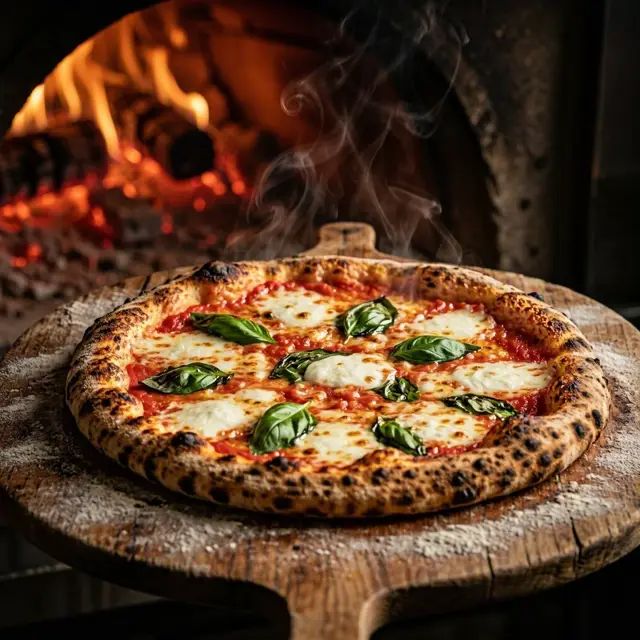
The dish itself is straightforward: a flat base of leavened wheat dough topped with tomato, cheese and other ingredients, baked at high temperature, traditionally in a wood-fired oven. That is the whole invention. Bread, made flat, with dinner on top.
The Queen Story, and Its Problem
Raffaele Esposito, a Neapolitan pizzaiolo, is often credited with creating the modern version of pizza in Naples around 1889.
The legend is famous. Queen Margherita commissioned three pizzas, and preferred the one topped with tomato (red), mozzarella (white) and basil (green) — the colours of the Italian flag. Hence the Pizza Margherita.
It is a lovely story and it may not be true. Later research questions the account, noting there was no contemporary media coverage of the event and that the story only gained prominence in the 1930s and 1940s — half a century afterwards. That gap is the classic signature of a tale assembled in hindsight. What is not disputed is what Naples achieved: in 2009 Neapolitan pizza was registered with the European Union as a traditional speciality guaranteed dish, and in 2017 the art of making it was added to UNESCO's list of intangible cultural heritage.
A Hundred and Twenty-Eight Billion Dollars
Pizza and its variants are among the most popular foods in the world, and the numbers make that concrete.
In 2017 the world pizza market was worth US$128 billion. In the United States alone it was $44 billion, spread across 76,000 pizzerias. And 13% of the US population aged two and over consumed pizza on any given day — roughly one American in eight, every single day.
It travelled there with people. Italian immigrants brought pizza to the United States in the late 19th century, and Lombardi's, the country's first pizzeria, opened in New York City in 1905. Today it is sold through pizzerias, Mediterranean restaurants, delivery and street food, and in grocery stores frozen or as self-assembly kits cooked in a home oven.
Knife and Fork, Actually
One detail reliably surprises people outside Italy. In Italy, pizza served in a restaurant is presented unsliced, and is eaten with a knife and fork.
The hand-held slice is the casual mode, not the default one. In informal settings pizza is typically cut into slices to be eaten while held in the hand — but the restaurant version arrives whole, and you are expected to cut it yourself.
It is a small thing that says something larger about how food travels. The version most of the world treats as definitive — folded, portable, eaten walking — is the export edition. The original is a plated dish you sit down to. Both are pizza; they just answer different questions about what a meal is for.