When the Receiver Paid the Bill
Before stamps, mail in the United Kingdom was paid for by the person receiving it. That caused a problem nobody could solve. If the receiver could not or would not pay, the post office lost money. And senders had no reason to limit how many, how big or how heavy their letters were.
People had tried other ideas. In April 1680, William Dockwra and his partner Robert Murray started the London Penny Post. For one penny, it carried letters and small parcels across London. Payment was marked with a hand stamp pressed right onto the letter. Many historians see it as the world's first postage stamp. That is also where the word stamp comes from: early marks were made with ink and hand stamps, usually of wood or cork.
In 1835, a civil servant named Lovrenc Košir in Ljubljana suggested paper stamps so thin they could not be reused. Officials studied it closely, but never adopted it.
The Penny Black Changes Everything
Rowland Hill described the modern stamp in 1837. He proposed "a bit of paper just large enough to bear the stamp, and covered at the back with a glutinous wash". His reform booklet ran to some 28,000 words.
The result was the Penny Black, on sale from 1 May 1840 and valid from 6 May. It showed the young Queen Victoria's profile, drawn by artist Henry Corbould from a medal by William Wyon. It paid for a letter under half an ounce to go anywhere in the United Kingdom. The Two Penny Blue followed on 8 May.
The idea took off. Letters sent in the UK jumped from about 76 million before 1839 to 350 million by 1850, a five-fold rise. Hill's brother Edwin even built a machine to fold envelopes fast enough to keep up. By 1860, stamps were used in 90 countries. And because the first stamps needed no country name, the UK still prints none on its stamps today.
From Scissors to Tiny Holes
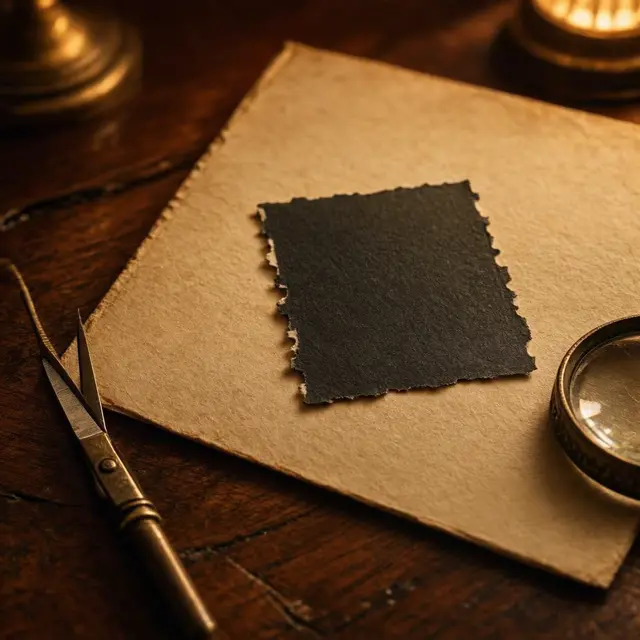
The first stamps came in sheets with no gaps to tear along. Clerks cut them apart with scissors, or simply ripped them, which is why many surviving examples have ragged edges. For post offices handling huge piles of stamps every day, this was a real nuisance.
The fix was perforations, rows of tiny holes between stamps. Henry Archer, an Irish landowner and railway man, invented the first machine to punch them in London. The 1850 Penny Red was the first stamp perforated during his trials. The UK government later paid Archer £4,000 for his machine and patent, and from 1854 Britain perforated all its stamps.
The United States followed. Its first officially perforated stamp, a 3-cent George Washington, came out on 24 February 1857. At first there were not enough machines to perforate everything. So perforated stamps used between February and July 1857 are now scarce and quite valuable.
Stamps You Can Smell, Play and Peel
Stamps are not always little paper rectangles. Some are circles, triangles or pentagons. Sierra Leone and Tonga have issued stamps shaped like fruit. In 2000, the United States issued its first round stamp, a hologram of the Earth.
The materials can be wild too. Switzerland made a stamp containing a bit of lace and another with wood. The US made one of plastic, and the Netherlands made one of silver foil. Bhutan issued a stamp with its national anthem on a playable record.
Bhutan also issued the first scented stamps, in 1973. Rub one and it releases a smell, thanks to ink filled with tiny scent capsules. Scents have included coffee, roses, chocolate, vanilla, cinnamon and freshly baked bread. The smell only lasts a few months or years. Even design choices had clever reasons. Brazil's 1843 Bull's Eye stamp used an abstract pattern instead of the emperor's portrait, so a postmark would not deface his face.
A Hobby Worth Printing For
Collecting stamps is a hobby. Studying them is called philately, and the two are not quite the same thing. Collectors matter so much that some small countries print elaborate limited runs mainly for them, far beyond their real postal needs. By 2000 there were 400,000 different types of stamps, with about 10,000 new types each year.
Some deals got creative. In the 1890s, an agent named Nicholas F. Seebeck offered to supply Latin American countries with all their stamps for free. In return, he got the exclusive right to sell to collectors. Each year's issue expired at year's end, which kept new stock coming.
Collectors also prize the first day cover, especially ones mailed in everyday use without any plan to collect them. Famous rarities include the British Guiana 1c magenta and the Inverted Jenny. Meanwhile, the Netherlands began offering handwritten codes instead of stamps in 2013, and 590,000 people used them on cards in December 2020.