Four Old Ideas, One New Machine
Johannes Gutenberg did not invent printing. Around 1440 he combined four things that already existed and added his own refinements.
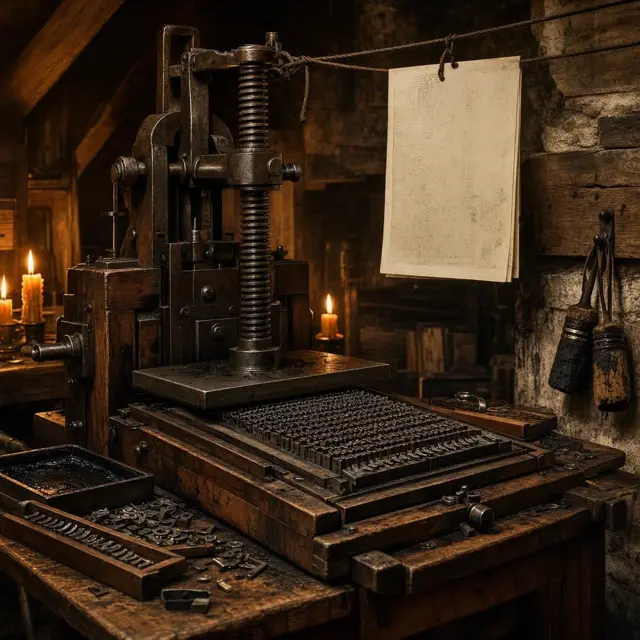
The first was the screw press, brought in by the Romans and used for centuries to squeeze grapes and olives. Gutenberg adapted it so the flat plate pressed evenly on paper without smearing, and added a sliding undertable so sheets could be swapped quickly.
The second was movable type, invented in the 11th century by the Chinese artisan Bi Sheng using baked clay characters. Around 1300 Wang Zhen made wooden type arranged on revolving tables. The oldest surviving book printed with metal movable type is the Jikji, made in Korea in 1377.
The third was the codex, the bound book format, which had replaced the scroll among scribes by around 500 AD. The fourth was cheap paper, mass produced in water-powered mills from 1282, which in Italy became far cheaper than parchment.
Why It Worked in Europe
East Asian printing had a mathematical problem. Chinese writing uses thousands of distinct characters, so casting a full set of type was enormously expensive, and woodblock printing stayed the practical method. Gutenberg's press benefited from the Latin alphabet, which needs a comparatively small set of pieces.
His background helped too. He had worked as a goldsmith, and he was the first to make type from an alloy of lead, tin and antimony, which was durable enough for high quality work. He built a hand mould that could cast new letters quickly and identically from a single template. His type case is estimated to have held about 290 separate boxes, counting special characters, ligatures and punctuation.
He also had to solve ink. Water-based inks did not sit properly on metal, so after a good deal of experimenting he settled on an oil-based ink, more durable than what came before. He printed on both paper and vellum.
From One Workshop to a Continent
Gutenberg's shop in Mainz was the only one in Europe. By 1480, printers were working in 110 different places across Germany, Italy, France, Spain, the Netherlands, Belgium, Switzerland, England, Bohemia and Poland. By the end of the century around 270 European cities had printing.
The output numbers explain the upheaval. Presses in Western Europe had produced over 20 million copies by 1500, and somewhere between 150 and 200 million by 1600. A single press around 1600 could manage between 1,500 and 3,600 impressions in a working day.
The effect on religious argument was immediate. Martin Luther became Europe's most published author around 1520. German printers reissued 291 editions of his 45 original works, and between 1518 and 1520 they put out 300,000 copies, an output that caught both the pope and secular rulers by surprise. Printers who had won readers with those pamphlets kept them by producing news sheets, and the first weekly newspaper followed in the early 17th century. Books printed before 1501 are known as incunabula.
What Print Did to Knowledge
Printing changed science before science changed itself. Ptolemy's astronomy stood as the authority for some 1,400 years. Copernicus overtook it in 1543, and his own work was overtaken in under a century.
Part of the reason was distribution. Scholars had circulated findings in handwritten letters to individuals. Now they could reach many people at once, further away and faster, and communities formed around shared questions and methods.
Pictures mattered as much as words. Hand-copied medical and botanical illustrations degraded with every copy, which is why classical authorities warned against trusting images and told students to look at nature directly. Printed anatomical plates and star charts could be reproduced without losing detail, so figures could finally accumulate corrections instead of errors.
Language shifted too. Books increasingly appeared in everyday regional languages rather than Latin, which standardised spelling and grammar. Two historians of the book argue that printing shaped national languages more than any other single factor.