Thirty Years of Nobody Listening
The core idea behind radar was demonstrated before anyone had a use for it. In 1886, Heinrich Hertz showed that radio waves bounce off solid objects. That is the whole principle. Everything since has been engineering.
It took a while for anyone to act on it. In 1895, Alexander Popov built apparatus using a coherer tube to detect lightning strikes, and in 1897 he noticed an interference beat caused by a passing ship — a direct hint that objects could be detected this way.
The first real attempt came in 1904, when Christian Hülsmeyer patented a device for detecting ships and estimating their distance. His telemobiloscope worked at a 50 cm wavelength using spark-gap pulses. It functioned. Nobody bought it. The technology sat almost untouched for three decades, waiting for a reason urgent enough to justify it.
The Experiment That Saved Britain
The reason arrived in the 1930s, and several countries reached for the same answer at once. In 1934, French researchers at CSF began work on obstacle-locating radio equipment, while the Soviet engineer P. K. Oshchepkov produced an experimental apparatus called RAPID that could detect aircraft within 3 km.
The decisive moment came in Britain. On 26 February 1935, Robert Watson-Watt's team ran the Daventry Experiment, detecting an aircraft using a BBC transmitter as the signal source. It was improvised, and it worked.
Britain moved fast. By 1936 Watson-Watt was superintendent of Bawdsey Research Station and the first five Chain Home stations were operational — an early-warning network watching the approaches to Britain years before the fighting reached them. That head start is precisely what a defending air force needs, because it converts a surprise attack into an expected one.
How You Measure a Sky You Cannot See
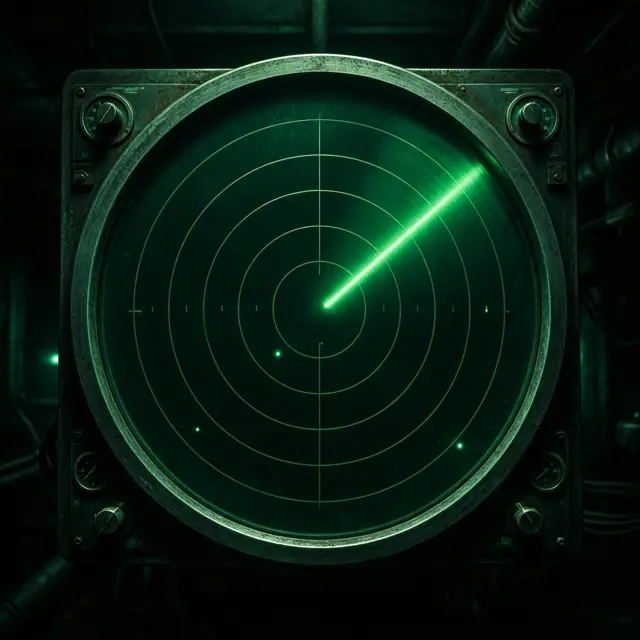
A radar system is conceptually simple: a transmitter producing radio or microwave waves, a transmitting antenna, a receiving antenna (often the very same one), and a receiver and processor. Waves go out, reflect off objects, and come back carrying information.
Distance comes from timing. Radio waves travel at the speed of light, so the delay between sending a pulse and hearing its echo gives the range directly. The convenient unit here is the radar mile: 12.36 microseconds, the time a pulse needs to travel one nautical mile — 1,852 metres — and return.
Speed comes from the Doppler effect. A target moving toward or away from the radar shifts the frequency of the returned signal, and the size of that shift reveals how fast it is closing. There is a brutal catch in the physics, though: received power falls off as the fourth power of range. Doubling the distance to a target cuts the returning signal to a sixteenth.
The Word Was Invented After the Thing
The name came late. In 1940, the United States Navy coined RADAR as an acronym for "radio detection and ranging." It has since become an ordinary English word, losing its capitals entirely — an anacronym, a term whose acronym origin most speakers have forgotten.
That same year brought the technology's biggest leap. The cavity magnetron, developed in the United Kingdom, made it possible to build relatively small systems with sub-metre resolution, and the Tizard Mission handed that technology to the United States.
What a radar sees depends on what a target is made of. Electrically conductive materials such as metal and carbon fibre reflect radio waves strongly, which is the basis of radar cross-section — how visible an object is to radar. A corner reflector, three flat surfaces meeting like the inside corner of a cube, throws signals straight back at the sender and makes an object deliberately easy to spot.
It Is Watching Far More Than the Sky
Radar quietly escaped the military and colonised ordinary life. It now handles air and terrestrial traffic control, marine navigation, ocean surveillance, aircraft anti-collision systems, and outer-space surveillance and rendezvous.
It also does far humbler work. Weather forecasting depends on meteorological precipitation monitoring. Ground-penetrating radar maps geology beneath your feet. Police speed enforcement, automatic doors, intrusion sensors, adaptive cruise control and emergency braking all run on the same principle Hertz demonstrated in 1886.
Modern systems use digital signal processing and machine learning to pull useful information out of extremely noisy returns. And close relatives now work in other parts of the spectrum: lidar uses infrared laser light rather than radio waves. With driverless vehicles arriving, radar is expected to be a core sense for machines navigating the world — the technology nobody wanted in 1904, now standard equipment in a family car.