Pushing Heat the Wrong Way
Refrigeration is the artificial cooling of a space or substance to hold it below the temperature around it. Stated plainly it sounds mundane. Stated physically it is stranger: heat moves from hot to cold on its own, and refrigeration forces it to travel against the temperature gradient.
Early refrigeration cheated. It used consumable coolants like ice and dry ice — substances obtained elsewhere and needing constant replenishment. Modern refrigeration is self-sustaining, and that is the real leap.
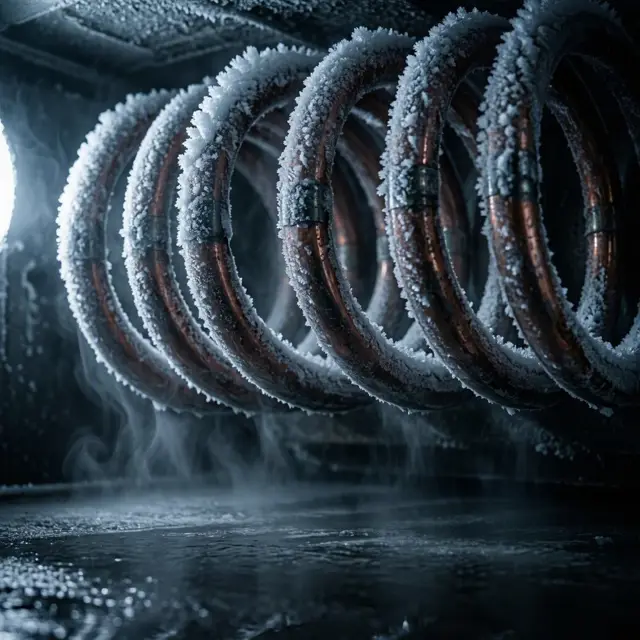
A refrigerant, the heat-transfer working fluid, absorbs heat from the cold side and releases it to the warm side, driven through an active phase change by a compressor and helped along by a radiator. The energy for that trip is traditionally supplied by melting ice or by an electromechanical machine, but it can also come from a heat pump, magnetism, electricity, or even laser cooling. Different engines, same trick: pay energy, and heat will flow uphill.
Thousands of Years of Salting and Waiting
Preserving food by cold is not a modern idea. It goes back to human prehistory. What was missing for thousands of years was any means of doing it on demand.
In tropical and most temperate regions, surplus food was preserved by curing — often salting — and by drying. Cold storage simply was not an option unless geography handed it to you. In arctic, subarctic and alpine regions people could harvest natural ice from glaciers and frozen water bodies, or exploit the natural chill of caves, root cellars and winter weather.
So for most of history your diet was shaped by your latitude. The nineteenth century began to break that constraint with the rise of the ice trade, which enabled the first cold chains — unbroken runs of refrigerated storage and transport from producer to consumer. Then, from the late 19th through the mid-20th century, mechanical refrigeration was invented, improved and expanded enormously.
Cities Built Where Cities Shouldn't Be
The consequences ran far past keeping milk fresh. Refrigeration reshaped agriculture, industry and where humans chose to live.
Refrigerated rail cars changed the map directly. They contributed to the settlement of areas that sat nowhere near the older transport channels — rivers, harbours, valley trails — because perishable goods no longer had to move by the fastest route to survive the journey.
More striking still, refrigeration sparked the building of large cities in places previously considered inhospitable because of heat. Houston, Texas and Las Vegas, Nevada are named as exactly that: settlements that thrive in climates that would otherwise have capped their growth. A machine for moving heat became, indirectly, a machine for moving people.
The Fragile Web Behind Every Supermarket
Cities and towns in most developed countries are now heavily dependent on refrigeration across food processing, distribution and retail — supermarkets and butcher shops alike — simply to keep daily food safe to eat.
That dependence bought a genuine gain. Better preservation significantly reduced food loss and waste from spoilage. But it also rebuilt the supply chain around a new assumption: large quantities of meat, seafood and produce can now be supplied from a smaller number of farms and fisheries, each producing far more food per person than in the late 1800s.
The upside is visible in any aisle. Refrigeration diversified what reaches consumers, including rare delicacies that could never have travelled before, and in doing so changed modern nutrition, tastes and culinary arts. The trade-off is concentration: the food of millions now flows through fewer points, every one of them requiring the cold to hold.