England's First Attempts
The Roanoke Colony was an attempt, backed by Sir Walter Raleigh, to create England's first permanent settlement in North America. The first try came in 1585, when a military outpost was set up on Roanoke Island, in what is now North Carolina.
It did not go well. Relations with some local Native American tribes turned hostile, food ran short, and a resupply mission was late. In 1586, the settlers gave up and sailed home with Sir Francis Drake.
Raleigh tried again. In 1587, about 115 people joined a new colony, led by Governor John White. This time they included women and children, among them White's pregnant daughter Eleanor and her husband, Ananias Dare.
They were meant to settle further north, at Chesapeake Bay. But when the ships stopped at Roanoke to check on a small group of men left there earlier, the settlers were ordered off at Roanoke and forced to stay.
On 18 August 1587, Eleanor gave birth to a daughter, named Virginia.
A Three-Year Wait
The colony was soon in a desperate situation. The colonists persuaded White to sail back to England to ask for help, and he reluctantly left in August 1587, leaving his daughter and newborn granddaughter behind.
His timing could not have been worse. By the time he reached England, the Spanish Armada was preparing to attack, and Queen Elizabeth had banned ships from leaving so they could help defend the country.
In 1588, White finally set out with two small ships. But their captains went hunting for Spanish ships to rob along the way, and near Morocco they were attacked by French sailors. The supplies meant for Roanoke were stolen, and the ships limped home.
It took until 1590 for White to get another chance, aboard a privateer expedition. On the night before landing, the men anchored off Roanoke and sang English songs, hoping the colonists would hear them.
CROATOAN
White came ashore on 18 August 1590, his granddaughter's third birthday. There were fresh footprints in the sand, but nobody came to meet them.
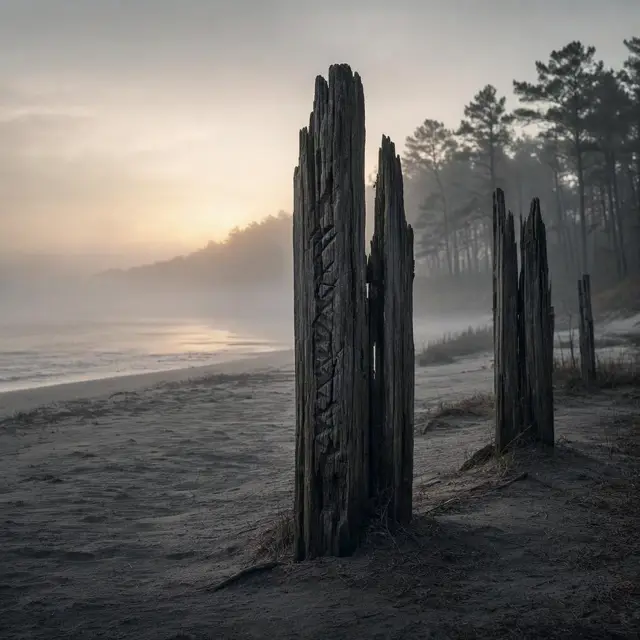
On a tree, they found the letters CRO carved into the bark. At the settlement, which had been surrounded by a palisade of tall wooden posts, the full word CROATOAN was carved into one of the posts.
The houses had been taken apart, and anything that could be carried was gone. Several chests, including three belonging to White, had been dug up and looted. None of the colony's boats remained on the shore.
White took this as good news. Before he left in 1587, he and the colonists had agreed that if they moved, they would carve their destination, and add a cross if they left in danger. There was no cross. Croatoan was the name of a nearby island, home to Native Americans who had been friendly to the settlers.
But he never got there. The ship's anchor cable snapped, the weather turned against them, and the search had to be abandoned.
The Lost Colony
The disappearance became known as the Lost Colony, and it has puzzled people for more than 400 years. There were no signs of a battle and no graves at the site, which suggests the colonists were alive when they left.
The most popular idea is that they joined local Native American tribes, especially the Croatan. The idea appears in writings from as early as 1605, and later stories told of people with European features in Native villages. The present-day Lumbee tribe identifies as descended partly from the Lost Colonists. Other theories suggest they tried to sail home and were lost at sea, or were attacked.
New clues keep turning up. In 2011, researchers found that a patch on one of White's maps hid the symbol of a fort, and digs at that spot, nicknamed Site X, uncovered English pottery. On Hatteras Island, once part of Croatoan, archaeologists have found parts of a sword and a gun, and in 2025 tiny iron flakes left over from blacksmithing, which they argue show settlers lived there.
None of it is conclusive, and some of the claims have been challenged. A set of carved stones found between 1937 and 1941, said to be messages from Eleanor Dare, is believed by most historians to be fake. And as of 2019, DNA studies had not identified a single living descendant.