A Word Born in a Play
The word robot started life on the stage. It was introduced by the Czech writer Karel Čapek in his play R.U.R., short for Rossum's Universal Robots, published in 1920.
The play is set in a factory that makes simplified living people to do work. They are efficient but have no feelings, and in the end some become self-aware and lead robots around the world in an uprising against humans.
Čapek did not actually invent the word. He first wanted to call his creatures laboři, from the Latin word for work, but did not like it. His brother Josef, a painter and writer, suggested roboti instead. The root word robota means forced labour or hard work in Czech. Traditionally, it was the work a serf had to do for his lord.
The word robotics came later, from the science fiction writer Isaac Asimov. He had simply assumed the word already existed.
Mechanical Birds and a Robot Named Eric
The dream of machines that move by themselves is ancient. In the 4th century BCE, the Greek thinker Archytas described a steam-powered mechanical bird called The Pigeon. Hero of Alexandria built many self-running devices, including a speaking automaton. Ancient Chinese texts even describe wooden birds that could fly.
In 1066, the Chinese inventor Su Song built a tower-shaped water clock with mechanical figures that chimed the hours. Its drummer could be programmed to play different beats by moving pegs around.
The 20th century brought machines with personality. In 1928, a humanoid robot called Eric gave a speech at an exhibition in London. At the 1939 New York World's Fair, a 2.1-metre robot named Elektro walked on voice command, spoke about 700 words and blew up balloons.
The first truly autonomous electronic robots arrived in 1948 and 1949, when William Grey Walter in Bristol built two slow, three-wheeled machines nicknamed tortoises. When their batteries ran low, they could find their own way back to a charging station.
The Arm That Changed Factories
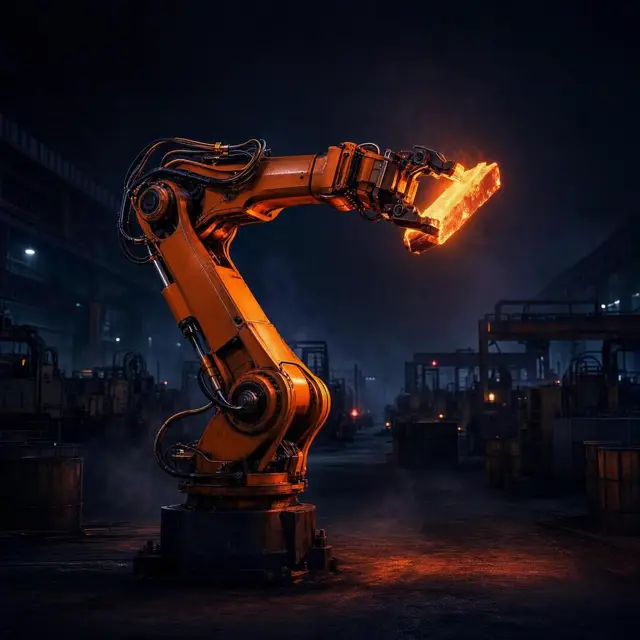
The modern robot industry began with an arm. In 1954, George Devol invented the first digitally operated, programmable robot, later called the Unimate. He sold the first one to General Motors, and in 1961 it went to work at a plant in Trenton, New Jersey, lifting hot pieces of metal out of a casting machine and stacking them.
That first job says a lot about what robots are for. They often take on work that is too dirty, dangerous or dull for people, and they can do many tasks more cheaply or more accurately.
Car factories show how far this has gone. Over the last three decades they have become dominated by machines. A typical car factory runs hundreds of them, each one an industrial robot, with about one robot for every ten human workers. On an automated line, a car body is welded, glued, painted and put together at a series of robot stations.
Robots also go where people cannot. Almost every uncrewed space probe ever launched counts as a robot, including the Voyager probes.
The Three Laws and the Jobs Question
Science fiction has shaped how we think about robots. Isaac Asimov, who published over 500 books, created the Three Laws of Robotics in a 1942 short story. A robot must not harm a human, must obey human orders unless that would cause harm, and must protect itself unless that breaks the first two laws.
The laws are pure fiction. No technology can yet understand or follow them, and one researcher has pointed out that every one of Asimov's robot stories is about how such simple rules fail.
The real debate today is about work. For centuries, people have predicted that machines would put workers out of a job. In 2011, the Taiwanese company Foxconn announced plans to grow its robot workforce from ten thousand to a million over three years. Bill Gates has suggested taxing companies for using robots, to slow the change and pay for other kinds of work.
Still, a 2019 World Bank report found that while automation replaces some workers, new technology creates more new industries and jobs overall.