The First Preservative
Salt is mostly sodium chloride, and it is essential to life as the source of two dietary minerals. Saltiness is one of the basic tastes, and salt reliably improves how food tastes by suppressing bitterness.
For thousands of years it was the best known way to keep food from spoiling, which is why its availability shaped where people could live. What is thought to be the first city in Europe, Solnitsata in Bulgaria, was a salt mine supplying the Balkans from 5400 BC.
Processing goes back further still. At a site in Romania, Neolithic people were boiling water from a salt spring to extract salt as early as 6050 BC, a technique called briquetage, and the local population grew rapidly soon after production began. Harvesting from a lake in Shanxi, China, dates to at least 6000 BC.
Diet explains the demand. Animal tissue contains more salt than plants do, so nomads living off their herds do not need to add it, while farmers eating mainly grain and vegetables must.
Money, Caravans and Taxes
As civilisation spread, salt became one of the world's main trading commodities, valued by the Greeks, Romans, Byzantines, Hittites and others.
In several places it simply was money. South of the Sahara salt was used as currency, and slabs of rock salt served as coins in Abyssinia. The Tuareg have long run caravans across the Sahara specifically to carry it, returning laden with salt pillars and dates. From about 2800 BC the Egyptians exported salted fish to the Phoenicians in exchange for cedar, glass and dye.
Some cities are named after it. Salzburg means salt castle and the river Salzach means salt river, in an Austrian region with extensive deposits. Nearby Hallstatt was the site of the world's first salt mine and gave its name to an entire archaeological culture.
Governments taxed it, and people revolted. The oppressive French salt tax was one cause of the French Revolution, and in 1930 Gandhi led a march of 100,000 people to make salt from the sea in protest at the colonial salt tax in India.
Two Words and a Myth
The word salary comes from the Latin word for salt. Why it does is genuinely unknown, and the popular explanation is wrong: the persistent claim that Roman legions were sometimes paid in salt is baseless.
Another word is more straightforward. Salad literally means salted, and comes from the Roman practice of salting leaf vegetables.
The conflicts were real enough. Venice fought the Salt War of 1304 with Padua over supply rights, and the War of Ferrara in the 1480s for the same reason. Towns on overland trade routes grew rich by charging duties on salt passing through, and Liverpool flourished on exporting salt from the mines of Cheshire.
One more old practice attaches to it. Salting the earth, scattering salt around a defeated city to symbolically prevent anything growing, was an ancient wartime gesture. The famous story that Rome did this to Carthage is now considered entirely apocryphal.
Where It Comes From Now
World production reached 300 million tonnes in 2018, led by China, the United States and India. Only a small fraction of that is eaten: food accounts for about 17.5 percent of production worldwide, and just 7 percent in Europe.
The rest goes to industry. Salt is a feedstock for caustic soda and chlorine, used to make PVC and paper pulp, and it serves as a flux in aluminium production, an emulsifier in synthetic rubber, a mordant in textile dyeing, and a glaze when thrown into a pottery kiln. It also de-ices roads and softens water.
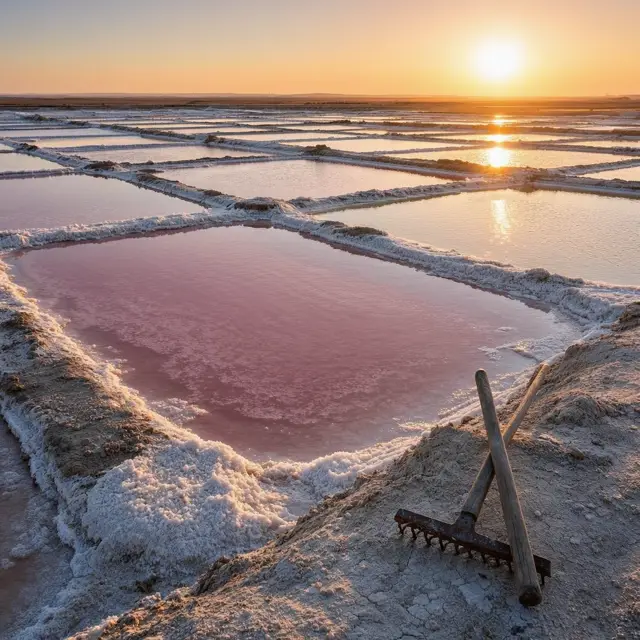
There are two basic sources. Seawater has a salinity of about 3.5 percent, and in hot dry countries it is simply run into evaporation ponds and left, sometimes turning vivid colours as salt-loving microorganisms thrive. Inland, salt is dug from rock salt deposits left by seas that evaporated long ago, or extracted by pumping water down into them.
The Khewra mine in Pakistan has nineteen storeys and 400 kilometres of passages, and draws around a quarter of a million visitors a year.