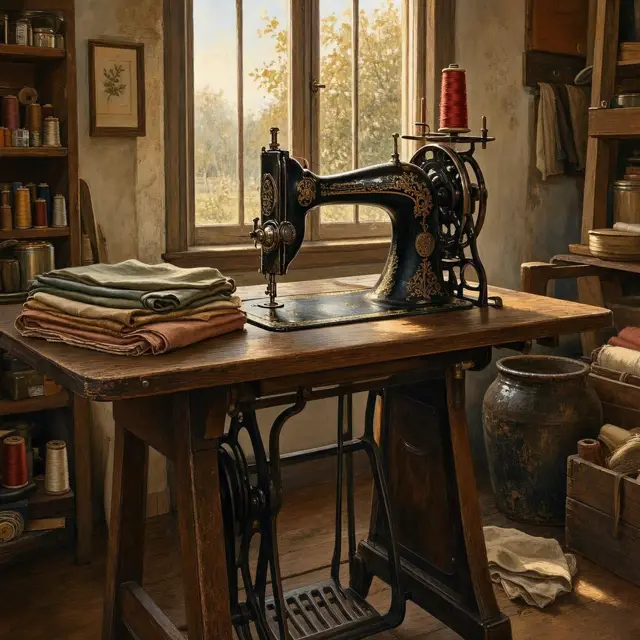
The Machine That Waited 84 Years to Be Built
The first sewing machine is generally credited to an Englishman named Thomas Saint, in 1790. He was a skilled cabinet maker, and he designed his machine for leather goods like saddles and shoe soles, though it could also handle canvas. There was one catch. Saint probably never built it.
His idea sat on paper for decades. In 1874, a sewing machine maker named William Newton Wilson found Saint's drawings in the UK Patent Office. He adjusted one part, the looper, and built a working machine. It is now owned by the Science Museum in London.
Saint's design used a chain stitch, where a single thread forms simple linked stitches. Even earlier, in 1755, a German-born engineer working in England received the first British patent for a mechanical sewing aid. It was a needle pointed at both ends, with an eye at one end.
A Wooden Machine and an Inventor Who Shrugged
The first practical, widely used sewing machine came from a French tailor, Barthélemy Thimonnier, in 1829. His original machine was made of wood. His patent was issued on 17 July 1830, and that same year he and his partners opened the world's first machine-based clothing factory, making army uniforms. The factory was later burned down, reportedly by workers afraid of losing their jobs.
In America, Walter Hunt invented the first American lockstitch machine in 1832. Its needle had the eye and the point on the same end. But Hunt lost interest. He sold machines without bothering to patent his idea, and only patented it in 1854.
Others kept tinkering across Europe. In Austria, a tailor named Josef Madersperger started work on his first machine in 1807 and showed a working one in public in 1814. In 1804, two Englishmen built a sewing machine, and a machine for embroidery was made in Scotland.
The Sewing Machine War
Elias Howe built his machine in 1845. After a long stay in England trying to drum up interest, he came home to find people copying his patent, including Isaac Merritt Singer. Howe went to court and won in 1854, earning the right to collect royalties.
Singer had seen a rotary machine being repaired in a Boston shop and thought it was clumsy, so he designed a better one. It had a vertical needle and a presser foot to hold the cloth in place. After losing to Howe, Singer paid him US$1.15 per machine. He then teamed up with a lawyer, Edward Clark, and they created the first hire-purchase plan, letting people pay for machines over time.
By the 1850s, companies were all suing each other, a tangle known as the Sewing Machine War. In 1856, four companies pooled their patents, and every other maker had to pay $15 per machine for a license. That lasted until 1877, when the last patent expired.
From 14 Hours to One
Before sewing machines, an experienced seamstress needed at least 14 hours to make a man's dress shirt. A woman's dress took 10 hours, and a pair of summer trousers took nearly three. Most people, except the very well-off, owned only two sets of clothing, one of them a work outfit.
Machines changed everything. A dress shirt now took an hour and 15 minutes, a dress took an hour, and summer trousers took just 38 minutes. From the 1860s, families began buying machines for home use. In Britain they cost £6 to £15, depending on features, and they became very common in middle-class homes.
The effects spread far beyond clothing. Factories grew, fewer workers could make the same amount of clothing, and prices dropped. Cotton demand rose so much that it was planted in new areas. Sewing machines also became important for making upholstered furniture, curtains, towels, toys and even books.
Clever Parts Inside the Machine
Allen B. Wilson invented the four-motion feed, which moves forward, down, back and up to pull the cloth through smoothly. It is still used on every sewing machine today. In almost all home machines, small toothed bars called feed dogs pop up through slots, drag the fabric past the needle, then drop back down.
The zigzag stitch relies on a cam. As it turns, a finger-like follower connected to the needle bar rides along its dips and moves the needle from side to side. Very old machines lack this hardware, so they cannot make a zigzag on their own.
Singer introduced the first electric machines in 1889. At first, they were ordinary machines with a motor strapped on the side. Electronic machines with circuit boards and computer chips arrived in the 1970s. They do not last as long as purely mechanical machines, which can keep going for over 100 years.