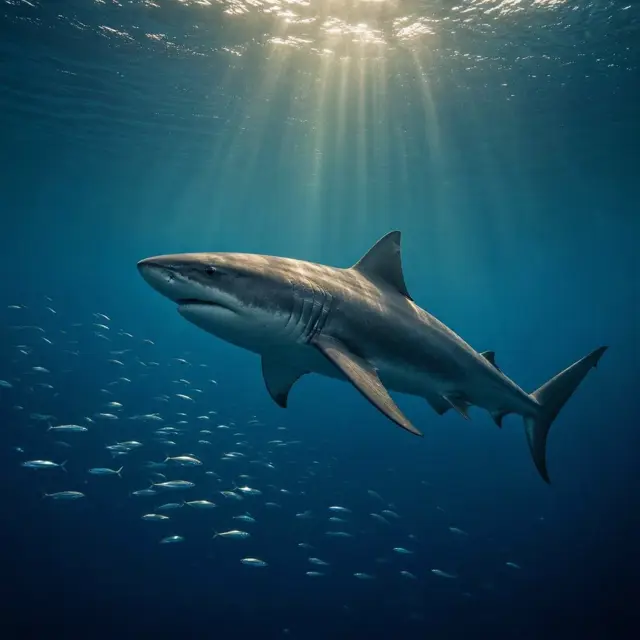
Teeth on a Conveyor Belt
If you lost a tooth every week, you would run out fast. Sharks never do. Their teeth sit in the gums instead of being fixed to the jaw, and rows of new teeth are always growing behind the old ones.
As the front teeth fall out, the ones behind move forward like a conveyor belt. Some sharks lose 30,000 or more teeth in their lifetime. Depending on the species, a tooth can be replaced every 8 to 10 days, or every few months.
Tooth shape depends on what a shark eats. Sharks that eat shellfish have flat teeth for crushing. Fish eaters have thin, needle-like teeth for gripping. Those that hunt larger animals have jagged, triangular teeth for cutting.
Older Than You Would Believe
Sharks are ancient. Shark-like fish first appeared in the Devonian period, between 419 and 359 million years ago. Some shark-like scales found in rocks are even older, from more than 440 million years ago.
Today there are more than 470 species, and they come in every size. The dwarf lanternshark, which lives in the deep sea, is only 17 centimetres long. The whale shark is the largest fish in the world, reaching up to about 18.8 metres.
Some individual sharks are ancient too. Whale sharks may live more than 100 years. A study of one large Greenland shark estimated it was about 392 years old, give or take 120 years.
Built Without Bones
A shark's skeleton is not made of bone at all. It is made of cartilage, the same bendy material that shapes your ears and nose. Cartilage is strong and flexible, but only about half as heavy as bone, which saves the shark energy.
Sharks also have no ribs. Because of that, a large shark can be crushed under its own weight on land.
Most fish stay afloat using a gas-filled bladder. Sharks do not have one. Instead, they rely on a huge oily liver, which can make up to 30% of their body weight. That still is not quite enough, so many sharks must keep swimming to avoid sinking. Some even keep swimming while asleep.
A Sixth Sense for Electricity
Sharks have an amazing sense of smell. Some can detect as little as one part per million of blood in seawater. They can even tell which direction a smell comes from, by noticing which nostril catches it first.
But their strangest sense is electroreception. Special organs called the ampullae of Lorenzini pick up the tiny electric fields that all living things give off. Sharks have the greatest electrical sensitivity of any animal.
This lets them find prey hiding under the sand. The hammerhead shark is especially good at it. Sharks may also use electric fields in ocean currents to help them find their way across the sea.
Babies Without a Father, and Other Surprises
Here is one of the most surprising things about sharks. In a number of cases, female sharks kept with no males have still had pups. This is called parthenogenesis. DNA tests showed the pups had no father at all. Scientists think it is rare in the wild and probably a last resort when no mate is around.
Sharks are also far less dangerous than their reputation. Out of more than 470 species, only four are involved in a significant number of deadly attacks on people. From 2001 to 2006, unprovoked attacks caused an average of just 4.3 deaths a year worldwide.
The real danger runs the other way. Since 1970, shark numbers have fallen by 71%, mostly because of overfishing.