Racing the 1964 Olympics
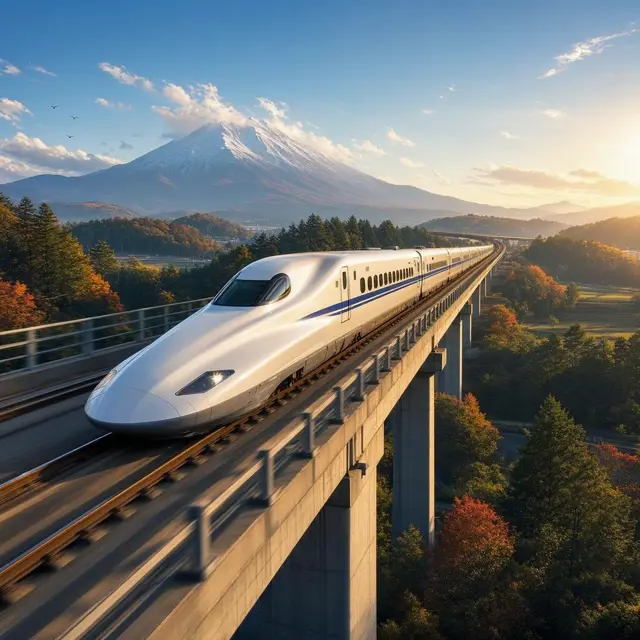
Japan's first bullet train line opened on 1 October 1964, just nine days before the Tokyo Olympics began. The Tōkaidō Shinkansen linked Tokyo, Yokohama, Nagoya and Osaka, the four largest cities in Japan. Shinkansen means "new main line". The English name "bullet train" comes from a Japanese nickname from 1939.
Before the line, express trains took about 6 hours and 40 minutes from Tokyo to Osaka. The new Hikari service cut that to four hours, and later speed increases brought it down to three hours and ten minutes. Suddenly people could go to Osaka and back in one day. That changed how business worked and how people lived.
The line was an instant hit. It carried 100 million passengers by 13 July 1967 and passed one billion in 1976. It is still the busiest line in the network, with more than 6.5 billion passengers since opening. At peak times, up to 16 trains an hour run in each direction, each with 1,323 seats.
Built by Former Aircraft Designers
In the 1950s, many people in Japan thought railways would soon be finished. The United States was moving to planes and highways. But Shinji Sogō, president of Japanese National Railways, pushed hard for fast trains.
The engineering came from a team led by chief engineer Hideo Shima. Three key engineers on the first line had all worked on aircraft design before. A 1957 test helped too. A narrow-gauge train called the Romancecar set a world record of 145 km/h (90 mph) for its type. That gave designers the confidence to build something even faster on standard gauge track.
Construction began in April 1959. The cost was first estimated at nearly 200 billion yen, partly paid with an $80 million loan from the World Bank. The real cost turned out to be about 380 billion yen. When the shortfall became clear in 1963, Sogō resigned to take responsibility. Three tunnels dug for an abandoned 1940s plan ended up in the new line.
Why the Noses Are So Long
Japan is a hard place to build fast trains. It has frequent earthquakes, soft ground, mountains, heavy snow and crowded cities. Compared with other countries, its high-speed lines have tracks closer together, tighter curves and smaller tunnels.
Small tunnels cause a strange problem called a tunnel boom. When a fast train enters, it squeezes the air ahead of it into a wave. That wave makes an intense noise like an explosion. People living near tunnel exits were not happy. Japan is crowded, there were strong protests over train noise, and noise is now limited to less than 70 dB in residential areas.
The fix shows up on newer trains. Their long, complex, streamlined noses are designed to soften that blast. Engineers also made the pantograph, the arm that takes power from the overhead cable, smaller. They cut the weight of the cars and built noise barriers. The coaches are even air-sealed, so the pressure inside stays steady when they shoot into a tunnel.
Late by 24 Seconds
In 2016, JR Central reported that the average Shinkansen train ran just 24 seconds behind schedule. That figure even includes delays from natural disasters. A big reason is that most lines never share track with slower trains. They never cross roads at street level either, and walking on the tracks is against the law.
The trains are run by automatic train control, so there are no signals beside the track. When a big earthquake hits, a warning system introduced in 1992 brakes the trains automatically.
In more than 60 years and over 10 billion passengers, there has never been a passenger fatality from a derailment or collision. Only two trains in passenger service have ever left the rails. In 2004, eight of ten cars derailed during an earthquake, yet none of the 154 passengers were hurt. Snow is another enemy. On the Jōetsu line it can pile up two to three meters deep, so the tracks have strong sprinklers.
Faster Than Flying
For trips under 750 km (470 mi), the Shinkansen wins more passengers than planes do. Between Tokyo and Osaka, it holds around 85% of the market against air travel. Some air routes, like Tokyo to Nagoya and Tokyo to Sendai, simply shut down after the trains arrived. The Shinkansen does both trips in about two hours or less.
It is greener too. Going from Tokyo to Osaka by Shinkansen produces only around 16% of the carbon dioxide of the same trip by car. On snowy days, it also tends to face fewer delays than planes do.
And the speeds keep climbing. The fastest regular trains run at 320 km/h (200 mph), and 360 km/h is planned for the late 2030s. A conventional test train hit 443 km/h in 1996. Then in 2015, the L0 Series maglev reached a stunning 603 km/h (375 mph) on a test line. Maglev service at 505 km/h is planned between Tokyo and Nagoya.