Colors Made From Nothing
Here is a strange fact: a soap bubble is just clear water wrapped around clear air. So where do all those swirling colors come from? Not from the same trick as a rainbow, which bends light. A bubble's colors come from interference.
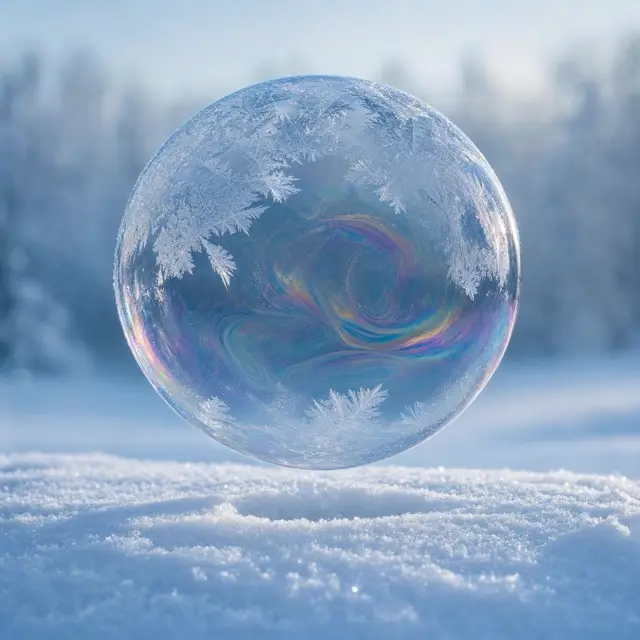
Light bounces off both the front and the back of the soap film. The film is about as thin as a wavelength of visible light, so the two reflections overlap. Depending on how thick the film is at each spot, some colors get stronger and others cancel out. That shifting shimmer is called iridescence.
Each color marks a different thickness of the film. Bubble performer Tom Noddy compared it to looking at a contour map of the bubble's surface. Most bubbles last only a few seconds before they burst, on their own or when they touch something. Together with their round shape and fragility, those colors give bubbles their magical look for children and adults alike.
Nature's Shortcut to Perfect Shapes
A bubble always takes the shape with the smallest possible surface area for the air inside, a kind of minimal surface. Mathematicians have known since 1884 that a sphere is the least-area way to hold one volume of air. That was a theorem of H. A. Schwarz.
Two bubbles stuck together were much harder. Only in 2000 was it proven that a merged double bubble is the best way to wrap two different volumes of air. The puzzle was called the double bubble conjecture. When two bubbles of equal size merge, the wall between them is flat. If one is smaller, the wall bulges into the bigger one, because the smaller bubble has higher pressure inside.
Foam follows strict rules too. Where bubbles meet, only three walls meet along a line, always at 120 degree angles. Only four walls can meet at a single point. These rules are called Plateau's laws.
Bubbles That Design Roofs
Because soap films find the smallest surfaces on their own, people have put them to work. Structural engineer Frei Otto used soap films stretched between several points to find the shape of a sheet with the least surface area. He then turned those shapes into new kinds of stretched roofs. A famous example is his West German Pavilion at Expo 67 in Montreal.
Soap films do not have to form spheres. Dip a wire frame into soapy water and the film can take almost any shape. That means people can design many different minimal surfaces just by bending wire.
Sometimes it is actually easier to make these shapes with real soap than to work them out with math on a computer. For that reason, soap films can be seen as a kind of analog computer. Depending on how complex the problem is, they can even beat ordinary computers at it.
Why Bubbles Pop, and How They Float
A bubble's skin is a soap film about a micrometre thick, and it breaks easily. Gravity pulls the water in the film downward. Adding glycerol makes the water thicker and slows this down. Evaporation also weakens the film, which is why bubbles last longer in damp air or with a little sugar in the mix. Touching an object usually pops a bubble, but wetting that surface first, ideally with soapy water, can prevent it.
After experiments, researchers found a long-lasting recipe: 85.9% water, 10% glycerol, 4% dishwashing liquid and 0.1% guar gum.
Floating is another small puzzle. The liquid shell is heavier than air, yet a bubble can still rise. The gas inside usually holds more water vapor than the air outside, and water vapor is lighter than dry air. That can give the bubble buoyancy. Using warm liquid helps, since warmer gas inside is lighter still.
Frozen, Colored and Sold by the Million
In freezing air, bubbles turn into something else. Below about minus 15 °C, they freeze when they touch a surface. Below about minus 25 °C, they freeze in mid-air and may shatter when they hit the ground. On snow, with the air around minus 10 to minus 14 °C, small bubbles can freeze within 2 seconds.
Colored bubbles are surprisingly hard to make. Adding dye fails, because the dye sticks to the water and not to the soap, so it just drains to the bottom of a clear bubble. Dye chemist Ram Sabnis solved this with a special dye that clings to the soap itself. In 2010, Japanese astronaut Naoko Yamazaki showed that colored bubbles can form in microgravity.
People have loved bubbles for at least 400 years. Flemish paintings from the 1600s show children blowing them with clay pipes. Today, by one industry estimate, retailers sell around 200 million bottles of bubble solution each year.