A Piece of Africa in the Indian Ocean
Socotra sits in the Indian Ocean between the Gulf of Aden and the Arabian Sea, about 380 kilometres south of the Arabian Peninsula and 232 kilometres east of the Horn of Africa. It belongs to Yemen culturally and administratively, but geologically it belongs to Africa.
That is because it is not a volcanic island. It is a continental fragment, a piece of the old supercontinent of Gondwana that detached during the Miocene in the same rifting that opened the Gulf of Aden. It is one of the most isolated landforms of continental origin on Earth.
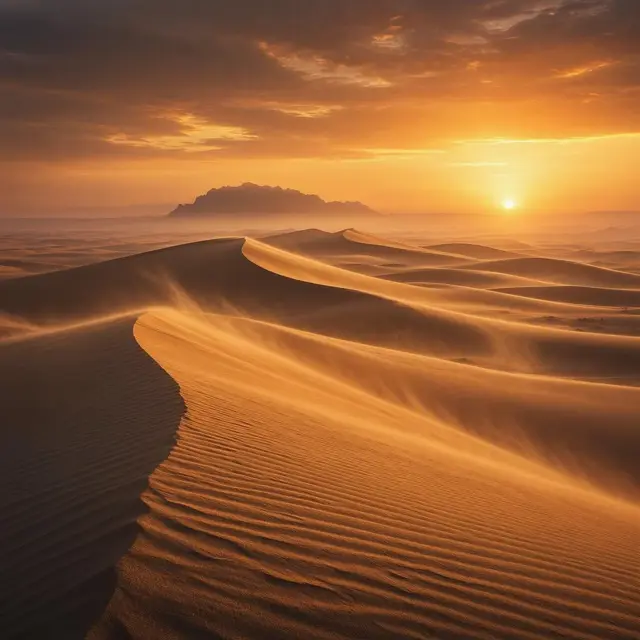
The main island runs about 125 kilometres long and 45 across, and it has three distinct regions. Narrow coastal plains carry white sand dunes built by monsoon winds that lift sand up the coast in a spiral. Behind them are limestone plateaus with karst topography, long used for herding goats and sheep. In the centre stands the Hajhir massif of granite and metamorphic rock, rising to 1,503 metres.
The island was recognised as a UNESCO World Heritage Site in 2008.
Plants That Exist Nowhere Else
Isolation plus harsh climate produced extraordinary endemism. About 37 percent of Socotra's plant species, 90 percent of its reptiles and 95 percent of its land snails are found nowhere else on Earth, which is why it has been called the most alien-looking place on the planet.
Many plants survive drought by storing water in swollen, bulbous stems. One of the strangest is the cucumber tree, the only tree in the cucumber family, which grows over six metres tall and has cells that expand to hold water in wet periods.
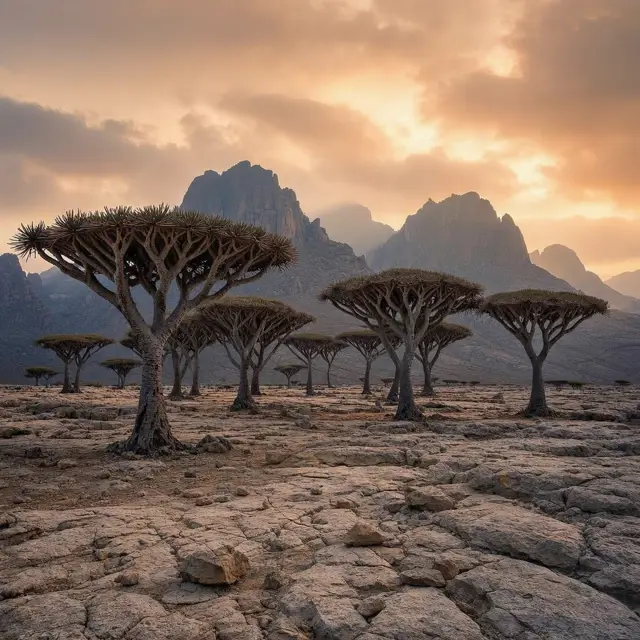
The famous one is the dragon's blood tree, whose trunk splits into a dense umbrella-shaped crown. That shape is functional. Tightly packed leaves and wide branches help condense water out of humid air, and the shade underneath slows evaporation from the soil. The tree produces a bright red sap that is harvested commercially.
Several endemic plants have taken an unusual evolutionary bet: living a very long time rather than reproducing often. They grow slowly and rarely flower or fruit.
Wet Pockets and Slow Growth
The island's climate is hot and dry, with a mean annual temperature above 25 degrees Celsius and light rainfall spread through the year. The mountains change that locally: air forced upward drops far more water, and the highest interior areas can average as much as 800 millimetres a year.
Those damp places matter enormously. Cliffs and escarpments that catch extra rain and mist form refugia, isolated wet pockets where species survive and diverge. A species in a refugium is twice as likely to be endemic as one elsewhere on the island, and 55 endemic species on the Hajhir massif are found only on that massif.
Evolution here also shows up across water. The genus Dirachma has just two species, one on Socotra and one in Somalia over 1,000 kilometres away, sharing unusual eight-part flowers.
The trends are not good. Plant diversity has declined steadily for decades under erosion, overgrazing and stronger winds, and the single remaining dragon's blood forest averages around 300 years old, which suggests little new growth is replacing it.
A Language of Its Own
The people of Socotra are called Soqotrans, and they speak both Arabic and Soqotri.
Soqotri is a Semitic language, related to the Modern South Arabian languages spoken on the Arabian mainland such as Mehri and Shehri. European scholars only began studying this family in the 19th century.
There is a long tradition of poetry on the island, and a poetry competition is still held there every year. The first Socotran poet on record is believed to be Fatima al-Suqutriyya, from the ninth century, who remains a popular figure in the island's culture.
Getting there was historically difficult. Before the airport was built, the only way in was by cargo ship, and the practical window for visiting runs from October to April, since the southwest monsoon from June to September brings strong winds and heavy seas.
The weather can turn extreme. In November 2015 the normally arid western side of the island received more than 410 millimetres of rain from a single cyclone.