A trick of light spotted in 1839
In 1839, French physicist Edmond Becquerel noticed that some materials make an electric charge when light hits them. The first solar cells built on this idea were too weak to run even simple electric devices. So they were put to a different use: measuring light.
Nobody repeated Becquerel's result until 1873, when English engineer Willoughby Smith found that light hitting selenium could do the same thing. In 1881, American inventor Charles Fritts made the first commercial solar cell. He reported that its current was 'continuous, constant and of considerable force', even in 'dim, diffused daylight'. Still, it was far too weak to compete with coal power plants.
The real turning point came in 1939, when Russell Ohl created the cell design still used in many modern panels. He patented it in 1941. In 1954, Bell Labs used his design to build the first commercially viable silicon solar cell.
How a flat panel turns sunshine into power
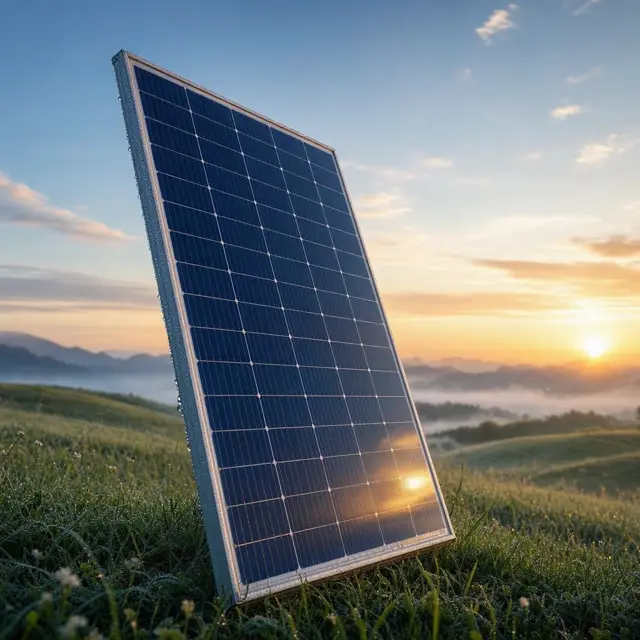
A solar panel is a group of photovoltaic cells. These cells are made of materials whose electrons get excited when light hits them. The moving electrons flow through a circuit as direct current, which can power devices or charge batteries.
Cells are wired in a chain to raise the voltage, then side by side to raise the current. A typical panel measures roughly 1 by 2 meters and is rated from 75 to 600 watts. Most silicon cells turn 10 to 20 percent of sunlight into electricity, and newer models pass 22 percent. Focusing sunlight with lenses or mirrors onto small, expensive cells can push that to around 45 percent.
Where alternating current is needed, an inverter converts the power. Spacecraft use costly multi-junction cells, because they give the most power per kilogram lifted into space.
Panels hate heat and dust
You might expect solar panels to love a scorching day. In fact, their power drops as they get hotter. Cold weather can actually help, because electrical resistance inside the cells falls. Winter brings its own problems, though: snow, short days and less sunlight.
Dirt is another enemy. Dust, grime and pollen build up in a layer known as soiling. Dust can cut a panel's output by up to 30 percent in a single month. Cleaning is still mostly done with hand tools, but smarter fixes are coming. In 2019, a coating of tiny etched wires let water droplets carry away 98 percent of dust. In 2022, MIT researchers showed a waterless system that gives dust an electric charge, so the panel pushes it away.
Panels also wear out slowly. Crystalline silicon panels lose about 0.8 to 1.0 percent of their output each year.
From 150 dollars a watt to 60 cents
The biggest story in solar is price. In 1970, panels cost about 150 US dollars per watt. By 2012, that had fallen to about 60 cents, 250 times cheaper. Since 2010 alone, the cost of solar electricity has dropped 85 percent. In many countries, solar has been cheaper than fossil fuel power from the grid since 2012, a milestone known as grid parity.
Cheap panels sparked explosive growth. From 2016 to 2022, solar grew about 26 percent a year, doubling roughly every three years. By the end of 2022, the world had about 1,185 gigawatts installed, supplying over 6 percent of global electricity demand, up from about 3 percent in 2019.
That success brings new puzzles. In Queensland, Australia, more than 30 percent of households had rooftop solar by the end of 2017. When homes make more power than they use, electricity flows back into a network that was never designed for two-way traffic.
Fences, carports and a growing pile of old panels
Not every panel faces the noon sun. Some stand upright, facing east and west, so they catch the morning and evening sun. These bifacial panels usually make slightly less power in total, but they match the times people use energy better. They show up as solar fences, on farms, and as highway and railroad noise barriers. They suit far-north places like the Nordic countries, where the sun sits low.
Other panels sit on top of parking lot canopies, shading cars while powering electric vehicle chargers. Some trackers tilt and turn panels to follow the sun all day.
The flip side is waste. There were 30 thousand tonnes of panel waste in 2021, and the yearly amount could pass 10 million tons by 2050. In the United States, around 90 percent of retired panels end up in landfills. Yet most of a panel can be recycled, including up to 95 percent of certain semiconductor materials.