The Wire That Shrank an Ocean
In 1858, a message crossed the Atlantic in minutes instead of the ten days a ship needed. It felt like magic. It also barely worked.
The first transatlantic telegraph cable, promoted by Cyrus West Field, was plagued with problems from the outset and stayed in operation for only about a month. Even at its best, operators could push through just 10 to 12 words per minute.
The reason was buried in physics nobody had planned for. A long cable sitting in seawater behaves like a capacitor — it stores charge instead of passing it cleanly along. Michael Faraday explained the trouble: the electric charge travelling down the wire induces an opposite charge in the water around it, smearing each crisp telegraph pulse into a slow blur. The cable was not just a wire. It was a wire fighting the entire ocean.
The Ship That Finally Got It Right
The fix arrived with better technology and a genuinely enormous ship. The SS Great Eastern laid the first successful transatlantic cable across 1865 and 1866, replacing the humiliating failure of 1858.
What followed was one of the fastest infrastructure land-grabs in history. By 1872, every continent except Antarctica had been linked by submarine cable. Britain dominated completely: by 1892, British firms owned and operated two-thirds of the world's cables, and in 1896, of the 30 cable-laying ships in existence worldwide, 24 belonged to British companies.
Early cables were copper wire wrapped in gutta-percha, a natural latex that happened to be a superb underwater insulator, then India rubber, then steel armour. Curiously, Antarctica is still waiting. As of February 2026, despite plans being drawn up, it remains the only continent with no submarine cable link to the rest of the world.
Glass Threads Beat Satellites, Badly
Ask most people how data crosses an ocean and they will point at the sky. They are wrong by a wide margin.
Submarine cables carry 99% of the data traffic across the oceans. Satellites handle less than 5% of global data transmission. Cables are not one option among several — they are the essential technical infrastructure underneath effectively all internet communication.
The gap comes down to capacity. TAT-8, the first transatlantic telephone cable to use optical fibre, went live in 1988 with two operational pairs and one backup pair. By 2012, operators had demonstrated long-term, error-free transmission at 100 gigabits per second across Atlantic routes up to 6,000 km. A typical satellite link manages around 1 gigabit per second. That is roughly a hundredfold difference — and a single modern cable carries many channels at once.
Anchors, Trawlers, and Fifty Repairs a Year
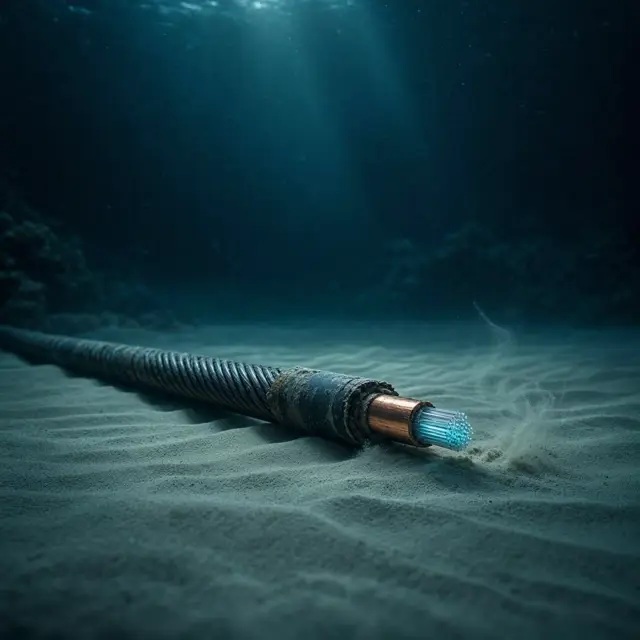
For something the world completely depends on, the modern cable is startlingly slight: about 25 mm in diameter — roughly an inch — weighing around 1.4 tonnes per kilometre in its deep-sea sections.
It gets broken constantly. The Atlantic alone sees more than 50 repairs a year. The culprits are rarely dramatic: fishing trawlers dragging gear, ship anchors dropped in the wrong place, and occasionally earthquakes. Between 1959 and 1996, fewer than 9% of breaks came from natural events. The rest were us.
Burying cable in the seabed changed the maths enormously. Fault rates fell from 3.7 per 1,000 km per year between 1959 and 1979 to 0.44 faults per 1,000 km per year after 1985. The economics stay brutal regardless: a typical multi-terabit transoceanic system costs several hundred million dollars, and the late-1990s boom saw more than $22 billion invested between 1999 and 2001.