Boats, Never Ships
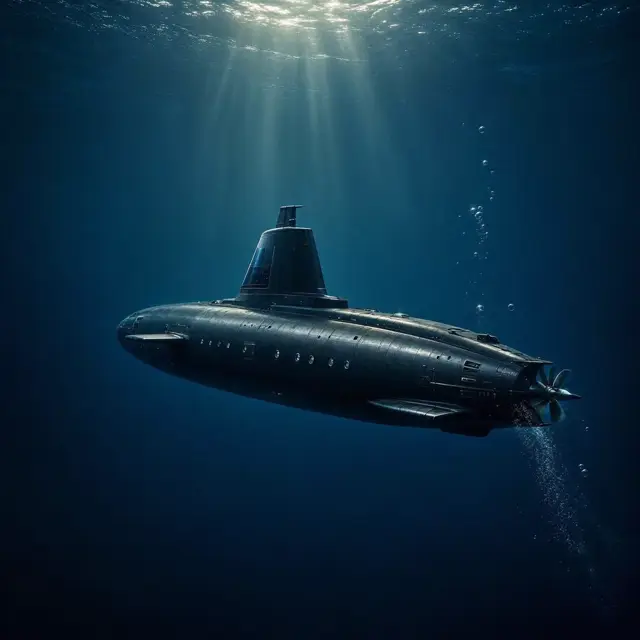
By navy tradition, submarines are called boats, not ships, no matter how big they get. That includes the Typhoon class, the biggest submarines ever built, which can stay underwater for six months. Even the word is a shortcut. It is a contraction of submarine boat, and German, Dutch and Swedish still use words that mean exactly that.
Most large submarines share a familiar shape. They have a long, tube-shaped body with rounded or pointed ends. A tall structure in the middle holds the periscopes, radios and sensors. Americans call it the sail, while Europeans call it the fin. A propeller at the back pushes the boat along.
Submarines come in every size. Some carry just one or two people for a few hours. A typical nuclear submarine has a crew of over 80. Their civilian jobs include marine science, exploration, salvage, undersea cable repair and even tourism. They can work at depths far beyond what any human diver could survive.
Oars, Leather Bags and an Acorn
The first submersible with reliable records was built in 1620 by Cornelis Drebbel, a Dutchman working in England, and it moved by oars. In 1747, Nathaniel Symons built the first known working boat that used a ballast tank to dive. His tanks were leather bags that filled with water. To come back up, a mechanism twisted the water out of the bags.
In 1775 came Turtle, a hand-powered, acorn-shaped craft built for one person. It was the first verified submarine able to move on its own underwater, and the first to use screws to push itself along. In 1850, Germany built Brandtaucher, which is still the oldest known surviving submarine in the world.
Then the engines arrived. In 1863, the French Plongeur became the first submarine not powered by people, running on compressed air. In 1866, Sub Marine Explorer became the first to dive, cruise underwater and resurface under its crew's control. Reliable underwater power only came in the 1880s, once batteries were good enough.
How to Sink on Purpose
A floating ship weighs less than the water it would push aside if it were fully underwater. To dive, a submarine has to flip that balance. It does this with ballast tanks that hold changing amounts of water and air. Fill them with water and the boat sinks. Blow air in and it rises.
Large main tanks handle diving and surfacing. Smaller depth control tanks fine-tune the depth. Pumps also move water between front and back trim tanks to tip the nose up or down. Meanwhile, the sea presses on a steel hull at up to 4 MPa, about 580 psi.
A submerged submarine never just sits still. As it goes deeper, the hull gets squeezed a little and pushes aside less water. The water gets slightly denser too, but not enough to make up for it. So the boat always tends to sink or rise, and the crew must keep adjusting tanks or fins to hold a steady depth.
The Hull Must Be Perfectly Round
The pressure hull is the strong inner shell that keeps the sea out, and building one is very hard. If its cross-section is perfectly round, the pressure spreads evenly. If not, it can buckle. Even a one-inch bend away from round cuts the load it can take by over 30 percent. So every weld must be flawless, and joints are checked many times.
The earliest steel hulls could reach about 100 metres. Stronger alloy steel later allowed 200 metres, and today's steel boats reach 250-400 metres. A few submarines got titanium hulls, which can be lighter and stronger. One titanium boat had a test depth of 1,000 metres.
The deepest diver of all is Trieste. On 23 January 1960, it carried Jacques Piccard and Don Walsh to the floor of the Challenger Deep in the Mariana Trench. It was the first time any vessel had reached the deepest point in Earth's oceans. Its instruments showed 11,521 metres, later revised to 10,916 metres.
Under the Ice, Air Made From Water
Submarines have a long history with polar ice. On 3 August 1958, USS Nautilus used an inertial navigation system to reach the North Pole. The next year, USS Skate surfaced through the ice right at the pole. In 1986, three submarines met and surfaced together at the North Pole for the first time.
Staying down for months takes clever life support. With nuclear power, the time underwater is limited mainly by food, since air is recycled and fresh water is made from seawater. Most modern military submarines make breathing oxygen by electrolysis of fresh water.
Even trash has its own system. Garbage is pressed into steel cans and loaded into a tube. An ice plug protects the valve at the bottom. Then the tube floods, the valve opens and weighted cans drop into the sea. The first tourist submarine began service in 1964, and by 1997 there were 45 around the world.