Land That Vanishes Every Day
The Sundarbans is a forest where the ground does not stay put. The tides here are so large that roughly one third of the land disappears under water and then reappears every day. The mudflats sink at high tide and come back at low tide, so their shape can change within a single tidal cycle. The forest floor sits only 0.9 to 2.11 metres above sea level.
This is the world's largest mangrove forest, covering 10,277 square kilometres. It sits in the Ganges Delta, where the Ganges, Brahmaputra and Meghna rivers meet the Bay of Bengal. About 60 percent of it lies in Bangladesh and about 40 percent in India.
The rivers here are meeting places of salt water and fresh water. A thick web of tidal streams, channels and small islands cuts through the whole area, so almost every corner of the forest can be reached by boat.
Named After a Tree
The name Sundarbans literally means "beautiful forest". But its likely origin is more down to earth. It probably comes from sundari, the local name of a mangrove tree that grows all over the area. The sundari gives a hard wood that people use to build houses and make boats and furniture.
Twenty-six of the fifty broad mangrove species found in the world grow well here. Still, mangrove forests are not home to a great variety of plants. They have a thick canopy, and the ground below is mostly covered with seedlings of the mangrove trees themselves. The mangroves even help form new land.
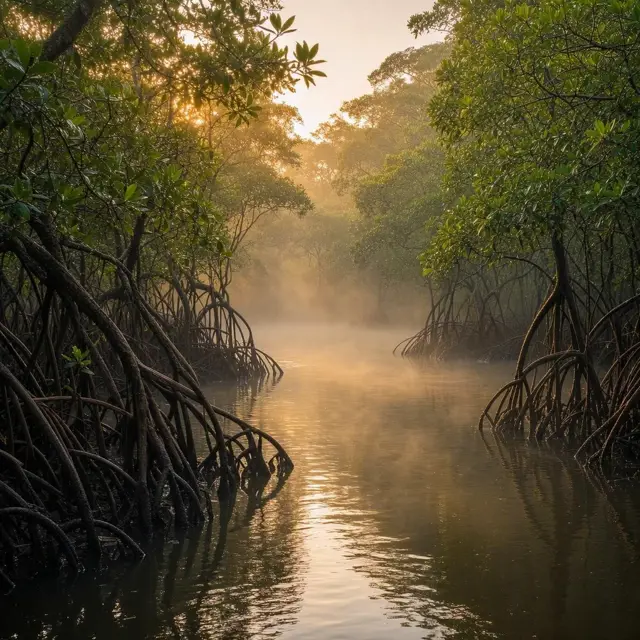
The mud is low in oxygen, so many roots do something strange. Known as pneumatophores, they grow upward out of the mud to reach the air. Their tangled mass gives small fish, crabs and shrimps a place to feed, hide and breed.
Tigers That Swim to Dinner
The Sundarbans is the only mangrove region on Earth that is home to the Bengal tiger, the largest land predator of the Indo-Pacific region. Unlike tigers in other places, the tigers here live among the islands and swim between them. They hunt scarce prey such as chital deer, Indian muntjacs, wild boar and rhesus macaques.
Counting them is tricky. Older estimates were based on counting unique pugmarks, which are paw prints, and they gave much higher numbers. Newer counts use camera traps, a better method that gives more accurate results. Surveys in 2015 in Bangladesh and 2011 in India found about 180 tigers, with 106 on the Bangladesh side and 74 on the Indian side.
The tigers share the forest with about 30,000 spotted deer. Smaller wild cats live here too, including the jungle cat, the fishing cat and the leopard cat.
A Crowded Home for Wildlife
The forest gives a home to 453 kinds of wild animals. That includes 290 bird, 120 fish, 42 mammal, 35 reptile and eight amphibian species. It is an important winter stop for migrating water birds. It also holds globally important numbers of the critically endangered masked finfoot.
Other rare residents include the estuarine crocodile, the Gangetic dolphin, the olive ridley sea turtle and the northern river terrapin. The tiger and the dolphin are the two main species that wildlife managers plan around, both for protection and for tourism.
Not every animal made it. The Javan rhinoceros, the Indian rhinoceros, the water buffalo, the swamp deer and the mugger crocodile started to vanish from the Sundarbans around the middle of the 20th century, mainly because of heavy hunting. Today, killing or capturing any wildlife other than fish and some invertebrates is completely banned.
A Living Wall Against Storms
The mangroves do a big job for people. They form a natural barrier that shields millions of people in and around Kolkata, Khulna and the Port of Mongla from flooding caused by cyclones. They also protect the coast from tsunamis and soil erosion. More than 4 million people live in the Sundarbans.
But the forest is under pressure. Cyclone Sidr damaged around 40 percent of the Sundarbans in 2007. Rising seas and less fresh water are making the water saltier, and sundari trees are very sensitive to salinity. A 2012 study found parts of the coast pulling back by up to 200 metres a year.
About 200 years ago, the Sundarbans was measured at about 16,700 square kilometres, and it has since shrunk to about one third of that size. Lohachara Island has already disappeared under the sea, and Ghoramara Island is half under water. Four protected areas in the forest are UNESCO World Heritage Sites.