Ice, Rock and a Little Green
Svalbard is a Norwegian archipelago roughly halfway between the northern coast of Norway and the North Pole, between 74 and 81 degrees north. Its land area is just over 61,000 square kilometres, more than half of it the island of Spitsbergen.
The breakdown of that land says most of what you need to know. Glacial ice covers about 60 percent of it, another 30 percent is bare rock, and only the remaining tenth carries any vegetation at all. In summer you could ski almost the whole length of Spitsbergen from south to north.
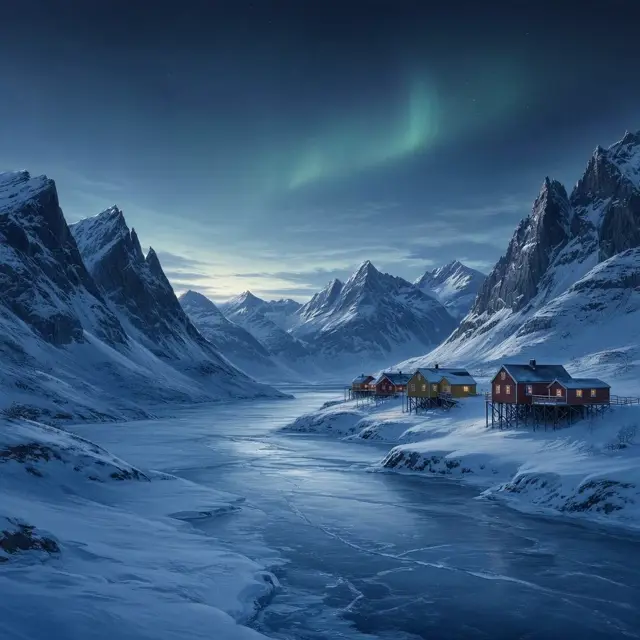
Being this far north means the sun behaves strangely. In the main settlement, Longyearbyen, the midnight sun lasts from 20 April to 23 August, and the polar night from 26 October to 15 February. In winter, a full moon on reflective snow adds useful light.
One surprise is the temperature. A warm ocean current keeps winters up to 20 degrees milder than places at the same latitude in Russia and Canada, and keeps the surrounding water navigable most of the year.
A Treaty Unlike Any Other
Talks about who owned these islands began in the 1910s and were interrupted by the First World War. The Svalbard Treaty was signed on 9 February 1920 and took effect in 1925, giving Norway full sovereignty.
The conditions attached are what make the place unusual. All forty-eight signatory countries have the right to conduct commercial activity there without discrimination, and Norway's power to tax is limited to what is needed to pay for services on the islands. Income tax is lower than the mainland and there is no value added tax.
Immigration works differently too. Svalbard is not part of the Schengen Area, issues no visas, and requires no residence permit. Regardless of citizenship, a person can live and work there indefinitely. The catch is practical rather than legal: there is no welfare and no unemployment assistance, almost all housing belongs to employers, and anyone without the means to support themselves can be turned away by the governor.
Roughly 300 Polar Bears
Only three land mammals live here besides people: the Arctic fox, the Svalbard reindeer and voles that arrived by accident. The sea is busier, with whales, dolphins, seals, walruses and polar bears.
The bears set the rules. As of 2021 around 300 live on the islands, sharing a wider population of roughly 2,650 with Franz Josef Land. Anyone leaving the settlements is required to carry a device for scaring bears off, and is advised to carry a firearm strictly as a last resort. Fatal attacks have happened, most recently at a campsite in Longyearbyen in 2020.
This produces one of Svalbard's strangest customs. Residents leave houses and cars unlocked, keys in the ignition, so that anyone being chased has somewhere to escape to.
About eighty bird species visit, nearly all migratory. Only the rock ptarmigan stays through winter. The Arctic tern makes the longest journey of all, flying to Antarctica.
Coal, Science and a Vault of Seeds
Three industries hold the place up: coal mining, tourism and research. Mining is fading, and mines around Longyearbyen have been closing since 2017.
Research is what the treaty made possible, since any nation may carry out non-military research there. Poland runs a polar station, China has one too, and Russia has facilities at Barentsburg. The University Centre in Svalbard teaches about 350 students, with no tuition fees and courses in English. Ny-Alesund, once a mining town, is now the northernmost functional civilian settlement in the world, with 35 people in winter.
Two vaults take advantage of the cold. The Svalbard Global Seed Vault is cut into rock near Longyearbyen to store seeds from as many crop varieties as possible, held at minus 18 degrees in a mountain that stays at minus 6 by itself. Nearby, the Arctic World Archive stores digital data, and in 2020 it took on its largest customer, the code hosting service GitHub.