An Island That Was Once Attached
Tasmania was not always an island. Until about 11,700 years ago, at the end of the last glacial period, it was joined to the Australian mainland. Then rising sea levels formed Bass Strait, and the land link disappeared under water. Today the main island sits 240 kilometres south of the mainland.
It is the 26th-largest island in the world, and the state also takes in about 1,000 smaller islands around it. Tasmania is Australia's smallest and least populous state, with 573,479 residents in June 2023. It is also the only Australian state that is not on the mainland. About 40% of its people live in and around Hobart, the capital.
Keep going south for about 2,500 kilometres and you reach the coast of Antarctica. That makes Hobart Australia's chief sea link to the frozen continent. Hobart is also the home port of the French ship l'Astrolabe, which makes regular supply runs to French territories near and in Antarctica.
The Strait That Fooled the Explorers
The Dutch explorer Abel Tasman made the first reported European sighting of the island on 24 November 1642. He named it Anthony van Diemen's Land, after his sponsor, the Governor of the Dutch East Indies. The British later shortened it to Van Diemen's Land.
Tasman may have come close to learning it was an island. On 5 December he followed the east coast north. Then his ships were hit by the Roaring Forties winds howling through Bass Strait. He was hunting for a southern continent, not more islands, so he turned east and sailed on. In April 1770, Captain James Cook sailed two hours west into the strait against the wind, turned back, and wrote that he was doubtful whether the two lands were one.
The question was settled when George Bass and Matthew Flinders sailed all the way around the island in 1798-99, and the strait was named after Bass. On 1 January 1856 the island was officially renamed Tasmania, after the explorer who first spotted it.
Mountains Built From Ancient Magma
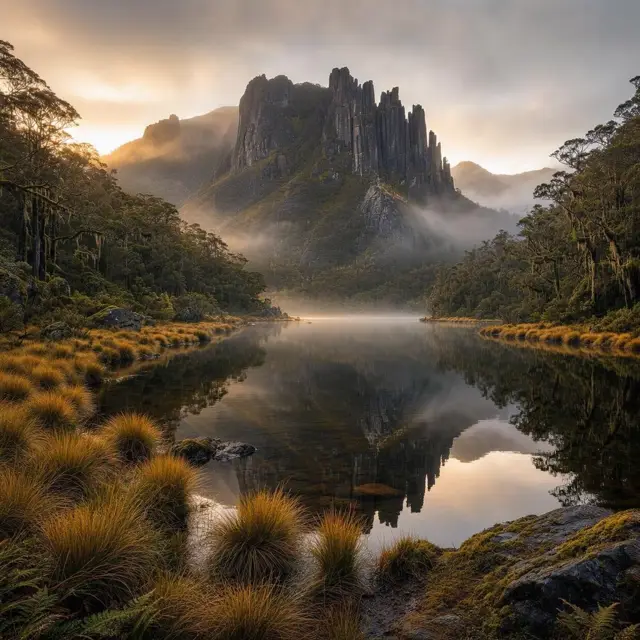
Tasmania has the world's largest areas of dolerite, and many of its mountains and cliffs are made of it. In places the rock forms giant columns. On Mount Wellington above Hobart, these columns are so neat that they are known as the Organ Pipes.
In the far southwest, the mountains are almost all quartzite. This pale rock gives the peaks the false look of being snow-capped all year round. Real snow is common too. Highland areas get snow above about 1,000 metres every year, and roughly every five years snow can even fall at sea level.
The tallest mountain is Mount Ossa at 1,617 metres. Cradle Mountain was once a nunatak, which shows how much ice once covered the island. Below the peaks, Tasmania has a high number of waterfalls, and Ocean Beach on the West Coast stretches for about 40 kilometres. The whole island sits right in the path of the Roaring Forties, a wind that circles the globe.
Record-Breaking Trees and Wild Places
Tasmania is the most forested state in Australia. The Tarkine, in the far northwest, is the country's largest temperate rainforest area, covering about 3,800 square kilometres. Some Tasmanian plants are related to species in South America and New Zealand, through ancestors that grew on a supercontinent 50 million years ago.
The trees here are record holders. The mountain ash can reach 100 metres, making it the tallest flowering plant and hardwood in the world. The Huon pine is one of the longest-lived tree species. The deciduous beech is Australia's only winter-deciduous tree. And the leatherwood tree is known for a honey made from its flowers alone.
About 42% of the state's land is protected in some form of reserve. The Tasmanian Wilderness World Heritage Area was listed by UNESCO in 1982. Most World Heritage sites meet only one or two of the ten criteria for that status. This one meets seven, and only one other place on Earth, China's Mount Taishan, meets that many.
Marsupials, Tigers and Speedy Parrots
Many Tasmanian animals are bigger than their mainland relatives, including the platypus. The island was also home to the thylacine, a striped marsupial nicknamed the Tasmanian tiger for the stripes across its back. It became extinct in 1936.
After that, the Tasmanian devil became the largest meat-eating marsupial in the world. Today it is found in the wild only in Tasmania. It is endangered because of a disease called devil facial tumour disease. Across the state, about 90 vertebrate species are listed as endangered, vulnerable or threatened.
Birds steal the show too. Tasmania has 12 endemic bird species. It is home to the world's only three migratory parrots, including the swift parrot, the fastest parrot in the world. In the rainforests, eucalyptus trees can rise up to another 50 metres above the canopy, and they are the most common nesting choice for giant wedge-tailed eagles.