One Plant, Every Kind of Tea
Tea is an aromatic beverage made by infusing hot or boiling water with fresh or cured leaves of *Camellia sinensis*, an evergreen shrub native to East Asia. It originated in the borderlands of southwestern China, northeast India and northern Myanmar.
The crucial fact hides in that sentence: it is one species. Green, black, white and oolong are not different plants. They are the same leaf, taken through different cultivars, processing and blends.
That variety of handling produces genuinely different drinks. Some have a cooling, slightly bitter and astringent flavour; others carry sweet, nutty, floral or grassy notes. Tea also has a stimulant effect on humans, primarily because of its caffeine content. And after plain drinking water, it is the most widely consumed beverage in the world — meaning the second most popular drink on the planet grows on a single kind of bush.
Steeped, Simmered, Whisked, Shaken
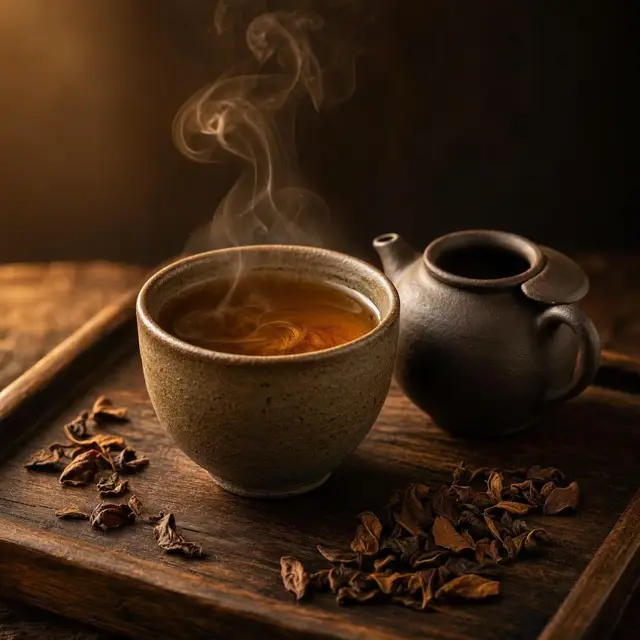
Traditionally, tea is made by steeping loose leaves in hot water in a teapot or teacup for a period of time. Compressed and fermented teas are handled differently, by decoction — simmering in a kettle rather than steeping.
Convenience has added many more routes to a cup: the tea bag, the infuser, the press, and powdered instant forms such as matcha, konacha and chai latte.
What gets added varies just as widely. Tea is most commonly drunk hot as a plain water infusion, but also appears as milk tea and butter tea, sweetened with sugar or substitutes, or flavoured with salt and spices. In modern times it is also served cold as iced tea, or in soft drink mixtures such as bubble tea. Very few foodstuffs tolerate that range — salted, buttered, iced, whisked to a foam, and shaken with tapioca pearls, all still recognisably the same drink.
From Medicine to Ceremony
The earliest credible record of tea drinking dates to the 3rd century AD, in a Chinese medical text written by the Eastern Han dynasty physician Hua Tuo. It enters history as medicine, not refreshment.
By the Tang dynasty it was being consumed as a recreational and social beverage, and Chinese tea culture inspired ceremonial drinking that spread across the Sinosphere — to Japan, where it is known as chado, to Korea as darye, and to Vietnam, typically as part of a wedding ritual.
It travelled overland too. Tea drinking spread into Inner Asia and South Asia via the Silk Road and the Tea Horse Road, particularly during the expansion of the Mongols — for whom salted milk tea, *süütei tsai*, has remained part of the staple diet ever since.
The Habit That Reshaped Empires
Tea reached Europe late. Portuguese priests and merchants introduced tea drinking there during the 16th century.
It caught on properly in the 17th century, when drinking tea became fashionable in Western Europe as part of the rise of Chinoiserie influence — the European vogue for Chinese styles and goods.
The British took to it hardest, and the consequences were not confined to the drawing room. Their import demand grew so high that they later began cultivating tea on a large scale in colonial India and Ceylon — places where tea had previously been used only as a herbal medicine. A national fondness for a hot drink became an agricultural transformation imposed on two other countries. Whole landscapes, economies and labour systems were reorganised because one island could not get enough of a leaf that grew somewhere else.