A Patent From a Spectacle Maker
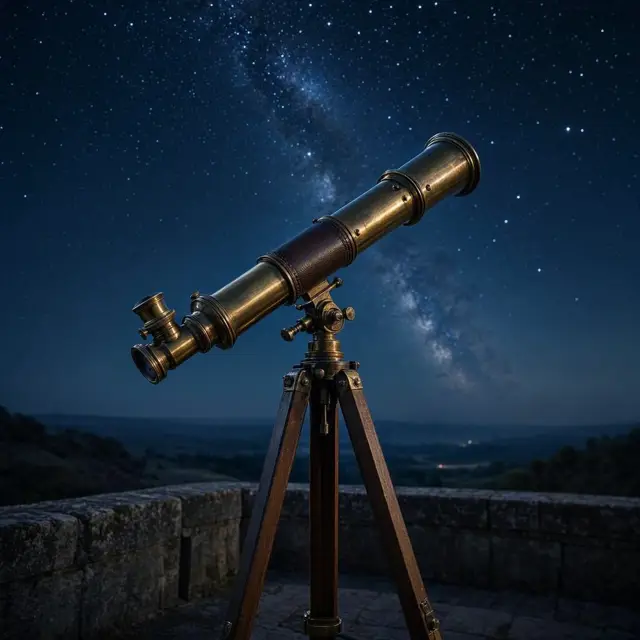
The oldest record of a telescope is not a star chart. It is a patent. In 1608, Hans Lipperhey, a spectacle maker from Middelburg, submitted a patent to the government of the Netherlands for a refracting telescope, one that uses glass lenses. Who actually invented it is still unknown. But word of it spread fast across Europe.
Galileo heard about the new device. In 1609, he built his own version and made his famous telescopic observations of objects in the sky.
The word telescope came a little later. In 1611, the Greek mathematician Giovanni Demisiani coined it for one of Galileo's instruments, shown at a banquet at the Accademia dei Lincei. Galileo himself had used the Latin word perspicillum. The new name joined two Ancient Greek words: tele, meaning far, and skopein, meaning to look or see. Put together, it means far-seeing.
Lenses Against Mirrors
Soon after the first telescopes, people wondered if a curved mirror could do the job of a lens. Mirrors promised sharper images without the colour errors that lenses caused. In 1668, Isaac Newton built the first practical reflecting telescope. His design still carries his name: the Newtonian reflector.
Both types had problems. In 1733, the achromatic lens partly fixed the colour errors of simple lenses, allowing shorter and more useful lens telescopes. Mirror telescopes had their own issue. Through the 18th and early 19th centuries, their mirrors were made of speculum metal, which tarnished quickly. Silver-coated glass mirrors arrived in 1857, and aluminium-coated mirrors in 1932.
In the end, size decided the contest. Lens telescopes top out at about 1 metre across. So the vast majority of large research telescopes built since the early 1900s use mirrors. The biggest today have mirrors larger than 10 metres, and designs of 30 to 40 metres are in the works.
Telescopes That See the Invisible
The word telescope now covers far more than lenses and mirrors. In the 20th century, astronomers built radio telescopes in the 1930s and infrared telescopes in the 1960s. The first purpose-built radio telescope started work in 1937.
A radio telescope is usually a large dish that collects radio waves. Some dishes are made of wire mesh, with gaps smaller than the waves being studied. A classic radio dish does not produce a picture the way an optical telescope does. It records a single signal that changes over time.
The clever part comes when several dishes work together. By combining signals caught at the same moment, astronomers can build sharp images. This technique is called aperture synthesis. The group of dishes acts like one giant telescope as wide as the distance between them. As of 2005, the record array, which used a Japanese satellite, was many times wider than Earth itself.
Why Some Telescopes Have to Leave Earth
Our atmosphere blocks most kinds of light from space. From the ground, astronomers can only observe a few bands: visible light, near-infrared, and part of the radio range. That is why there are no ground-based X-ray or far-infrared telescopes. Those have to work from orbit.
Even for light that does reach the ground, space has perks. Up there, there are no clouds, no blurring from the air, and no light pollution. The downsides are cost, size limits, and the difficulty of repairing or upgrading a telescope in space.
NASA has launched several famous ones. Hubble detects visible, ultraviolet and near-infrared light. Spitzer detects infrared, and Kepler discovered thousands of planets around other stars. The James Webb Space Telescope launched on 25 December 2021 from Kourou, French Guiana, on an Ariane 5 rocket. It detects infrared light and orbits a spot called the L2 Lagrange Point.
Catching X-Rays and Gamma Rays
X-rays are much harder to collect and focus than other kinds of light. X-ray telescopes use special ring-shaped mirrors made of heavy metals. These catch the rays at a shallow, glancing angle and turn them by only a few degrees. In 1952, Hans Wolter described three ways to build a telescope using only this kind of mirror. The Chandra X-ray Observatory uses this design, and so does NuSTAR, launched in 2012.
At even higher energies, telescopes give up on focusing completely. Instead, they use a coded aperture mask. The mask casts a patterned shadow, and that pattern can be rebuilt into an image.
Because Earth's atmosphere blocks these rays, such telescopes usually ride on high-flying balloons or satellites. One example is the Fermi Gamma-ray Space Telescope, launched in June 2008. Spotting the very highest-energy gamma rays takes even more specialized tools, such as Cherenkov telescopes and water-based Cherenkov detectors.