Seeing From Far Away
The word television mixes Ancient Greek and Latin: tele, meaning far, and visio, meaning sight. It was first used in 1900 by the Russian scientist Constantin Perskyi, in a paper he gave during the World Fair in Paris.
The idea came long before the technology. In 1884, a 23-year-old German student named Paul Nipkow patented a spinning disc with a spiral of holes in it. As it turned, each hole scanned one line of a picture. Nipkow never built a working model, but versions of his Nipkow disk became the heart of early television.
The first live transmission of images came in Paris in 1909. It used 64 light-sensitive cells arranged in a square, giving a picture just 8 dots wide and 8 dots tall. Each dot is called a pixel, and 64 of them were only enough to show single letters of the alphabet.
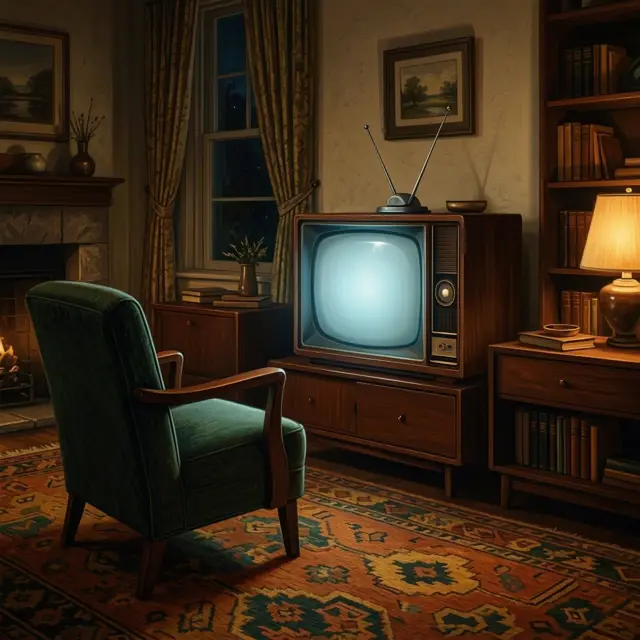
The short name TV arrived in 1948. Before flat screens, people also called it the tube, after the bulky glass tube inside most sets.
A Dummy Named Stooky Bill
The Scottish inventor John Logie Baird gave the first public demonstration of moving silhouette images at Selfridges department store in London in March 1925.
He had a problem, though. Human faces did not have enough contrast to show up on his simple system. So he used a dummy belonging to a ventriloquist, named Stooky Bill, whose painted face stood out much better, and showed it talking and moving.
In January 1926, Baird showed a real moving human face by radio to members of the Royal Institution in London. This is widely seen as the world's first true public television demonstration. His picture had just 30 lines, barely enough to recognise a face.
Baird kept pushing. In 1928, he sent the first television signal across the Atlantic, between London and New York, and that same year he demonstrated the world's first colour transmission.
But spinning discs could only do so much. They could not carry enough detail, and electronic systems soon took over.
A Straight Line in San Francisco
Electronic television relied on the cathode-ray tube, a glass tube that fires a beam at a glowing screen, first invented by the German physicist Ferdinand Braun in 1897.
On 7 September 1927, the American inventor Philo Farnsworth's camera tube sent its first image from his laboratory in San Francisco: a simple straight line. By 1929, his system had no moving mechanical parts at all, and he sent live images of people, including a small picture of his wife, Elma, with her eyes closed, possibly because of the bright lights.
A big legal fight followed. The company RCA claimed its own engineer, Vladimir Zworykin, had invented the idea first. In 1935, the US Patent Office sided with Farnsworth, and in 1939 RCA agreed to pay him 1 million dollars over ten years to use his patent rights.
Regular broadcasting was already under way in Britain. In 1936, the BBC started the world's first regular high-definition television service from Alexandra Palace in London, using 405 lines.
Colour, Flat Screens and Streaming
Colour took a long time to reach homes. Early colour systems in the 1940s did not work with existing black-and-white sets, and during World War II the United States stopped making television equipment for the public altogether. It was the mid-1960s before colour broadcasting spread across the US and most developed countries.
Sets got smaller, too. Early televisions were big and bulky, packed with vacuum tubes. After the transistor was invented, the first fully transistorised portable set, the Philco Safari, came out in 1959. That began a shift from families watching together to people watching on their own.
The next big change was the screen itself. Heavy tube TVs gave way to thin, energy-saving flat panels, and flat-screen TVs finally overtook the old tubes in the early 2010s.
Today, many people watch through streaming services such as Netflix over the internet. By 2013, 79 percent of the world's households owned a television set.