A Brain in Every Arm
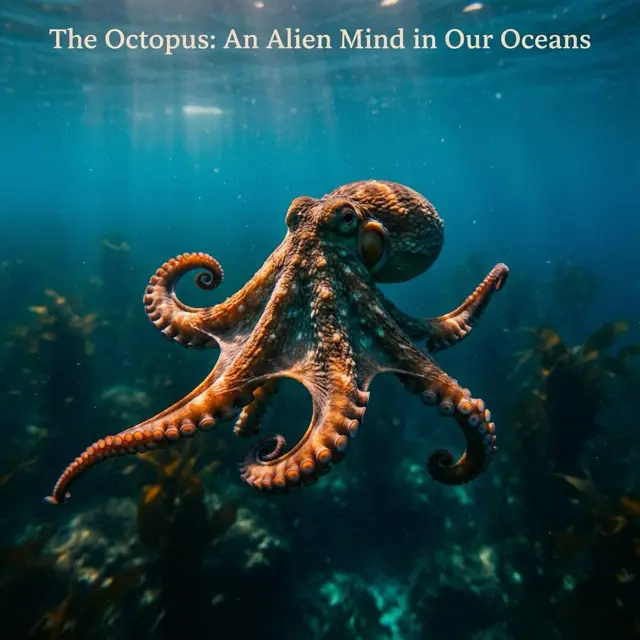
An octopus is a soft-bodied, eight-limbed mollusc in the class Cephalopoda, with around 300 species famous for their intelligence and shape-shifting. They carry over 500 million neurons — about as many as a dog.
But here's the twist: roughly two-thirds of those neurons sit in the nerve cords of the arms, not the central brain. In a real sense, an octopus thinks with its limbs.
Built Unlike Us
Octopus biology is gloriously strange. Their blood uses copper-rich haemocyanin instead of iron, making it bluish. Their arms are muscular hydrostats, moving without any bones, and a funnel-like siphon jets water for propulsion.
They are masters of disguise thanks to chromatophores — skin cells packed with pigment that let them change color in an instant for camouflage or signaling.
Rewriting Their Own Code
Octopuses do something most animals can't: extensive RNA editing, tweaking their genetic instructions on the fly, especially in the nervous system. It may help them fine-tune how their neurons work.
Males also have a specialized arm called a hectocotylus for transferring sperm. The French zoologist Georges Cuvier first described it in 1829 — mistaking it for a parasitic worm before its true role was understood in 1856.
Brilliant, but Brief
For all their smarts, octopuses live fast and die young. After reproducing, they enter senescence, stop feeding, and rapidly decline. A giant Pacific octopus female can lay 180,000 eggs and guard them for about five months — then dies.
Humans have long been fascinated: octopuses appear on Minoan coins from possibly as early as 1650 BCE, and Aristotle documented their color-changing more than two thousand years ago.