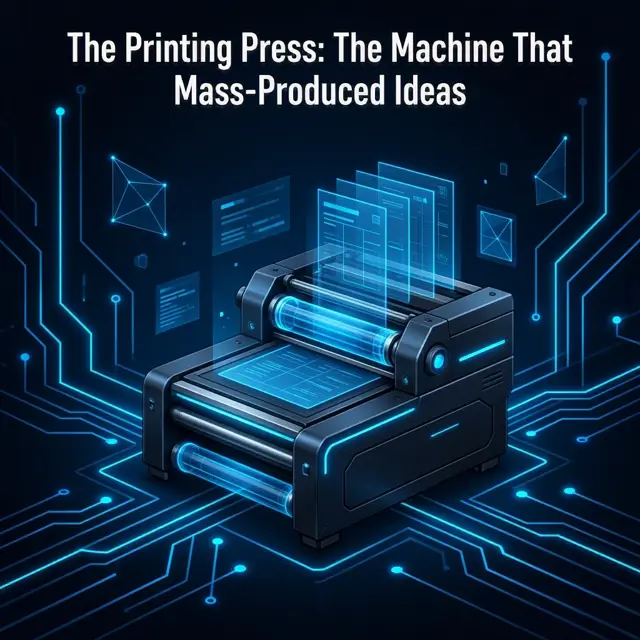
Four Old Ideas, One Explosive Combination
Around 1440, Johannes Gutenberg didn't invent printing from nothing — he combined four existing technologies: the screw press, movable type, the codex book format, and mechanized papermaking.
The payoff was staggering. A Gutenberg press could produce up to 3,600 pages a day, against about 1,500 sheets for woodblock printing and a mere handful for hand-copying. That leap kicked off the Printing Revolution.
How It Actually Worked
The heart of the machine was movable type — individual cast-metal letters that could be rearranged endlessly. Gutenberg's hand mould let him cast those letters quickly and identically, and he used a new oil-based ink that stuck to metal far better than water-based ink.
Paper was held by a padded tympan and protected at the margins by a frisket, then pressed against the inked type by a flat platen. Books printed before 1501 — the very first generation — are still called incunabula.
Ideas Went Viral
From a single shop in Mainz, printing spread to around 270 cities by the end of the 15th century. By 1500, Europe's presses had already produced more than twenty million copies — and that figure rose tenfold the next century.
The technology supercharged the Reformation. In 1518–1519, Martin Luther became Europe's most-published author, his works reaching 291 editions, and his tracts circulated in some 300,000 copies.
Faster, Faster, Faster
The press kept accelerating. Lord Stanhope's iron press reached 480 pages an hour, then steam arrived — The Times adopted Koenig's steam presses in 1814, hitting 1,100 sheets an hour.
Then came the rotary press, using spinning cylinders to print continuously at 8,000 pages an hour — capable of millions of copies in a single day. Each jump made the written word cheaper and more universal.