Do Not Open Until 6939
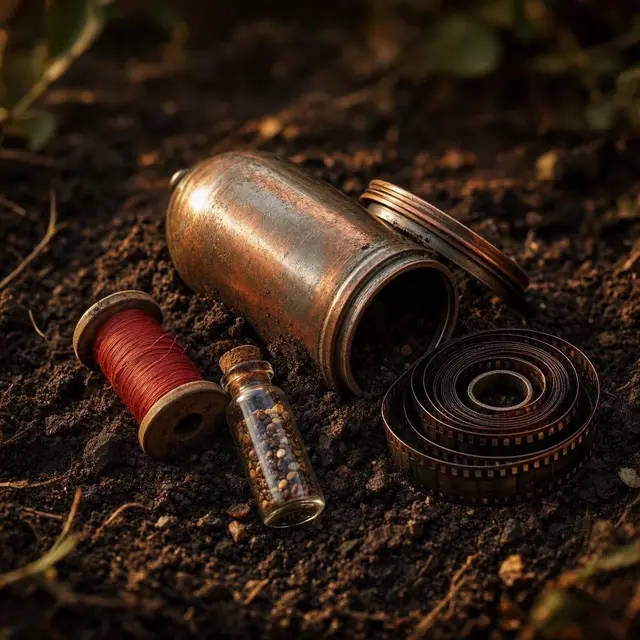
At the 1939 New York World's Fair, the company Westinghouse buried a capsule meant for the very distant future. It was about 2.3 metres long and weighed around 360 kilograms. It was made of a copper, chromium and silver alloy the company named cupaloy, which it claimed was as strong as mild steel.
Inside were everyday things: a spool of thread, a doll, a vial of crop seeds, a microscope and a 15-minute newsreel. Spools of microfilm squeezed in a whole Sears Roebuck catalog, a dictionary, an almanac and other texts.
In 1965, a second capsule joined it about 3 metres to the north. Both now lie 15 metres below Flushing Meadows Park, where the fair was held. Both are meant to be opened in the year 6939. Another early project, the Crypt of Civilization at Oglethorpe University from 1940, is set to open in 8113.
Hidden in a Grasshopper and a Lion
The phrase time capsule only dates from 1938, but the idea is much older. In Poland, a capsule from 1726 has been found. Around 1761, people tucked dated objects inside a hollow copper grasshopper weathervane on top of Faneuil Hall in Boston.
Boston has more. In 1795, a capsule credited to Samuel Adams and Paul Revere was set into the cornerstone of the Massachusetts State House. It was opened in 1855, topped up with new items and sealed again. In 2014 it came out once more and was reopened in January 2015 at the Museum of Fine Arts, with limits on media coverage to protect the fragile items. It is the oldest known time capsule in the United States, and it went right back into its spot.
In 1901, another capsule was hidden inside the head of the copper lion on Boston's Old State House. It was opened in 2014 during repairs to the sculpture and building.
Big Ceremonies, Small Surprises
On the last day of 1900, Detroit sealed its Century Box, to be opened 100 years later. It held photos and letters from 56 well-known residents describing life in 1900 and guessing at the future, plus a letter from the mayor to whoever would be mayor in 2000. City officials opened it right on schedule on December 31, 2000.
Not every opening is thrilling. In 1912, the town of Otta in Norway sealed a box labelled "Can open in 2012". A century later, after lots of excitement and a ceremony, people found notebooks, newspaper clippings and town council papers. The crowd was disappointed.
Time capsule historian William Jarvis says this is common. Most capsules are packed with shiny new useless junk that says little about real daily life. Historians wish people would add personal notes, photos and videos. Worse, many capsules are simply lost, because people forget where they are or groundwater ruins them within a few years.
Messages Sent to Space and the Moon
Some time capsules have left Earth entirely. The two Pioneer Plaques and the two Voyager Golden Records were attached to spacecraft, in case travelers in the far future ever find them.
An even stranger plan is the KEO satellite. It is meant to carry personal messages from people on Earth and fall back to the planet around the year 52,000, addressed to whoever lives here then. It was supposed to launch in 2015 or 2016, but it has been delayed again and again, and it still had no launch date as of July 2019.
Then, on February 22, 2024, a group called the Arch Mission Foundation landed its Lunar Library on the Moon. Among other content, it carries the English Wikipedia. Back on Earth, a structure called Earth's Black Box, about the size of a city bus, sits at a remote site in Tasmania. Powered by solar panels, it is designed to store climate data for future generations.
Singing Frogs and Emails to Yourself
Time capsules have a fun side in pop culture. The 1955 Warner Bros. cartoon One Froggy Evening is about a singing and dancing frog pulled out of a time capsule, then hidden in one again. Steven Spielberg called it the Citizen Kane of animated shorts.
You can make your own, too. Sealed containers are sold just for personal capsules. Tip: hiding one inside a wall usually beats burying it, because a wall cache can last as long as the building does, while groundwater often wrecks buried ones. In 2005, Forbes magazine ran an email version, promising to send people's notes to themselves back after up to twenty years.
Digital capsules bring new headaches. Old formats go out of date and storage slowly decays, a risk known as the digital dark age. The art collective Ant Farm offered one answer: the best way to preserve digital media is to distribute it.