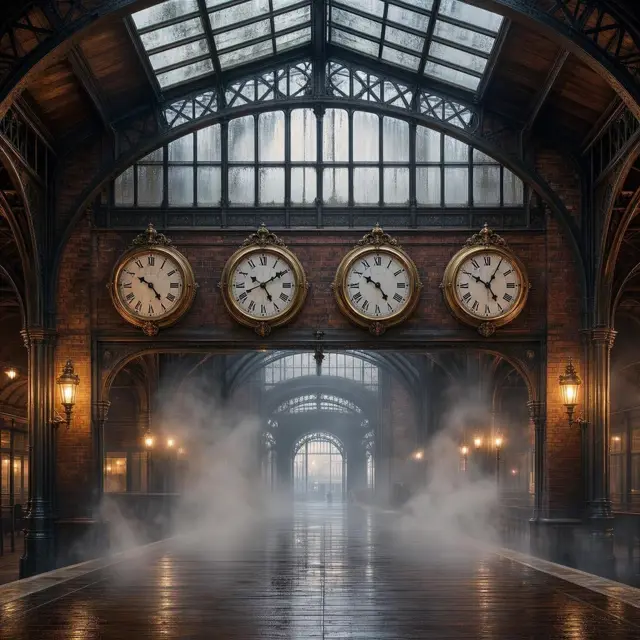
When Every Town Kept Its Own Noon
Because Earth is a sphere, the Sun reaches its highest point at different moments depending on where you stand. That variation works out at four minutes for every degree of longitude. When it is solar noon in London, it is about ten minutes before solar noon in Bristol, roughly 2.5 degrees to the west.
For most of history that was simply how time worked. Local solar time had been tied to civil timekeeping since sundials appeared, and an Egyptian sundial was being used to measure labourers' working hours around 1500 BC.
The first crack in the system came from navigation rather than daily life. The Royal Observatory at Greenwich, founded in 1675, established Greenwich Mean Time as an aid to mariners trying to determine longitude at sea. It gave sailors a standard reference, while every location in England carried on keeping its own separate time.
The Railways Forced the Issue
In the 19th century, faster transport and telegraphs made a patchwork of local times genuinely dangerous rather than merely quaint.
Britain moved first. In November 1840 the Great Western Railway began using GMT kept by portable chronometers, a practice other companies adopted and which became known as railway time. Time signals were first sent by telegraph from the Royal Observatory around 23 August 1852, and by 1855, 98% of Great Britain's public clocks were on GMT, though it did not become the island's legal time until 1880. Some British clocks from this period were built with two minute hands, one for local time and one for GMT.
North America had it worse. Each railroad kept its own standard time, usually based on its headquarters, and published its timetables in that time. Some junctions served by several railroads had one clock per railroad, each showing something different. Accidents happened when trains from different companies sharing the same tracks mistimed their passings.
The Day of Two Noons
Charles F. Dowd proposed hourly standard time zones for North American railroads around 1863, but published nothing at the time and did not consult railroad officials until 1869. His system was never accepted.
The version that stuck came through Cleveland Abbe, chief meteorologist at the United States Weather Bureau, who had divided the country into four zones for consistency between weather stations and published his *Report on Standard Time* in 1879. By 1883 he had convinced the railroad companies. The scheme actually adopted was William F. Allen's, with borders running through railroad stations in major cities, so the line between Eastern and Central ran through Detroit, Buffalo, Pittsburgh, Atlanta and Charleston.
It took effect on Sunday, 18 November 1883, a day remembered as "The Day of Two Noons", when every railroad station clock was reset as standard noon arrived in each zone. Within a year, about 200 cities of over 10,000 people were on standard time. Detroit held out, sitting almost exactly between two meridians, and only settled the matter by popular vote in 1916.
Where the Map Stops Making Sense
The global system took much longer and never became fully tidy. Quirico Filopanti proposed worldwide time zones in 1858 and was ignored until long after his death. Sandford Fleming proposed his own in 1876, dividing the world into 24 lettered zones of 15 degrees each.
By about 1900 almost every inhabited place had adopted some standard time, but many simply applied a local observatory's time to a whole country with no reference to Greenwich at all. By 1929 most countries used hourly offsets, though Iran, India, Myanmar and parts of Australia ran on half hours. Nepal was the last to settle, shifting to a 45 minute offset in 1986.
Today offsets run from UTC minus 12:00 to UTC plus 14:00, a spread of 26 hours. China and India each use a single time zone despite spanning far more than the 15 degrees of longitude an hour is supposed to cover, and countries such as Spain and Argentina use hour-based offsets that do not match their geography. Zones follow national and administrative borders, because it is simply more convenient for people who talk to each other to share a clock.